

EN
Get In Touch

Zero-inventory pipe prefabrication is a manufacturing strategy that produces pipe spools only when they are needed for installation. Instead of storing large quantities of materials and semi-finished products in a warehouse, shipyards synchronize the prefabrication process with the construction schedule.
This method helps shipyards:
Many modern shipyards use digital production planning, modular construction, and pipe spool fabrication to create a more cost-effective manufacturing model.
Zero-inventory pipe prefabrication is a production method that limits the storage of raw material, steel pipe, valves, and pipe components. Materials arrive according to the production schedule, enter the fabrication process, and move directly to assembly or installation.
Unlike traditional manufacturing, which often depends on large storage yards, this approach reduces the amount of unused inventory.
In marine and offshore projects, pipe spool fabrication is usually connected to:
The goal is simple: manufacture only what is required and deliver it exactly when it is needed.
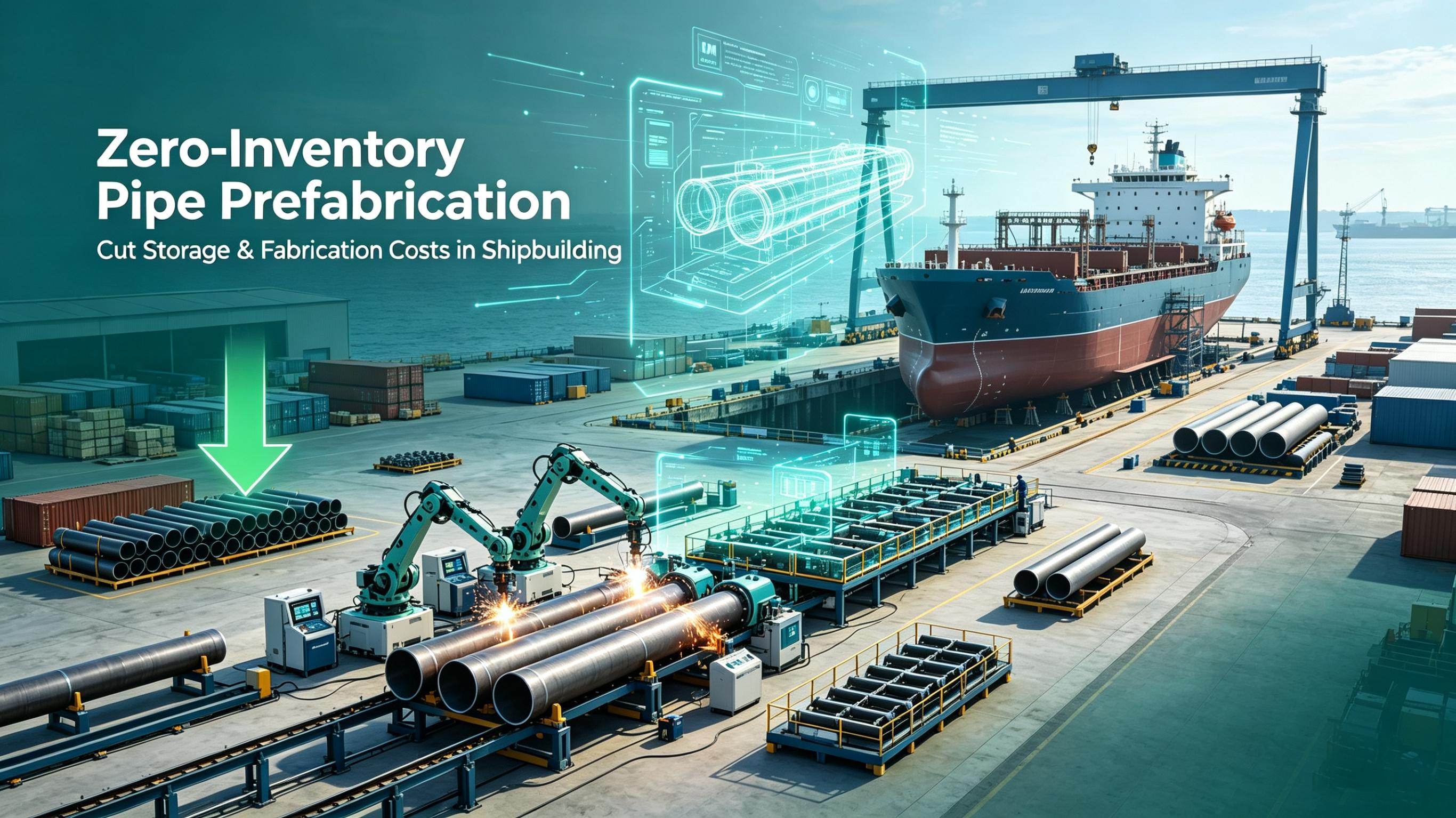
A pipe spool is a preassembled section of a piping system manufactured in a controlled workshop before final installation.
A typical pipe spool consists of:
After fabrication, these components are assembled into prefabricated pipe sections and transported to the construction area for installation.
Pre fabricated pipe spools are commonly used in:
Traditional shipyards often purchase materials in large quantities and store them for months.
This approach creates several challenges.
Large inventories require:
Stainless steel materials can be damaged during long-term storage because of:
When materials are stored in different locations, workers spend more time searching, transporting, and organizing components.
As a result, production efficiency decreases.
Traditional construction methods depend heavily on site fabrication. More welding and assembly activities must be completed at the shipyard or construction site.
This often increases labor requirements.
The process begins with procurement.
Every raw material is selected according to engineering specifications.
Materials may include:
Each material receives an identification number for complete traceability.
Before manufacturing begins, the quality control team verifies:
Inspection at this stage prevents defective materials from entering production.
The fabrication process starts with:
Modern workshops use automated equipment to improve dimensional accuracy.
Pipe spool fabrication combines individual components into complete assemblies.
The fabrication process may include:
At this stage, every pipe spool requires strict dimensional control.
The welding process directly affects the safety and reliability of the final piping system.
Common welding methods include:
Qualified welders follow approved welding procedures to ensure consistency.
For stainless steel applications, weld cleanliness is especially important because contamination can reduce corrosion resistance.
Inspection continues after welding.
Common testing methods include:
Non-destructive testing:
Destructive testing:
Destructive testing verifies whether the welding procedure meets mechanical requirements.
Every finished assembly should be pressure tested before delivery.
Pressure testing helps identify:
A pressure tested pipe spool reduces the possibility of unexpected failures during commissioning.
After inspection, pipe spools receive:
The finished products are then delivered directly to the installation team.
This workflow eliminates unnecessary storage.
Traditional shipyards often store thousands of components.
Zero-inventory production minimizes the storage of:
Materials move through the workshop only once.
This reduces:
Digital production systems provide real-time tracking for:
This improves planning accuracy.
Site fabrication often requires additional labor.
When pre fabricated assemblies arrive at the installation area, workers perform fewer on-site welding operations.
Prefabricated pipe sections are already assembled and inspected.
Installation teams only need to:
This significantly reduces field installation time.
Manufacturing inside a workshop provides a controlled environment.
Compared with outdoor fabrication, workshops offer:
As a result, product consistency improves.
Accurate cutting and automated fabrication reduce:
This makes the entire process more cost effective.
The advantages of prefabricated pipe spools include:
| Benefit | Impact |
|---|---|
| Reduced storage | Lower warehouse costs |
| Improved quality control | Better product consistency |
| Reduced field installation | Lower labor requirements |
| Faster construction | Shorter project schedules |
| Pressure-tested assemblies | Higher system reliability |
| Less material waste | Lower production costs |
| Better safety | Fewer on-site operations |
Pipe spools offer a practical solution for modern shipyards that need to control costs while maintaining product quality.
Design engineers and production teams should share information throughout the project.
Better communication reduces manufacturing delays.
Tracking systems improve:
Standardization simplifies manufacturing and reduces fabrication complexity.
Material procurement should match the installation sequence.
This approach prevents unnecessary storage.
Every piping system should follow documented inspection procedures.
Inspection should cover:
A pipe spool is a prefabricated assembly that contains pipes, fittings, flanges, and other components. Multiple pipe spools are connected together to create a complete piping system.
Common materials include carbon steel, stainless steel, duplex stainless steel, nickel alloys, and other corrosion-resistant materials.
Pipe spool fabrication takes place in a controlled workshop environment. This improves quality, reduces weather-related delays, and minimizes field installation work.
Pressure testing verifies the structural integrity of the assembly and identifies leaks before the piping system enters service.
Yes. Prefabricated pipe sections are widely used in shipbuilding because they reduce construction time, improve quality control, and lower overall project costs.
Yes. Zero-inventory manufacturing reduces storage expenses, minimizes material handling, decreases labor requirements, and shortens production cycles, making the entire process more cost effective.
Shipyards are moving away from traditional inventory-heavy manufacturing models. Zero-inventory pipe prefabrication combines digital planning, precise manufacturing, and just-in-time delivery to create a faster and more efficient production system.
By reducing storage requirements, improving quality control, minimizing field installation, and delivering pressure-tested assemblies directly to production areas, shipbuilders can lower fabrication costs while maintaining high manufacturing standards.