

EN
Get In Touch

Modular piping systems are prefabricated piping assemblies that are manufactured, tested, and assembled in a controlled workshop before being transported to a shipyard or offshore installation for final connection.
Compared with traditional field fabrication, modular pipe systems can:
For shipbuilding and offshore engineering projects, modular piping solutions are widely used in fuel systems, cooling systems, ballast systems, process systems, utility systems, and cargo handling systems.
A modular piping system is a prefabricated piping assembly that combines pipes, fittings, valves, supports, instruments, and other components into a complete module before installation.
Instead of fabricating pipe directly at the installation location, manufacturers complete most of the work in a workshop and then transport the finished assembly to the shipyard, offshore platform, or industrial plant.
A modular pipe can include:
After delivery, the module is positioned and connected to the main piping network.
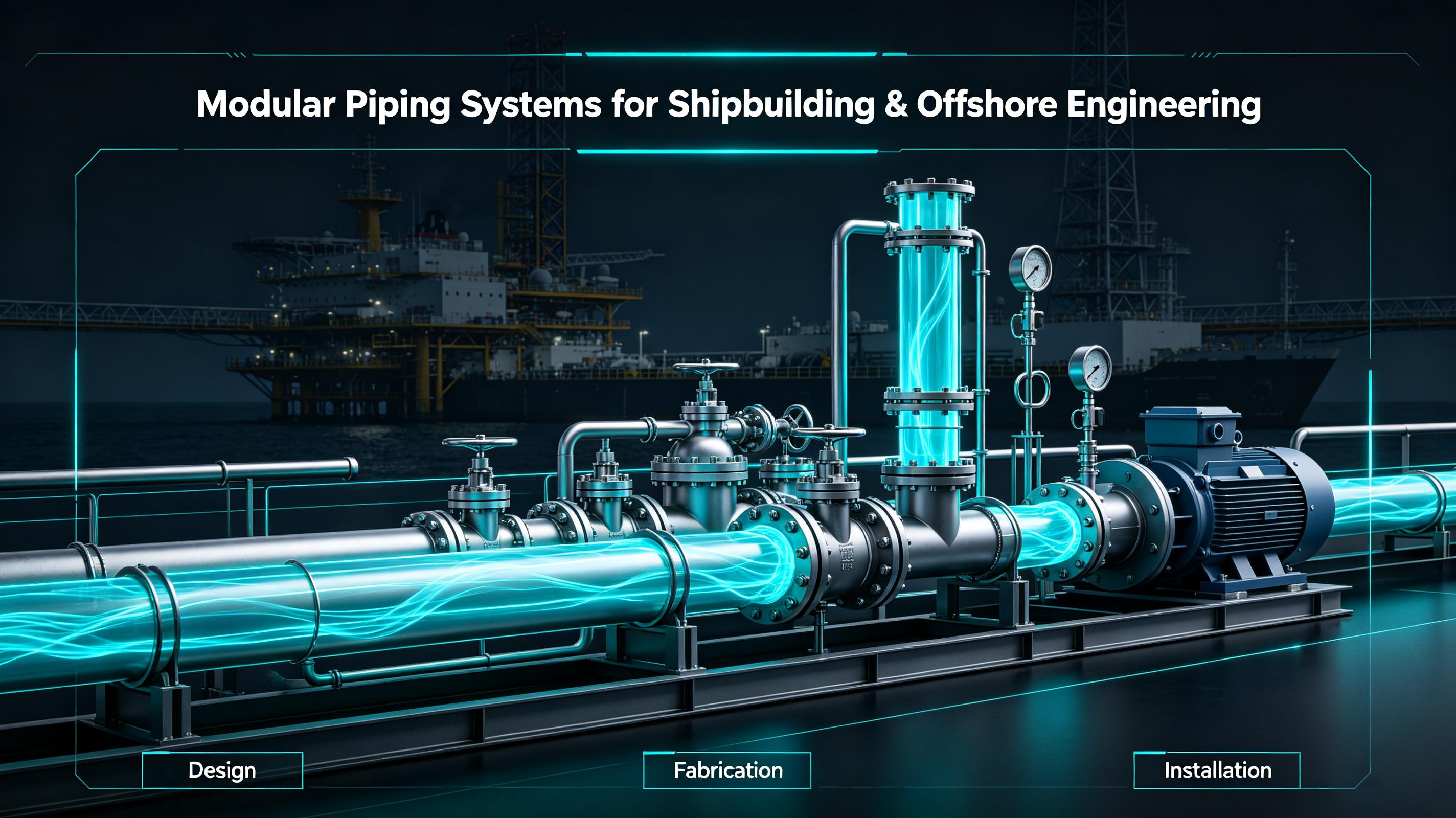
For decades, many piping systems were built through traditional field fabrication. Workers transported materials to the installation area and completed cutting, welding, fitting, and assembly at the construction site.
This approach worked, but it also created several challenges.
Modern vessels contain thousands of meters of piping.
Engine rooms, fuel preparation rooms, pump rooms, and utility spaces often provide very little working area. Workers frequently perform site fabrication inside a confined space, making access difficult.
When piping work depends entirely on field assembly, multiple construction activities compete for the same work area.
Electrical installation, equipment positioning, structural work, insulation, and pipe installation often occur simultaneously.
As a result, project timelines can easily be affected.
Traditional field methods usually require:
These activities increase labor costs and create workflow interruptions.
The process of fabricating pipe modules usually follows a standardized workflow.
Engineers develop a complete digital model of the piping system.
The model includes:
Advanced 3D modeling software allows engineers to identify potential conflicts before production begins.
Raw materials are selected according to project specifications.
Materials may include:
Pipes are cut according to engineering drawings, and fittings are prepared for assembly.
The pipe fabrication stage includes:
Unlike site fabrication, these activities take place in a controlled manufacturing environment.
Before shipment, every module undergoes inspection and testing.
Typical procedures include:
This approach allows manufacturers to maintain consistent quality control throughout the production process.
After testing, the completed module is transported to the construction site.
Workers then:
Because most fabrication work has already been completed, installation becomes much faster.
Workshop manufacturing provides a more stable production environment than field construction.
Environmental factors such as:
can be monitored more effectively.
This allows manufacturers to maintain higher welding consistency and more reliable inspection procedures.
One of the biggest advantages of modular construction is parallel production.
While the shipyard builds the vessel structure, manufacturers can simultaneously fabricate piping modules in the workshop.
Multiple activities can proceed at the same time, which significantly reduces construction time.
Traditional installation methods often require large field teams.
Modular systems reduce the amount of labor required at the installation location because many tasks have already been completed.
This approach helps reduce labor costs and improve resource allocation.
Shipbuilding often requires workers to operate in confined space environments.
Reducing welding, grinding, and cutting activities at the installation site lowers safety risks.
Less field work also means fewer personnel working in hazardous areas.
Unexpected delays can affect vessel delivery schedules.
Modular construction creates a more predictable workflow and helps project teams better manage project timelines.
Because modules are manufactured according to predefined schedules, project managers can coordinate installation activities more efficiently.
Fuel systems commonly use modular construction for:
Preassembled modules simplify installation and improve commissioning efficiency.
Cooling systems contain numerous interconnected pipelines.
Modular manufacturing reduces installation complexity while improving assembly accuracy.
Ballast systems often require extensive pipe networks throughout the vessel.
Using modular pipe assemblies reduces installation time and improves system standardization.
HVAC systems are another common application.
Large vessels contain complex HVAC systems that connect:
Prefabricated modules simplify installation and reduce congestion in equipment rooms.
Offshore production facilities rely heavily on modular piping solutions.
Common applications include:
Many offshore modules are completely assembled and tested before transportation.
The oil and gas industry was one of the earliest adopters of modular construction.
Large offshore facilities often require specialized engineering because of:
Many oil and gas facilities are now built using modular concepts to improve efficiency and reduce installation risks.
Modules are commonly used for:
| Comparison | Modular Pipe | Traditional Field Fabrication |
|---|---|---|
| Fabrication location | Workshop | Construction site |
| Quality control | Standardized | Variable |
| Construction time | Shorter | Longer |
| Labor requirements | Lower | Higher |
| Safety | Better | More field exposure |
| Rework | Reduced | More frequent |
| Schedule control | More predictable | More vulnerable to delays |
| Installation efficiency | Higher | Lower |
When selecting a supplier, consider the following factors:
Evaluate:
Look for experience in:
Some projects require specialized materials, including:
Suppliers should demonstrate proven manufacturing experience with these materials.
Verify whether the manufacturer can perform:
Strong testing procedures support more consistent product quality.
A modular piping system is a prefabricated piping assembly that is manufactured, tested, and partially assembled in a workshop before installation at the project location.
They reduce costs by decreasing on-site labor, minimizing rework, shortening installation schedules, and improving manufacturing efficiency.
Traditional field fabrication completes most work at the installation location, while modular construction transfers fabrication activities to a controlled workshop environment.
Shipbuilding, offshore engineering, oil and gas, power generation, petrochemicals, water treatment, and industrial manufacturing all use modular piping systems.
Yes. HVAC systems frequently use modular assemblies because they simplify installation and improve project scheduling.
Manufacturing in a controlled environment allows better supervision of welding, inspection, material handling, and testing procedures, resulting in more consistent quality.
Modular piping systems have changed the way modern ships and offshore facilities are built.
By moving fabrication activities away from the construction site and into specialized manufacturing facilities, shipbuilders can reduce construction time, lower labor costs, improve quality control, and create more predictable project timelines.
As vessels become more complex and offshore projects continue to grow in scale, modular piping solutions will continue to become a standard approach for shipbuilding and offshore engineering projects.