

EN
Get In Touch

Pipe spool fabrication is usually more cost effective than traditional field fabrication because most work is completed in a controlled environment before materials arrive at construction sites.
Prefabricated pipe spools offer several advantages:
On-site piping still has advantages for projects that involve design changes, limited transportation access, or highly customized installation requirements. However, for most modern industrial piping projects, the prefabrication of pipe spools can improve quality, reduce costs, and shorten construction schedules.
Pipe spool fabrication is the process of manufacturing piping assemblies in a fabrication workshop before they are transported to the job site.
A pipe spool consists of several preassembled spool components, including:
During the pipe spool fabrication process, pipes are cut, beveled, welded, assembled, inspected, tested, coated, and labeled according to engineering drawings.
After fabrication is complete, the finished spools are delivered to construction sites and installed as ready-to-connect sections.
Prefabricated pipe spools are widely used in:
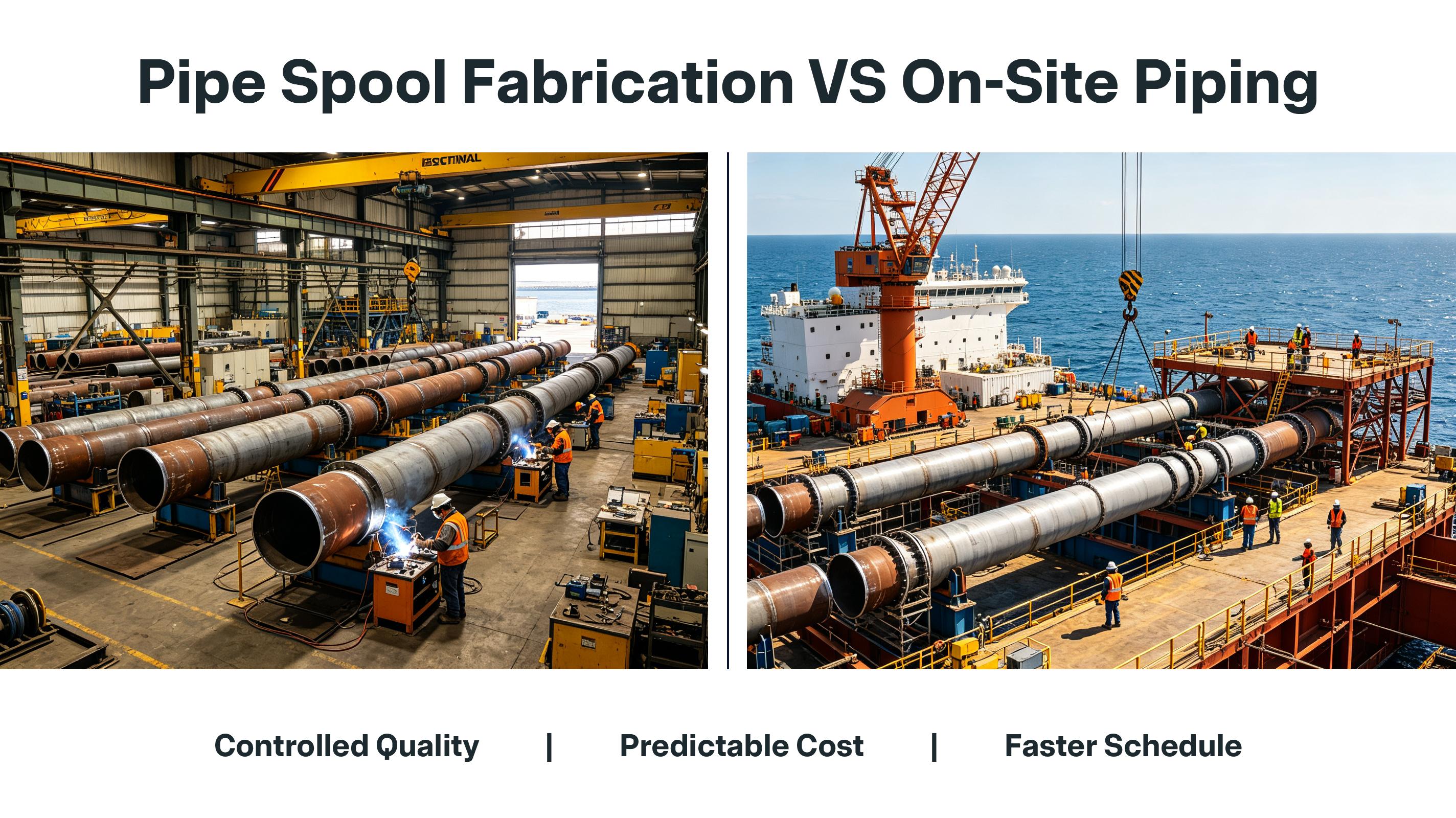
The typical pipe spool fabrication process includes several stages.
Before fabrication begins, engineers review:
Raw materials are verified to ensure that all components meet project specifications.
The second step involves material preparation.
At this stage:
Automated cutting equipment often improves dimensional accuracy.
Fabricators assemble all spool components according to approved drawings.
The assembly process may include:
Because fabrication takes place in a controlled environment, welders can maintain consistent procedures throughout production.
This approach usually delivers improved quality compared with field welding.
Every fabricated spool should undergo multiple inspections.
Typical inspection methods include:
Pressure tests confirm that the fabricated piping can safely operate under design conditions.
Many industrial piping systems require documented inspection records before installation.
After testing is complete, surface treatment is performed.
Depending on the project, surface treatment may include:
Proper surface treatment improves corrosion resistance and extends service life.
Finished spools are packaged, labeled, and transported to construction sites.
Installation teams connect the pipe spools according to the project sequence.
Because most fabrication work has already been completed, field installation becomes much faster.
| Comparison Factor | Pipe Spool Fabrication | On-Site Piping |
|---|---|---|
| Fabrication location | Controlled workshop | Construction sites |
| Labor efficiency | High | Moderate |
| Quality consistency | Excellent | Variable |
| Material waste | Lower | Higher |
| Installation speed | Faster | Slower |
| Weather impact | Minimal | Significant |
| Inspection control | Easier | More difficult |
| Rework | Less frequent | More common |
| Project schedule | Shorter | Longer |
| Total cost | Usually lower | Usually higher |
Field labor is usually more expensive than workshop labor.
Several factors increase labor costs at construction sites:
The prefabrication of pipe spools shifts most activities to a manufacturing facility, where labor productivity is generally higher.
Pipe spool fabrication often generates less material waste.
Digital cutting systems improve accuracy and reduce unnecessary scrap.
Because materials are carefully tracked throughout the fabrication process, waste management becomes easier.
Less waste directly reduces costs.
Workshops use equipment more efficiently than field locations.
Examples include:
Equipment can operate continuously in a fabrication shop, improving productivity.
Poor fit-up during field fabrication can create expensive rework.
In contrast, workshop fabrication provides:
As a result, the likelihood of costly rework decreases.
Environmental conditions affect welding quality.
Outdoor fabrication may be affected by:
A controlled environment eliminates many of these variables.
Quality control procedures are easier to implement inside fabrication facilities.
Inspection checkpoints can be established throughout the entire production cycle.
This approach delivers improved quality and greater consistency.
Fabrication shops often use specialized measuring equipment.
Accurate measurements improve:
For systems that require extremely tight tolerances, workshop fabrication usually produces better results.
One of the biggest advantages of prefabricated pipe spools is that fabrication and site preparation can happen simultaneously.
While the workshop produces the spools, construction teams can complete:
Parallel activities shorten project timelines.
Installing a prefabricated spool often takes only a fraction of the time required for field fabrication.
Because pipes are cut, assembled, welded, inspected, and tested before delivery, installation teams can focus on final connections.
Weather is one of the most common causes of project delays.
Workshop fabrication minimizes weather-related interruptions.
This creates a more predictable schedule.
Despite the advantages of prefabrication, on-site piping remains the better solution in some situations.
Examples include:
Projects with frequent engineering modifications may require field fabrication.
Large pipe spools can be difficult to transport.
Remote locations sometimes limit the size of prefabricated assemblies.
Some systems require final measurements after equipment has been installed.
Field adjustments may be necessary to achieve proper alignment.
Pipe spool fabrication is commonly used in a wide range of industries.
These include:
Large industrial piping projects benefit the most because they involve thousands of welded connections.
Digital models help identify design conflicts before fabrication begins.
Inspection should be integrated into every stage of production.
Pressure tests should verify the integrity of every fabricated assembly.
Standardized welding improves consistency across all fabricated spools.
Complete documentation improves traceability and simplifies future maintenance.
A pipe spool is a preassembled section of piping that contains pipes, pipe fittings, flanges, valves, and other components that are fabricated before installation.
Pipe spool fabrication takes place in a workshop, while on-site piping is fabricated directly at construction sites.
Prefabricated pipe spools reduce labor hours, minimize material waste, improve productivity, and shorten installation time.
Common inspections include visual inspection, dimensional inspection, non-destructive testing, and pressure tests.
Marine engineering, oil and gas, chemical processing, power generation, water treatment, and pharmaceutical manufacturing all use pipe spool fabrication.
No. Some projects still require on-site piping because of transportation limitations, design modifications, or equipment alignment requirements.
The comparison between pipe spool fabrication and on-site piping goes beyond cost alone.
Quality, schedule, safety, labor efficiency, and long-term maintenance should all be considered during project planning.
For most industrial piping applications, the prefabrication of pipe spools offers clear advantages. Better quality control, a controlled environment, reduced material waste, and faster installation help companies improve productivity while keeping projects on schedule.