

EN
Get In Touch

Factory pipe prefabrication is a manufacturing method in which pipes, fittings, flanges, valves, supports, and other components are assembled into complete pipe spools inside a factory before being delivered to a shipyard or construction site.
Compared with traditional on-site fabrication, factory-prefabricated piping offers better quality control, shorter installation time, less material waste, improved precision welding, and more predictable project timelines. Because each assembly arrives ready to install, shipbuilders can reduce labor requirements and improve project management efficiency.
Factory pipe prefabrication is the process of manufacturing piping assemblies in a controlled environment before transportation to the final installation location.
A typical prefabricated piping assembly is called a pipe spool.
A pipe spool consists of:
Instead of welding every component inside a shipyard, manufacturers complete most of the fabrication process in specialized workshops. The finished assemblies are then delivered to the construction site for final connection and testing.
This approach has become the preferred solution for modern industrial and shipbuilding projects because it improves production efficiency and reduces installation risks.
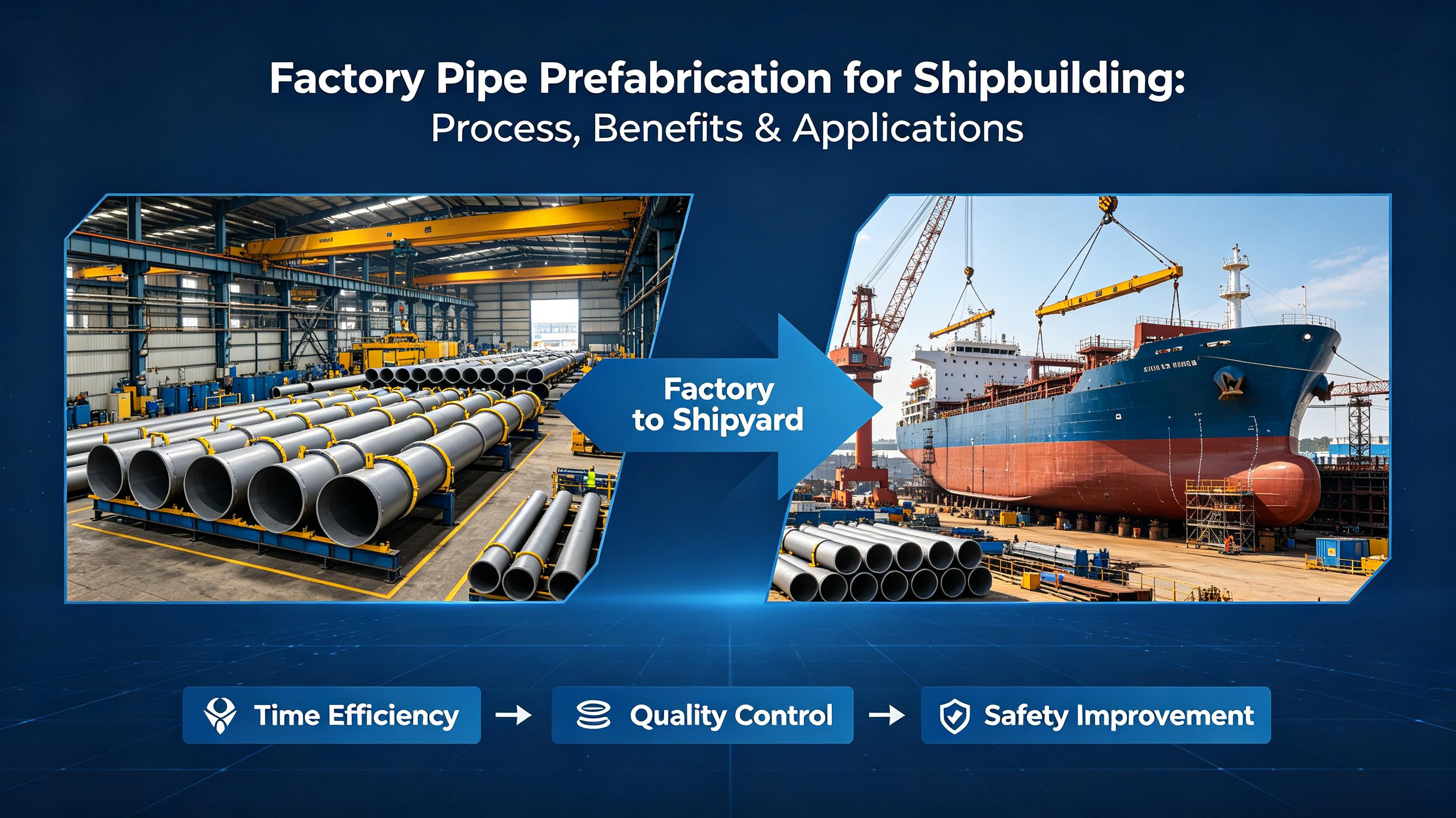
Ships contain thousands of meters of piping.
Many vessels include:
As vessels become larger and more technically advanced, every system requires a higher level of manufacturing accuracy.
Traditional fabrication methods often involve:
These challenges become even greater when a project includes complex piping systems such as LNG fuel systems, methanol fuel supply systems, offshore modules, or cryogenic cargo systems.
Factory prefabrication moves most production activities away from crowded shipyards and into specialized manufacturing facilities.
The first step in pipe spool fabrication is selecting the appropriate materials.
Common materials include:
| Material | Typical Applications |
|---|---|
| Carbon steel | General service piping |
| Stainless steel | Corrosion-resistant systems |
| Duplex stainless steel | High-strength marine applications |
| Super duplex stainless steel | Seawater and offshore systems |
| Nickel alloys | Extreme temperature environments |
Material certification is verified before production begins. Mill certificates, chemical composition reports, and mechanical property records are reviewed to ensure compliance with project specifications.
Engineering teams create detailed fabrication drawings based on:
Modern software allows manufacturers to identify potential interference before production starts.
This step improves coordination between engineering teams and production departments while reducing errors during installation.
Pipes are cut according to engineering drawings.
The preparation stage usually includes:
Automated equipment helps maintain dimensional accuracy throughout the fabrication process.
Technicians assemble individual components according to fabrication drawings.
A typical pipe spool consists of several connected elements that must meet strict dimensional tolerances.
During this stage, workers verify:
Every measurement must be confirmed before welding begins.
Precision welding is one of the most important stages in pipe prefabrication.
Depending on the application, manufacturers may use:
For stainless steel systems, welding parameters must be carefully controlled to preserve corrosion resistance.
Qualified welders follow approved welding procedures to ensure consistent weld quality.
After welding is completed, inspection teams perform several verification procedures, including:
Defects can be identified and corrected before the assemblies leave the factory.
Additional treatments may include:
These treatments help protect the piping during transportation and storage.
After final inspection, the pipe spools are labeled, packaged, and transported to the shipyard.
Because the assemblies are already completed, they arrive ready to install.
Workers only need to position the spool, connect the interfaces, and complete final system integration.
Quality control is easier to maintain inside a factory than at an outdoor construction site.
Factory environments provide:
These conditions improve manufacturing consistency.
Traditional field fabrication often generates excess material waste because cutting and fitting are performed on-site.
Factory production improves material utilization through:
Reducing waste also lowers production costs.
One of the biggest advantages of prefabrication is the reduction in installation time.
Field activities are minimized because major fabrication tasks have already been completed.
Benefits include:
This allows shipbuilders to complete projects more efficiently.
Factory production reduces the amount of welding, cutting, and material handling required at the installation site.
Workers spend less time in confined spaces and elevated work areas.
As a result, safety risks can be reduced.
Delayed piping work often affects other departments.
Electrical systems, insulation, equipment installation, and commissioning activities all depend on completed piping.
Prefabrication helps manufacturers maintain more predictable project timelines by reducing unexpected delays.
Prefabricated piping is widely used in:
These systems require precise fabrication because they operate under demanding pressure and temperature conditions.
Cooling systems circulate seawater or freshwater throughout the vessel.
Because these systems extend across multiple compartments, prefabricated pipe spools simplify installation and improve dimensional accuracy.
Ballast systems contain extensive piping networks that connect pumps, tanks, and control equipment.
Factory fabrication reduces the complexity of field assembly.
Engine rooms contain some of the most complex piping systems on a ship.
Typical applications include:
Prefabrication improves organization and simplifies equipment integration.
Offshore platforms and skid-mounted systems depend heavily on prefabricated piping.
Factory assembly supports:
The result is seamless integration between piping, equipment, and structural components.
| Factor | Factory Prefabrication | On-Site Fabrication |
|---|---|---|
| Production location | Controlled environment | Construction site |
| Quality control | Standardized | Variable |
| Welding quality | Consistent | Dependent on field conditions |
| Material waste | Lower | Higher |
| Installation time | Shorter | Longer |
| Safety | Better | More field exposure |
| Project management | Easier | More complicated |
| Project timelines | More predictable | Greater risk of delays |
Early design reviews reduce production changes and improve manufacturing efficiency.
Standardized designs simplify procurement, production, transportation, and installation.
Digital tracking systems improve traceability throughout the fabrication process.
Manufacturers should have experience with:
A pipe spool is a prefabricated piping assembly that combines pipes, fittings, flanges, valves, and other components into a single unit before installation.
Pipe prefabrication takes place inside a factory, while field fabrication occurs directly at the construction site. Factory production generally provides better quality control and shorter installation schedules.
Shipbuilding uses prefabricated piping because it reduces installation time, improves welding quality, minimizes material waste, and supports more efficient project timelines.
Common materials include carbon steel, stainless steel, duplex stainless steel, super duplex stainless steel, and nickel alloys.
A controlled environment provides stable working conditions, standardized procedures, specialized equipment, and dedicated inspection areas, resulting in more consistent manufacturing quality.
Yes. LNG, methanol, ammonia, hydrogen, and other fuel systems frequently use prefabricated piping because these applications require precise manufacturing and strict dimensional control.
Factory pipe prefabrication has transformed the way shipbuilding projects are executed.
By moving production into a controlled environment, manufacturers can improve quality control, reduce material waste, shorten installation time, and simplify project management.
As ship designs become more sophisticated, prefabricated piping will continue to support reliable piping systems across commercial vessels, offshore platforms, and advanced dual-fuel ships.
For shipbuilders facing increasingly complex engineering requirements, factory prefabrication offers a practical and efficient solution.