

EN
Get In Touch

Offshore engineering uses piping systems to move oil, gas, water, steam, chemicals, and other process fluids under demanding conditions. Some services operate at high pressure and require pipe with greater wall thickness than standard process piping.
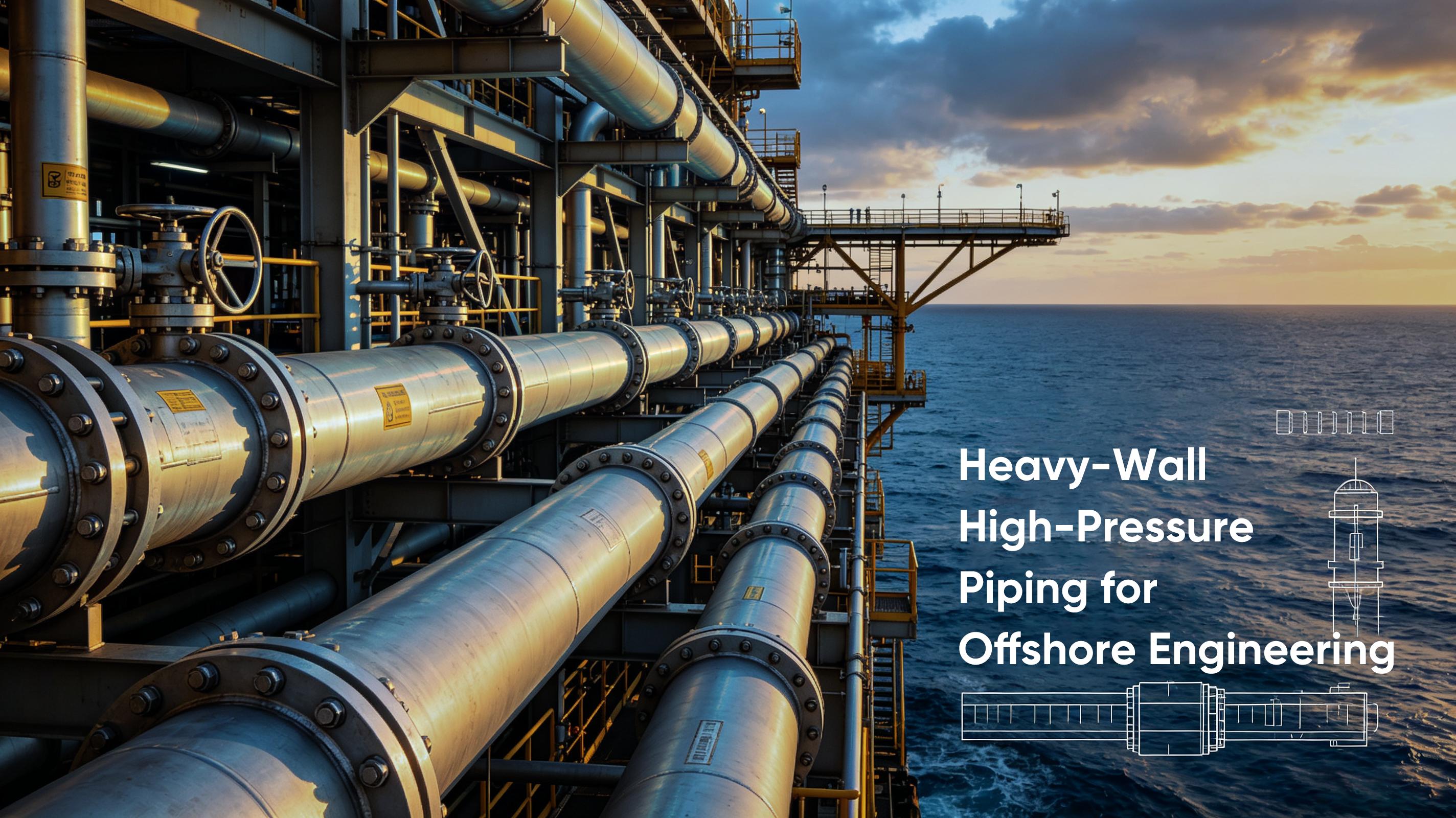
Heavy-wall high-pressure piping is designed to withstand high internal pressures while maintaining suitable mechanical properties, corrosion resistance, and dimensional stability. It is used in offshore production facilities, FPSO units, platforms, subsea systems, and other high-pressure applications.
This guide explains what heavy-wall high-pressure piping is, why wall thickness matters, which materials are commonly used, how pressure pipe is selected, and what engineers should consider when designing offshore piping systems.
Heavy-wall high-pressure piping is pressure pipe manufactured with a relatively thick wall to withstand high internal pressures, mechanical loads, temperature changes, corrosion, and other service conditions.
For offshore engineering, the required wall thickness depends on factors such as:
Heavy-wall pipe is commonly considered for high pressure applications in oil and gas production, injection systems, hydraulic systems, high-pressure water services, and selected process and utility lines.
Heavy-wall high-pressure piping refers to piping manufactured with a thicker-than-standard pipe wall for service conditions that create high stress or pressure loads.
The wall thickness provides a larger cross-sectional area of material to resist internal pressure. However, simply increasing thickness does not make a piping system suitable for every high-pressure service. Material grade, manufacturing quality, welding, heat treatment, corrosion allowance, fittings, connections, and inspection all affect the final pressure capability.
In offshore engineering, heavy-wall piping may be supplied as seamless or welded pipe, depending on the diameter, material, pressure class, service requirements, and applicable specifications.
Wall thickness is one of the main parameters used when evaluating a pressure pipe.
When fluid pressure acts on the inside surface of a pipe, it creates stresses in the pipe wall. As internal pressure increases, the pipe needs sufficient wall thickness and material strength to keep these stresses within allowable limits.
A simplified relationship for thin-wall pipe is often expressed as:
Hoop stress ≈ P × D / 2t
Where:
This simplified equation is useful for understanding the relationship between pressure, diameter, and wall thickness. Actual offshore pipe design normally uses the applicable design code, material allowable stress, weld efficiency, corrosion allowance, temperature effects, and other design factors.
A larger diameter pipe generally experiences higher circumferential stress at the same pressure. Increasing wall thickness reduces the calculated stress for a given pressure and diameter.
The difference between heavy-wall and standard-wall piping is mainly related to the required wall thickness for the service.
Standard-wall pipe may be sufficient for moderate pressure and temperature conditions. Heavy-wall pipe is selected when the design requires greater resistance to internal pressure, external loads, corrosion allowance, mechanical loads, or other demanding conditions.
| Factor | Standard-Wall Pipe | Heavy-Wall Pipe |
|---|---|---|
| Wall thickness | Lower | Higher |
| Pressure capability | Suitable for specified service | Suitable for higher or more demanding loads |
| Material volume | Lower | Higher |
| Weight | Lower | Higher |
| Fabrication | Generally easier | May require additional preparation |
| Welding | Usually simpler | Requires careful heat control and procedures |
| Corrosion allowance | Depends on design | Can accommodate larger allowances when specified |
| Typical use | General piping services | High pressure applications and demanding services |
Heavy-wall pipe should not be selected only because it is thicker. The complete piping design must be checked against the actual service conditions.
Heavy-wall piping can be found in several areas of offshore engineering.
Oil and gas production systems can contain high-pressure fluids from wells and process equipment. High-pressure production lines may require pipe with suitable wall thickness, strength, and corrosion resistance.
The piping must also accommodate changes in pressure, temperature, flow rate, and fluid composition.
Water injection is widely used in offshore oil production to help maintain reservoir pressure.
Injection piping can operate at high pressures. The selected pressure pipe must have sufficient mechanical strength and suitable resistance to the water chemistry and operating environment.
Offshore equipment often uses hydraulic systems for valves, actuators, control equipment, lifting systems, and other machinery.
These systems can operate at high pressure, making material strength, wall thickness, connection design, and fatigue performance important considerations.
Gas processing and transportation systems may operate at high pressure. Heavy-wall pipe can be used where the design pressure, pipe diameter, material properties, or corrosion allowance requires additional wall thickness.
For gas service, leak prevention and connection integrity are especially important because compressed gas can release significant energy if containment is lost.
Offshore facilities may include steam, boiler, cooling water, compressed air, and other utility services. Similar heavy-wall design principles can also be applied to high-pressure piping in power plants and industrial facilities.
The final pipe specification depends on the pressure, temperature, fluid, material, and applicable code.
Material selection depends on pressure, temperature, fluid chemistry, corrosion risk, welding requirements, and mechanical loads.
Common materials include carbon steel, low-alloy steel, stainless steel, duplex stainless steel, and super duplex stainless steel.
Carbon steel is widely used because it provides good mechanical properties at a relatively competitive cost.
It is suitable for many oil and gas and utility services when corrosion is controlled through material selection, coatings, corrosion allowance, chemical treatment, or other measures.
Low-alloy steels can provide higher strength and improved performance at elevated temperatures compared with some conventional carbon steels.
They may be considered for high-pressure and high-temperature services where higher allowable stress is required.
Austenitic stainless steels are selected when corrosion resistance is an important design requirement.
They can be suitable for process fluids and environments where carbon steel does not provide adequate corrosion performance.
Duplex stainless steel combines relatively high mechanical strength with good corrosion resistance.
Its properties make it attractive for offshore piping exposed to seawater, chloride-containing fluids, and demanding process conditions.
Super duplex stainless steel offers higher alloy content and strong resistance to many forms of corrosion, including chloride-related corrosion.
It is often considered for demanding offshore services where both high mechanical strength and high corrosion resistance are required.
The mechanical properties of the pipe material directly affect its pressure rating and structural performance.
Important properties may include:
A material with higher yield strength may allow a thinner wall for a specific pressure calculation. However, this does not mean that the highest-strength material is always the best choice.
Offshore engineers must also consider weldability, toughness, corrosion behavior, fabrication requirements, availability, and lifecycle cost.
Operating pressure and design pressure should not be treated as the same value.
Operating pressure is the pressure expected during normal operation.
Design pressure is the pressure used for engineering the piping system and normally includes an appropriate margin above expected operating conditions.
For example, a system may normally operate below its design pressure. The pipe, fittings, valves, flanges, and other components must still be capable of meeting the specified design conditions.
The complete piping system must be evaluated rather than looking at pipe alone. A heavy-wall pipe connected to a lower-rated valve or flange does not make the entire system suitable for the higher pressure.
Wall thickness is determined through engineering calculations and applicable piping standards.
The calculation may consider:
A simplified pressure calculation can explain the basic relationship, but offshore projects should use the relevant design standard and project specification for the final wall thickness.
For example, a nominal wall thickness may need to be increased after considering corrosion allowance and the negative manufacturing tolerance permitted by the applicable specification.
Corrosion resistance is a major consideration for offshore piping systems because seawater, salt spray, humid air, chemicals, and process fluids can accelerate corrosion.
Common corrosion mechanisms include:
Heavy-wall construction can provide additional corrosion allowance when specified. However, thicker material does not automatically prevent corrosion.
Material selection, fluid chemistry, corrosion monitoring, coatings, cathodic protection, insulation design, and maintenance may all be required.
Internal pressure is only one part of offshore pipe design.
Subsea piping and pipe exposed to external pressure may also need to resist collapse. This becomes particularly important as water depth increases.
External pressure depends on factors such as:
For subsea applications, engineers may therefore increase wall thickness not only to handle internal pressure but also to improve resistance to external pressure and collapse.
Both seamless and welded pipe can be used in high-pressure piping systems, depending on project requirements.
Seamless pipe is manufactured without a longitudinal weld seam. It is commonly used for high-pressure services and smaller pipe sizes where the applicable specification calls for seamless construction.
Advantages can include:
Welded pipe is manufactured by forming plate, strip, or other feedstock and joining it through a welding process.
For larger diameters, welded pipe can provide practical manufacturing advantages.
The weld procedure, inspection, heat treatment, and nondestructive testing requirements must be appropriate for the service.
The choice between seamless and welded pipe should be based on the project specification, code requirements, dimensions, material, pressure, and manufacturing capability.
A piping system is more than the pipe itself.
High-pressure systems may include:
Each component must be rated for the applicable pressure and temperature.
The connection between components also needs careful design. Poorly selected fittings or incompatible flange ratings can reduce the pressure capability of the complete system.
Heavy-wall pipe fabrication requires controlled processes because thicker sections can affect welding, heat input, distortion, residual stress, and heat treatment.
Typical fabrication stages include:
Welding procedures should be qualified for the material grade and thickness range.
For some low-alloy and high-strength materials, preheating, interpass temperature control, and post-weld heat treatment may be required.
Quality control is important for high-pressure piping because defects can affect pressure containment and long-term service.
Common inspection methods include:
The exact inspection plan depends on the pipe specification, material, service category, design code, project requirements, and classification requirements.
Material certificates and traceability records are also important for offshore projects.
The same engineering principles used for offshore piping can apply to high-pressure systems in power plants.
Power plants may use high-pressure steam, feedwater, boiler systems, and other services that require carefully selected pressure pipe.
Offshore facilities face additional challenges because equipment is exposed to marine environments, space is limited, weight matters, and maintenance can be difficult.
As a result, offshore piping design often requires a balance between:
When selecting heavy-wall high-pressure piping, engineers should review the following factors.
Start with the maximum pressure that the piping system must safely contain.
Understand the normal operating pressure and possible pressure fluctuations.
Material strength and allowable stress can change with temperature.
Oil, gas, seawater, chemicals, steam, and produced water can require different materials.
Assess the internal and external corrosion environment before selecting the material and corrosion allowance.
Larger diameters can increase pressure-induced stresses and may influence the required wall thickness.
Consider weight, vibration, thermal expansion, bending, support loads, and equipment movement.
Offshore facilities can experience repeated pressure cycles, vibration, wave motion, and equipment-induced loads.
The selected material and thickness should be practical for cutting, forming, welding, heat treatment, and inspection.
The pipe should meet the relevant material, dimensional, testing, piping, offshore, and classification requirements.
Heavy-wall piping can provide several engineering benefits.
Benefits include:
However, there are also limitations.
Potential limitations include:
The objective is not to use the thickest pipe available. The objective is to select a wall thickness that meets the engineering requirements without unnecessary weight or cost.
Normal operating conditions do not always represent the maximum pressure that the piping may experience.
A thick pipe made from an unsuitable material may still have poor corrosion resistance or inadequate temperature performance.
Offshore corrosion can reduce the effective wall thickness during service.
Valves, fittings, flanges, branch connections, and other components must be rated for the same design conditions.
Subsea piping may need to resist external pressure even when internal pressure is low.
Repeated pressure and mechanical cycles can affect offshore piping over time.
Heavy sections can require specific welding procedures, heat input control, preheating, and post-weld treatment.
Heavy-wall high-pressure piping is pressure pipe manufactured with increased wall thickness to meet demanding pressure, mechanical, corrosion, or structural requirements. It is used in offshore oil and gas, subsea systems, process facilities, hydraulic systems, and other high-pressure applications.
A greater wall thickness increases the amount of material available to resist pressure-induced stress. It can also provide additional corrosion allowance and improve resistance to certain mechanical and external loads.
The required wall thickness depends on design pressure, pipe diameter, material allowable stress, design temperature, corrosion allowance, manufacturing tolerance, weld efficiency, external pressure, and applicable design codes.
No. Heavy-wall pipe is not automatically better. It adds weight, material cost, and fabrication requirements. The correct wall thickness should be determined from the actual service and engineering calculations.
Common materials include carbon steel, low-alloy steel, austenitic stainless steel, duplex stainless steel, and super duplex stainless steel. The correct choice depends on pressure, temperature, fluid chemistry, corrosion risk, and mechanical requirements.
Seamless pipe is widely used for many high-pressure applications, but it is not universally better than welded pipe. Welded pipe can also meet demanding pressure requirements when manufactured, inspected, and tested according to the applicable specification.
Not by itself. A thicker wall can provide additional corrosion allowance, but corrosion resistance primarily depends on the material, environment, protective measures, and corrosion management strategy.
Operating pressure is the pressure expected during normal operation. Design pressure is the engineering pressure used to establish the required pressure capability of the piping system and normally accounts for conditions beyond routine operation.
Typical applications include high-pressure oil and gas lines, water injection systems, hydraulic piping, gas systems, process piping, subsea piping, and other services where pressure, mechanical loads, or corrosion conditions require increased wall thickness.
Yes. Heavy-wall pressure pipe can be used in power plants for high-pressure steam, feedwater, boiler, and other services when the selected material, dimensions, and wall thickness meet the applicable design requirements.
Heavy-wall high-pressure piping provides a practical solution for offshore systems that must contain high internal pressures and withstand demanding mechanical and environmental conditions.
The correct wall thickness depends on more than pressure alone. Design pressure, operating pressure, pipe diameter, mechanical properties, temperature, corrosion resistance, external pressure, fatigue, fabrication, and applicable standards all need to be considered.
For offshore engineering, the best piping solution is one that meets the required pressure and service conditions while controlling weight, fabrication complexity, corrosion risk, and lifecycle cost. Careful material selection, engineering calculations, fabrication control, inspection, and testing help ensure that the finished piping system performs as specified throughout its service life.
For EPC contractors, offshore operators, and engineering teams, heavy-wall pipe should therefore be selected as part of a complete piping system rather than as an isolated component.