

EN
Get In Touch

Super duplex stainless steel piping is widely used in demanding FPSO and offshore applications where high corrosion resistance, high strength, and resistance to stress corrosion cracking are required. Compared with standard duplex and many austenitic stainless steel grades, super duplex offers a stronger combination of mechanical strength and corrosion performance.
Typical grades include UNS S32750 (2507) and other super duplex grades selected for seawater, produced water, offshore oil and gas, chemical injection, cooling water, firewater, and other corrosive services. Super duplex pipes are available in seamless and welded forms and can be manufactured to standards such as ASTM A790/A790M, subject to the project specification and applicable design code. ASTM A790/A790M specifically covers seamless and welded ferritic/austenitic stainless steel pipe for corrosive service, with emphasis on resistance to stress corrosion cracking.
For FPSO projects, material selection should consider chloride exposure, temperature, pressure, fluid chemistry, welding procedures, heat treatment, corrosion allowance, inspection requirements, and the applicable classification and piping standards.
Super duplex stainless steel is a ferritic-austenitic stainless steel with a carefully balanced two-phase microstructure. It combines the properties of ferritic and austenitic stainless steels.
The ferritic phase contributes high strength and good resistance to chloride stress corrosion cracking. The austenitic phase contributes toughness, ductility, and corrosion resistance.
Duplex stainless steels generally contain about equal amounts of ferrite and austenite. The final phase balance depends on chemical composition and heat treatment.
Super duplex is a higher-alloyed family within the duplex stainless steel group. Compared with standard duplex, it normally contains higher chromium and molybdenum content and often higher nitrogen. This raises its resistance to pitting and crevice corrosion.
A common example is 2507, or UNS S32750. World Stainless lists 2507 as a super duplex grade with approximately 24–26% chromium, 3–5% molybdenum, 6–8% nickel, and 0.24–0.32% nitrogen.
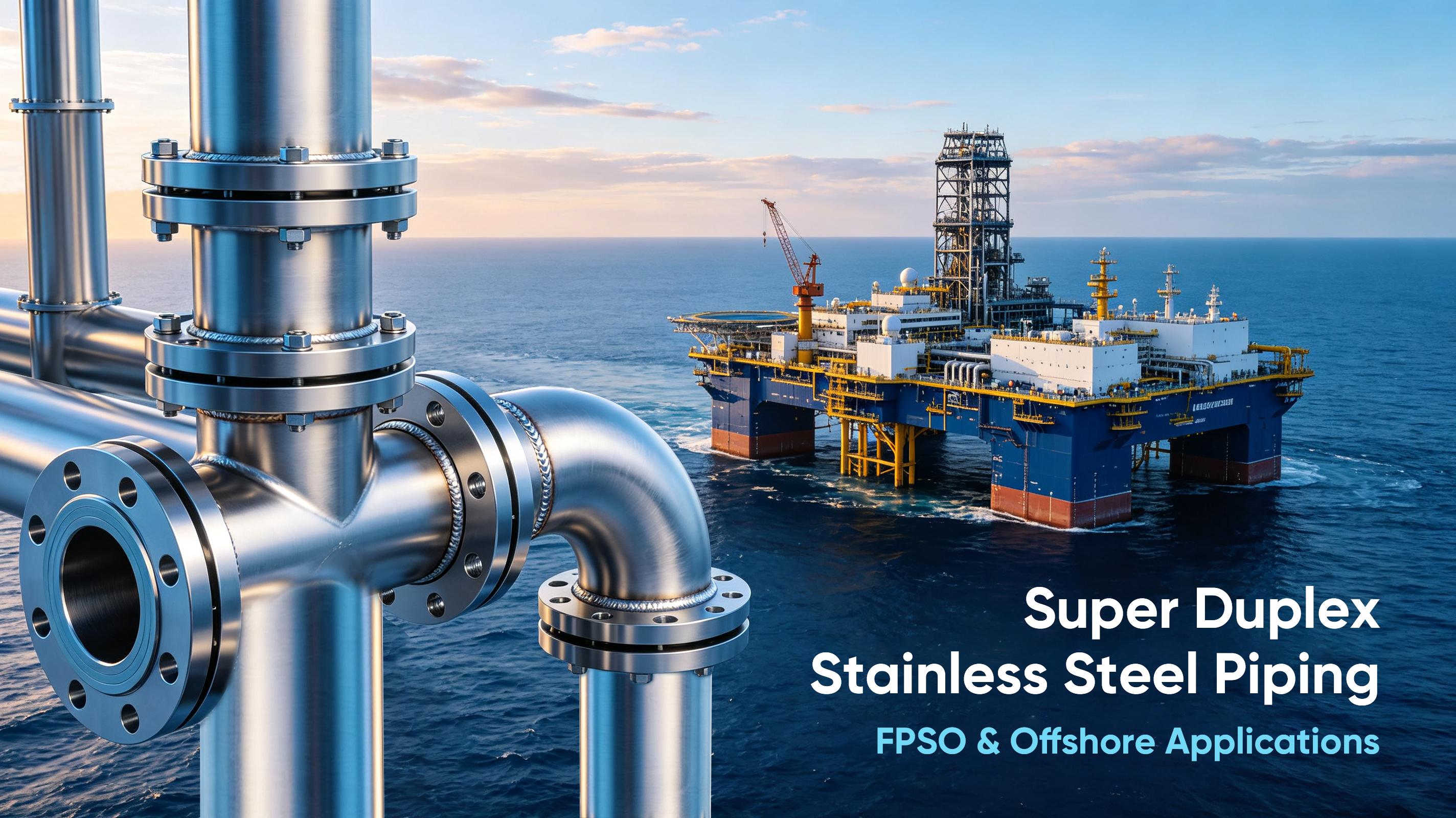
An FPSO operates in a marine environment where piping can be exposed to seawater, salt spray, humid air, produced fluids, chemicals, and high chloride concentrations.
Some piping systems also operate under high pressure or elevated temperature. These conditions place demands on both material strength and corrosion performance.
Super duplex stainless steels are attractive because they provide several useful properties in one material:
World Stainless notes that duplex stainless steels combine high strength with high corrosion resistance and have greater resistance to stress corrosion cracking than standard austenitic grades.
For offshore projects, this combination can make super duplex a practical alternative to both standard duplex and some high-alloy austenitic stainless steels.
Material selection for offshore piping is not simply a choice between stainless steel grades. Engineers need to compare corrosion conditions, pressure, temperature, fabrication requirements, availability, and project cost.
| Property | Austenitic Stainless Steel | Standard Duplex | Super Duplex |
|---|---|---|---|
| Microstructure | Mainly austenitic | Ferrite + austenite | Ferrite + austenite |
| Mechanical strength | Moderate to high | High | Very high |
| Chloride resistance | Depends strongly on grade | Good | Very high |
| Stress corrosion cracking resistance | Grade dependent | Very good | Very good to excellent |
| Molybdenum content | Low to high | Moderate | Generally higher |
| Seawater service | Selected grades | Suitable for many applications | Suitable for more severe conditions |
| High-pressure applications | Grade dependent | Good | Very good |
| Fabrication | Generally easier | More demanding | More demanding |
| Typical offshore use | General corrosion-resistant service | Offshore structures and piping | Seawater and more corrosive services |
The exact performance depends on the grade and service conditions. A material should not be selected only from a generic grade comparison.
The corrosion performance of duplex and super duplex stainless steels comes from the interaction of several alloying elements.
Chromium forms the passive film that protects stainless steel from corrosion.
Super duplex grades generally contain around 25% chromium. This supports their high corrosion resistance in chloride-containing environments.
Molybdenum content is one of the main differences between conventional stainless steel, standard duplex, and super duplex.
Molybdenum improves resistance to localized corrosion, especially pitting and crevice corrosion.
This is important for offshore piping because chloride-containing seawater can cause localized corrosion when conditions are unfavorable.
Nitrogen helps increase strength and supports the stability of the austenitic phase.
It also contributes to pitting resistance and helps maintain the desired duplex microstructure after fabrication and heat treatment.
Nickel supports the austenitic phase and helps balance the ferritic structure created by chromium and molybdenum.
The final alloy composition is designed to produce the required ferrite-austenite balance and corrosion performance.
Pitting Resistance Equivalent Number, or PREN, is often used to compare the theoretical resistance of stainless steels to pitting corrosion.
A commonly used formula is:
PREN = %Cr + 3.3 × %Mo + 16 × %N
Because super duplex contains relatively high chromium, molybdenum, and nitrogen levels, it generally has a higher PREN than standard duplex grades.
World Stainless describes typical standard duplex grades such as 2205 as having PREN values around 28–38, while super duplex grades are generally in the 39–45 range.
PREN is useful for material screening, but it should not be treated as a complete corrosion prediction. Actual performance depends on temperature, chloride concentration, pH, fluid composition, crevice conditions, surface condition, welding, and operating history.
One of the main advantages of super duplex is its high mechanical strength.
For example, World Stainless lists a minimum 0.2% yield strength of approximately 550 MPa and minimum tensile strength of approximately 795 MPa for ASTM plate grade 2507.
Higher yield strength can allow engineers to meet pressure and structural requirements with thinner wall sections in some applications.
However, wall thickness cannot be reduced based on yield strength alone. Engineers must also consider:
For high-pressure piping, the final wall thickness must be calculated according to the applicable design code.
FPSO facilities contain many piping systems operating under different pressure and temperature conditions.
Examples include:
Super duplex can be considered when both high pressure and corrosive conditions are present.
Its high mechanical strength can provide useful design flexibility, while its corrosion resistance helps address chloride-rich environments.
The material still needs to be qualified for the specific service. High pressure does not automatically mean that super duplex is the best material.
Seawater is one of the most common reasons for selecting highly corrosion-resistant stainless steels offshore.
Seawater contains chlorides that can promote pitting and crevice corrosion. Temperature, oxygen content, flow rate, deposits, and stagnant areas can further affect corrosion behavior.
Super duplex is therefore used in selected seawater piping and related offshore systems.
World Stainless documents offshore applications using duplex and super duplex grades, including 2205 and 2507, in marine environments.
Produced water can contain chlorides, dissolved gases, hydrocarbons, and other contaminants.
Its chemistry varies from field to field. A material suitable for one FPSO may not be suitable for another.
Super duplex can be considered where the combination of chloride exposure and mechanical requirements exceeds the practical range of lower-alloy materials.
Firewater piping must remain available after long periods of exposure to the marine atmosphere.
Depending on the project design, super duplex may be used where seawater or other corrosive conditions create a demanding service environment.
Water injection is used in many offshore oil and gas developments to support reservoir pressure and production.
The injected water may have a high chloride content or may require treatment and chemical dosing. High-pressure operation can also influence material selection.
Super duplex can provide a useful combination of high strength and corrosion resistance for selected injection services.
Heat exchangers on FPSOs can experience seawater, cooling water, produced fluids, and other aggressive media.
Material selection needs to consider both sides of the heat exchanger. Temperature differences, chloride levels, deposits, velocity, and crevice conditions can influence corrosion.
Super duplex may be selected for heat exchanger components or connected piping when corrosion resistance and mechanical strength requirements justify the material.
Offshore oil and gas processing can expose piping to hydrocarbons, water, hydrogen sulfide, carbon dioxide, chlorides, and process chemicals.
Super duplex is therefore considered for selected process and utility systems where standard carbon steel or lower-alloy stainless steels may require excessive corrosion allowance or additional protection.
Super duplex pipes can be produced as seamless pipes or welded pipes.
The choice depends on pipe size, pressure, manufacturing requirements, availability, project specifications, and applicable standards.
Seamless pipes are manufactured without a longitudinal welded seam.
They are often considered for smaller sizes and services where the project specification requires seamless construction.
ASTM A790/A790M includes seamless ferritic/austenitic stainless steel pipe as well as straight-seam welded pipe.
Welded pipes can be more practical for larger diameters and certain wall thicknesses.
However, welding changes the local microstructure. Welding procedures therefore need to control heat input, interpass temperature, filler selection, shielding, and cooling conditions.
For offshore projects, weld quality and post-weld inspection requirements should be defined before fabrication begins.
Heat treatment has a direct effect on the duplex microstructure.
The target is to maintain an appropriate balance between ferrite and austenite while avoiding unwanted intermetallic phases.
Incorrect thermal exposure can reduce corrosion resistance and toughness.
This is particularly important because duplex materials can be sensitive to thermal cycles during:
ASTM A790/A790M includes requirements covering chemical analysis, tensile testing, flattening, hydrostatic testing, and nondestructive electrical testing for the pipe covered by the specification.
Project specifications may impose additional testing and qualification requirements.
Welding super duplex requires tighter process control than many common austenitic stainless steels.
The welding procedure should be developed to maintain the required phase balance and corrosion performance.
Important controls can include:
The objective is not simply to produce a sound weld. The completed joint must also provide the required mechanical and corrosion performance.
This is especially important for FPSO pipe spools because fabrication often involves many welds, fittings, flanges, supports, and field connections.
Resistance to stress corrosion cracking is an important reason for considering duplex and super duplex stainless steels in chloride-containing offshore environments.
Austenitic stainless steel grades can be susceptible to chloride stress corrosion cracking under certain combinations of tensile stress, temperature, and chloride exposure.
Duplex structures generally provide better resistance to this failure mechanism.
ASTM A790/A790M identifies resistance to stress corrosion cracking as a particular consideration for ferritic/austenitic stainless steel pipe used in corrosive service.
This does not mean super duplex is immune to every cracking mechanism.
Offshore engineers must also consider hydrogen effects, weld defects, residual stress, cathodic protection, temperature, and service chemistry.
For subsea duplex components exposed to cathodic protection, DNV-RP-F112 specifically addresses hydrogen-induced stress cracking and provides design guidance.
Super duplex stainless steel offers strong corrosion resistance, but it should not be treated as a universal high-temperature alloy.
Long exposure to unsuitable high temperature ranges can cause phase changes or precipitation that reduce toughness and corrosion performance.
ASTM A790/A790M notes the potential for embrittlement of these ferritic/austenitic steels during prolonged exposure at elevated temperatures.
For this reason, an FPSO piping specification should define:
If high-temperature service is expected, material selection should be checked against the applicable material and design requirements rather than relying on a general stainless steel temperature rating.
The correct standard depends on the product form and project requirements.
For pipe, one commonly referenced specification is:
ASTM A790/A790M — Seamless and Welded Ferritic/Austenitic Stainless Steel Pipe
The current ASTM listing identifies A790/A790M-24 as the active edition and covers seamless and straight-seam welded ferritic/austenitic stainless steel pipe for corrosive service.
Other standards may apply to:
Offshore projects may also require compliance with DNV, ABS, API, ASME, ISO, NORSOK, or operator-specific specifications.
For submarine pipeline systems, DNV-ST-F101 addresses design, construction, operation, material selection, corrosion control, welding, testing, and installation requirements.
The exact standard list should therefore be established in the project material requisition and piping specification.
Inspection is part of material control from purchase through installation.
Typical checks can include:
Positive material identification or laboratory testing can verify alloy chemistry.
Chromium, molybdenum, nickel, and nitrogen levels are particularly relevant to duplex grade identification.
Depending on the applicable specification, mechanical tests may include:
Hydrostatic testing can be used to verify pressure integrity according to the applicable product and project requirements.
Depending on the product and specification, NDT may include:
Some offshore projects require additional corrosion testing or qualification based on the service environment.
Testing requirements should be established before procurement because they can affect manufacturing routes, inspection plans, and delivery time.
A practical material selection process should begin with the service conditions rather than the material name.
Identify whether the pipe carries:
Record:
Record normal, minimum, maximum, and design conditions.
This is especially important for high-pressure and high-temperature services.
Compare carbon steel, austenitic stainless steel, standard duplex, super duplex, nickel alloys, or lined systems as appropriate.
Consider pipe size, wall thickness, fittings, welding, heat treatment, machining, and pipe spool fabrication.
Check the applicable ASTM, ASME, API, ISO, NORSOK, DNV, ABS, or owner specifications.
Set the required MTC, PMI, NDT, hydrotest, mechanical tests, corrosion tests, and dimensional inspection before production.
316L is a widely used austenitic stainless steel, but it is not suitable for every offshore chloride service.
Super duplex generally provides higher mechanical strength and higher resistance to chloride-related localized corrosion.
The correct choice depends on the actual environment.
For mild offshore utility service, 316L may be adequate and easier to fabricate.
For more aggressive seawater or chloride-containing service, super duplex may offer a larger corrosion-performance margin.
However, super duplex also has more demanding fabrication and welding requirements. A lower-cost material can therefore be the better choice when the service environment does not require super duplex performance.
Standard duplex grades such as 2205 provide a useful balance between corrosion resistance, strength, and cost.
Super duplex is normally selected when a higher level of corrosion resistance or mechanical performance is required.
A simplified comparison is:
2205: suitable for many offshore and moderately corrosive environments.
2507: suited to more demanding chloride and seawater-related conditions where its higher alloy content and strength are useful.
World Stainless identifies 2205 as a standard duplex grade and 2507 as a super duplex grade, with 2507 offering higher typical PREN and strength.
The choice should always be based on the service conditions and project specification.
Super duplex pipes can be considered for:
DNV notes that superduplex alloys are widely used for subsea umbilical tubes because of their corrosion resistance and mechanical strength in seawater environments.
World Stainless notes that duplex grades can require stronger tools and may result in higher tool wear during cutting and forming compared with austenitic stainless steels.
Super duplex pipe is only one part of an FPSO piping system.
A complete pipe spool may include:
The design must account for thermal expansion, vibration, ship motion, support loads, fatigue, pressure loads, and installation tolerances.
For offshore applications, vibration and cyclic loading can be important because an FPSO is a floating structure.
Welding and fabrication quality also need to be considered at the pipe spool stage, not only after installation.
A strong quality-control plan should cover the entire supply chain.
Important documents may include:
Traceability is especially useful for large FPSO projects where thousands of pipe components may be delivered in multiple batches.
Super duplex stainless steel piping is piping made from a ferritic-austenitic stainless steel with high chromium, molybdenum, and nitrogen content. It combines high strength with high corrosion resistance and good resistance to chloride stress corrosion cracking.
Super duplex is used on FPSOs because it can handle demanding combinations of chloride exposure, seawater, pressure, mechanical loads, and corrosion. It is commonly considered for seawater, water injection, firewater, produced water, and selected process systems.
Super duplex generally contains higher alloy levels and offers higher corrosion resistance and strength than standard duplex. 2205 is a common standard duplex grade, while 2507 is a common super duplex grade.
Yes. UNS S32750, commonly known as 2507, is a widely used super duplex stainless steel grade. World Stainless lists 2507 with approximately 24–26% chromium and 3–5% molybdenum, with high nitrogen content.
Not in every application. Super duplex provides higher strength and better resistance to many chloride-related corrosion mechanisms than common austenitic grades. However, austenitic stainless steel can offer easier fabrication and better suitability for some temperature or forming requirements.
Yes, when the selected grade, wall thickness, fabrication method, and design comply with the applicable pressure design requirements. High mechanical strength is one reason super duplex is considered for high-pressure offshore systems.
Yes. Super duplex pipe can be manufactured as seamless pipe. ASTM A790/A790M covers seamless and straight-seam welded ferritic/austenitic stainless steel pipe for corrosive service.
Super duplex generally has strong resistance to chloride stress corrosion cracking compared with many conventional austenitic stainless steels. However, resistance depends on temperature, chloride concentration, stress, surface condition, fabrication, and service environment.
Yes. Heat treatment and welding thermal cycles affect the ferrite-austenite balance and can influence corrosion resistance and toughness. Fabrication procedures therefore need to control thermal exposure.
Yes. Super duplex grades are used in selected seawater and offshore applications. However, seawater service should be evaluated for temperature, flow, oxygen, chlorides, crevices, deposits, biofouling, and other factors before final material selection.
ASTM A790/A790M is a major specification for seamless and welded ferritic/austenitic stainless steel pipe. Other requirements may come from ASME, API, ISO, NORSOK, DNV, ABS, and project-specific specifications.
Super duplex stainless steel piping offers a strong combination of high mechanical strength and superior corrosion resistance for demanding FPSO and offshore applications.
Its higher chromium and molybdenum content, together with nitrogen and a balanced duplex microstructure, gives super duplex an advantage in many chloride-rich environments. This makes super duplex pipes suitable for selected seawater, produced water, water injection, firewater, heat exchanger, and offshore oil and gas services.
The material is not a universal solution. Proper selection requires a review of fluid chemistry, chloride exposure, pressure, temperature, corrosion mechanisms, welding, heat treatment, inspection, and applicable standards.
For FPSO projects, the best results come from treating material selection, pipe manufacturing, pipe spool fabrication, welding, testing, and installation as one engineering process. ASTM A790/A790M, DNV requirements, classification rules, and the project piping specification should be checked together before procurement and fabrication.