

EN
Get In Touch

An FPSO pipe spool is a prefabricated section of a piping system that connects pipes, flanges, fittings, valves, supports, and other components. Pipe spools are normally fabricated, inspected, tested, and prepared for installation before they are sent to the FPSO construction site.
For FPSO projects, spool fabrication is usually performed in controlled environments to improve dimensional accuracy, welding quality, traceability, and production efficiency. A well-managed spool process can reduce offshore work, shorten project timelines, limit costly rework, and make installation more predictable.
The typical process is:
Engineering design → Material procurement → Cutting and forming → Fit-up → Welding → Inspection → Testing → Surface treatment → Identification and preservation → Transportation → Installation → Commissioning
Because FPSOs operate in demanding offshore conditions, each pipe spool must meet the applicable design specifications, specification requirements, classification rules, and industry standards for the project.
An FPSO pipe spool is a prefabricated piping assembly manufactured from individual pipe sections and connected components according to approved engineering drawings.
A spool may include:
Instead of fabricating an entire piping line offshore, engineers divide the line into manageable spool sections. These sections are manufactured in a workshop and later assembled on the FPSO.
The exact spool configuration depends on the piping service, pipe size, material, pressure rating, temperature, layout, and installation requirements.
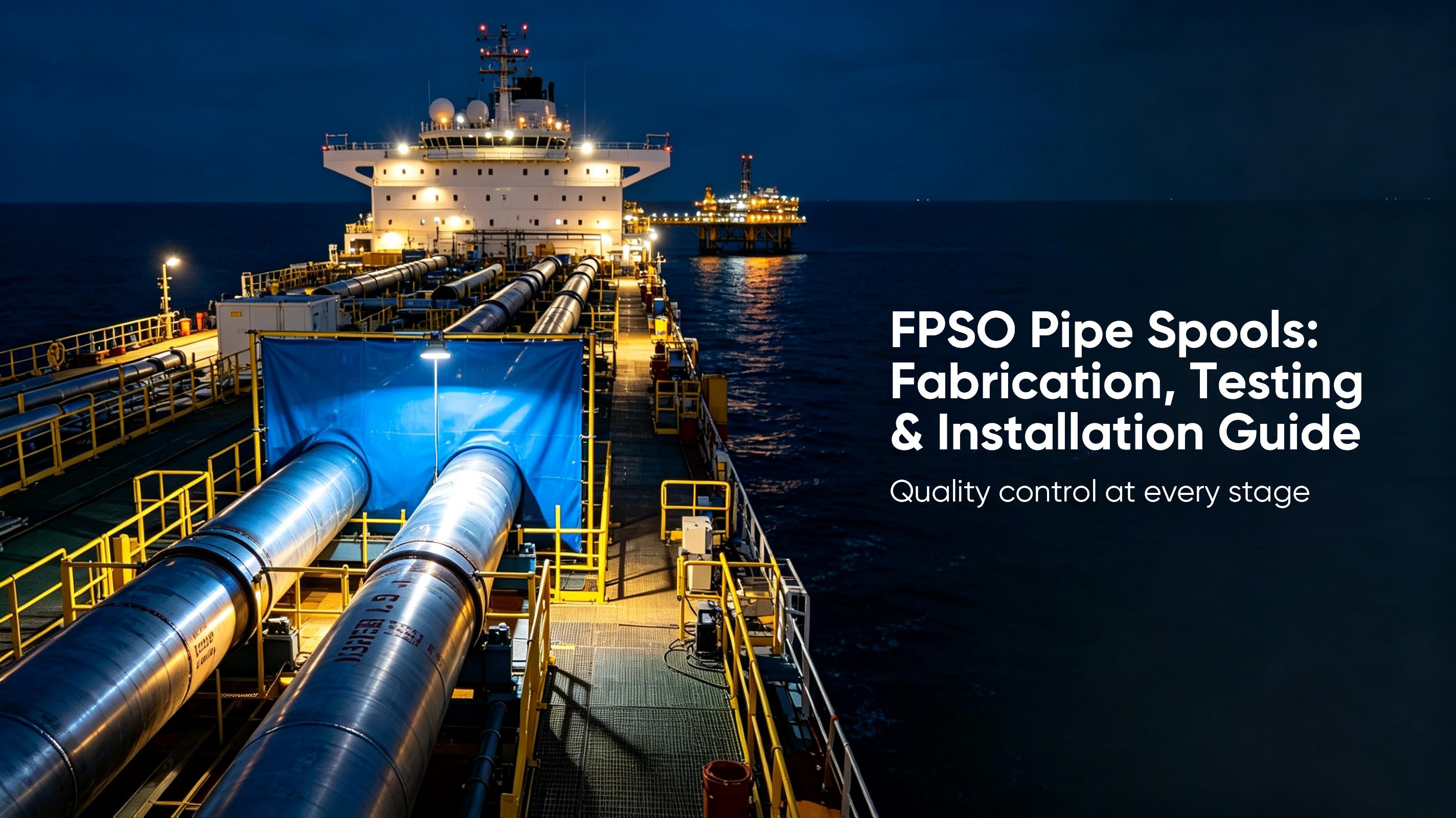
FPSOs contain extensive piping systems for crude oil processing, gas treatment, seawater, firewater, cooling water, fuel, utilities, drainage, chemicals, and other services.
A pipe spool provides a practical way to manufacture these systems in sections.
For large oil and gas projects, spool fabrication plays a crucial role in controlling production quality and coordinating construction activities. The work can be completed before the corresponding installation area is fully ready.
This approach offers several benefits.
Workshop fabrication gives welders and inspectors better access to the workpiece. Materials, welding equipment, measuring tools, and inspection equipment can be managed in a dedicated production area.
Offshore installation is more complex than workshop fabrication. Space is limited, weather can change quickly, and several construction teams may work in the same area.
Prefabricated pipe spools reduce the amount of cutting, fitting, and welding required offshore.
Multiple spools can be fabricated at the same time in different production areas. This allows fabrication to proceed while other FPSO construction activities are still underway.
Dimensional checks and inspections can be completed before transportation. Problems found in the workshop are generally easier to correct than problems discovered after installation.
Each spool can receive a unique identification number linked to its drawing, materials, weld records, inspection results, test records, and installation location.
Pipe spool design starts with the engineering model and approved piping drawings.
The design team must consider the operating conditions of the piping system as well as fabrication and installation constraints.
The spool drawing normally defines:
The drawing must match the project design specifications and approved 3D model.
FPSO piping ranges from small-bore instrument connections to large process and utility lines.
Wall thickness depends on factors such as:
Pipes and flanges must be matched according to the approved piping class.
Flange selection normally considers pressure class, material, facing type, temperature, gasket requirements, and connection design.
Incorrect flange selection can create installation problems or affect pressure integrity.
Spool break points determine where one prefabricated section ends and another begins.
A good break-point strategy should consider:
Spool sections that are too large may be difficult to transport and install. Spools that are too small can increase the number of field joints.
Material selection depends on the fluid, pressure, temperature, corrosion conditions, and project requirements.
Common materials include:
Carbon steel is widely used for many oil and gas piping services. It can provide a practical combination of strength, availability, and cost.
However, corrosion protection may be required depending on the service and environmental conditions.
Stainless steel is used where higher corrosion resistance is required.
Common applications include process lines, chemical services, utility systems, and selected seawater-related services.
Duplex stainless steel combines good mechanical strength with strong resistance to several forms of corrosion.
It may be selected for seawater and other demanding services where material performance requirements are higher.
Super duplex grades may be specified for highly corrosive marine services and other applications that require higher resistance to chloride-related corrosion.
Some FPSO services require special alloys because of high temperature, corrosive fluids, sour service, or other operating conditions.
Material selection should always follow the approved project specification rather than relying on general material preferences.
A typical spool fabrication process includes several controlled stages.
Before production begins, the fabrication team reviews the spool drawing and associated documents.
The review normally covers:
Any mismatch should be resolved before fabrication.
Materials are checked when they arrive at the fabrication facility.
Typical checks include:
Material traceability should be maintained throughout fabrication.
Pipe sections are cut according to the approved spool drawing.
Cutting may be performed using mechanical or thermal methods, depending on the material and project requirements.
The cut ends are then prepared for welding when required.
Dimensional accuracy at this stage affects later fit-up.
Pipe sections and fittings are positioned according to the spool drawing.
Fabricators check:
Incorrect fit-up can create problems during welding and installation.
Qualified welders perform the required joints using approved welding procedures.
Depending on the material and service, welding may include processes such as GTAW, SMAW, GMAW, or FCAW.
Welding records should identify the welder, procedure, material, joint, and inspection status as required by the project quality plan.
NDT methods are selected according to the piping class, weld type, material, service, and project requirements.
Common methods include:
Not every weld requires the same inspection method or inspection percentage. The approved inspection and test plan defines the applicable requirements.
The completed spool is measured against the approved drawing.
Typical checks include:
Modern fabrication facilities may use 3D measurement systems to compare the completed spool with the engineering model.
Depending on the piping service and project specification, pressure testing may be performed using hydrostatic or pneumatic methods.
Testing confirms the integrity of the completed piping assembly under the specified test conditions.
Test procedures should define:
After inspection and testing, the spool may undergo surface preparation and coating.
The coating system depends on the service and exposure conditions.
For FPSO applications, environmental conditions may include:
Coating preparation and application should follow the project coating specification.
Finished spools should be clearly identified before shipment.
Identification may include:
Open ends may need temporary protection to prevent contamination and mechanical damage during storage and transportation.
Quality control begins before fabrication and continues until installation.
A spool fabrication quality plan may cover material inspection, welding, NDT, dimensional inspection, pressure testing, coating, preservation, and documentation.
Material heat numbers should remain traceable from receipt through fabrication.
This is especially important when several similar materials are being processed at the same time.
Welding control may include:
A spool may meet welding requirements but still fail to fit during installation if its dimensions are incorrect.
Dimensional inspection therefore forms an important part of quality control.
Typical quality records can include:
These documents provide evidence that the spool meets the required specification requirements.
FPSO piping fabrication may involve several codes, standards, classification requirements, and project specifications.
The applicable requirements depend on the project, piping service, location, material, and classification society.
Common references may include:
For offshore projects, classification societies such as ABS, DNV, Lloyd's Register, and Bureau Veritas may have requirements relevant to the vessel and its systems.
The exact standard list should always come from the approved project documentation.
Testing verifies that a spool is ready for installation and service.
Visual inspection checks weld appearance, surface condition, component orientation, and visible defects.
Dimensional checks confirm that the spool matches the approved drawing and installation requirements.
NDT provides additional information about weld quality without damaging the completed spool.
Hydrostatic testing uses a liquid test medium, normally water, at a specified pressure.
The test method and acceptance criteria must follow the applicable code and project requirements.
Pneumatic testing uses compressed gas and can involve higher stored energy than hydrostatic testing. It therefore requires careful planning and safety controls.
Some systems may require additional leak testing depending on the service and project specification.
The testing method should be selected based on the piping class and engineering requirements.
After fabrication and testing, pipe spools are transported to the FPSO construction site or integration yard.
Installation typically involves:
The spool must be aligned with connected equipment and adjacent piping.
Common connection points include:
Poor alignment can place additional loads on equipment nozzles and piping connections.
A good spool design reduces unnecessary field welds.
However, some field joints are normally required because of:
Field welds should be planned early in the engineering and fabrication process.
Large FPSO projects may contain thousands of individual spools.
Real-time tracking can help project teams monitor spool status from fabrication through installation.
A digital tracking system may record:
For project managers, this information provides a clearer view of production progress.
It can also help identify delays before they affect downstream activities.
Pipe spool production is closely connected to the construction schedule.
A delay in engineering can delay material procurement. Material delays can affect fabrication. Fabrication delays can affect transportation and installation.
A coordinated spool strategy can reduce these chain reactions.
Project managers often monitor:
The goal is not simply to produce more spools. The goal is to produce the right spools at the right time and deliver them to the correct installation area.
Several issues can affect spool fabrication and installation.
A spool that does not match the drawing may require modification before installation.
Incorrect flange rotation or bolt-hole orientation can delay connection work.
Similar-looking materials can be difficult to distinguish without proper identification and traceability.
Weld defects can result in additional inspection, repair, and retesting.
A physically completed spool may still be unavailable for installation if required quality records are incomplete.
Large spools can be damaged if lifting points, supports, packaging, or transport routes are not planned correctly.
FPSO piping interfaces with structural systems, mechanical equipment, electrical systems, instrumentation, and other packages.
Changes in one system can affect adjacent spool layouts.
A coordinated 3D model helps identify interference before fabrication.
Consistent break-point rules can simplify fabrication, transportation, and installation planning.
Each component should remain linked to its documentation throughout production.
Checking dimensions and fit-up before welding can prevent larger problems later.
Digital systems can provide real-time information about spool status and outstanding work.
Fabrication should follow the installation sequence where practical.
Producing a large number of spools that cannot yet be installed can create storage and handling problems.
Late engineering changes can lead to rework.
Design changes should be reviewed for their impact on drawings, materials, fabrication, testing, and installation.
The objective of spool fabrication is not only to complete construction.
The finished piping system must continue to operate under its intended service conditions for the long term.
Long-term performance depends on:
The operating environment should also be considered. FPSOs are exposed to marine conditions, vessel motion, vibration, temperature changes, and process loads.
These factors can affect piping and support systems during operation.
FPSO piping systems serve many industrial applications.
Process piping transfers crude oil between separation, heating, treatment, storage, and export equipment.
Gas treatment systems may require piping for gas, condensate, chemicals, and associated utilities.
Produced-water piping must be selected according to fluid composition, pressure, temperature, and corrosion conditions.
Seawater can create demanding corrosion conditions. Material selection and coating requirements must reflect the intended service.
Firewater piping must meet the required flow, pressure, reliability, and inspection requirements.
Utility piping can include compressed air, nitrogen, fresh water, cooling water, steam, drains, and other services.
| Factor | Prefabricated Pipe Spools | Field-Fabricated Piping |
|---|---|---|
| Fabrication location | Workshop or fabrication yard | Installation site |
| Working environment | Controlled environment | Offshore or construction site |
| Dimensional control | Generally easier | More difficult |
| Welding access | Better | Can be restricted |
| Offshore labor | Lower | Higher |
| Transportation needs | Higher | Lower |
| Field connections | Reduced | More |
| Quality documentation | Easier to organize | More distributed |
| Installation speed | Generally faster | Depends on site conditions |
For FPSO projects, a combination of prefabricated spools and field fabrication is often used.
Before a spool is released for installation, the project team can verify:
This type of checklist helps prevent incomplete spools from reaching the installation area.
An FPSO pipe spool is a prefabricated section of piping assembled from pipes, flanges, fittings, and other components. It is manufactured and inspected before being installed as part of the FPSO piping system.
Spool fabrication is the workshop process of cutting, fitting, welding, inspecting, testing, coating, and preparing pipe sections for installation.
Prefabrication allows more work to be completed in controlled environments. It can improve dimensional control, reduce offshore welding, simplify quality control, and support faster installation.
Common materials include carbon steel, stainless steel, duplex stainless steel, super duplex stainless steel, and special alloys. The correct material depends on the fluid, pressure, temperature, corrosion conditions, and project specification.
Depending on the project, testing may include visual inspection, dimensional inspection, NDT, hydrostatic testing, pneumatic testing, and leak testing.
The applicable standards depend on the project. Common references can include ASME B31.3, ASME Section IX, ASTM standards, ISO standards, API requirements, IMO requirements, classification society rules, and owner or EPC specifications.
Pipe spools allow fabrication and inspection to take place before installation. This reduces the amount of cutting and welding required during construction and can make installation more predictable.
Early material checks, fit-up inspection, dimensional inspection, welding inspection, and testing can identify problems before the spool reaches the installation area.
A spool drawing normally includes dimensions, material information, pipe size, wall thickness, fittings, flanges, weld locations, component orientation, supports, tolerances, and relevant fabrication or testing requirements.
Project managers may track drawing release, material availability, fabrication progress, welding, NDT, testing, coating, shipment, installation, and outstanding quality issues.
Transportation depends on spool size, weight, installation location, and yard logistics. Spools may be moved using cranes, trailers, lifting frames, barges, or other approved handling equipment.
The terms can overlap. A pipe spool normally refers to a prefabricated piping section manufactured from pipe and fittings for later installation. A pipe assembly can be a broader term that includes additional components or equipment.
FPSO pipe spools connect engineering design with practical construction. A well-planned spool program covers design review, material control, fabrication, welding, inspection, testing, coating, transportation, and installation.
The best results come from controlling the process from the beginning. Accurate design information, clear specification requirements, reliable quality control, strong material traceability, and good coordination between fabrication and installation teams can reduce rework and support predictable project delivery.
For oil and gas projects, pipe spools are more than individual sections of pipe. They are building blocks of larger piping systems that must withstand pressure, temperature, vibration, vessel movement, corrosion, and changing environmental conditions throughout their service life.