

EN
Get In Touch

FPSO piping systems connect the vessel's subsea production risers, process equipment, storage tanks, utility systems, and offloading facilities. A typical system includes process piping, utility piping, produced-water lines, gas piping, seawater systems, firewater piping, drains, vents, and piping connected to skid units and modular equipment.
Material selection depends on fluid composition, pressure, temperature, corrosion conditions, fatigue loads, and project specifications. Carbon steel is widely used for many hydrocarbon and utility services, while stainless steel, duplex stainless steel, CRA-lined pipe, and other corrosion-resistant materials are selected for more demanding fluids.
Pipe spools are normally prefabricated in a controlled workshop before offshore installation. Skid units and modules allow equipment, valves, instruments, and piping to be assembled and tested as integrated packages. This approach can reduce offshore fabrication work and simplify installation on a crowded FPSO deck.
For an FPSO project, piping design must also account for vessel motion, structural movement, thermal expansion, vibration, fire safety, hazardous areas, maintenance access, and interfaces with the mooring systems and subsea pipelines.
An FPSO piping system is the network of pipes, fittings, valves, supports, instruments, and connected equipment used to collect, process, treat, transfer, store, and export fluids on a Floating Production Storage and Offloading vessel.
FPSO stands for Floating Production Storage and Offloading.
Unlike a conventional fixed offshore platform, an FPSO combines offshore production facilities with a floating storage vessel. The unit is normally connected to subsea production systems through risers and flowlines. Produced fluids are brought onboard, processed through topside facilities, and stored in the vessel before crude oil is transferred to an offtake tanker or exported through a pipeline system.
The U.S. Department of Energy describes FPSOs as ship-shaped floating vessels that house production facilities and are anchored near subsea production systems. Hydrocarbons can reach the vessel through flexible pipes, while storage and tanker offloading are integrated into the floating facility.
This arrangement makes piping one of the main interfaces between the subsea field, topside process equipment, storage tanks, utilities, and export systems.
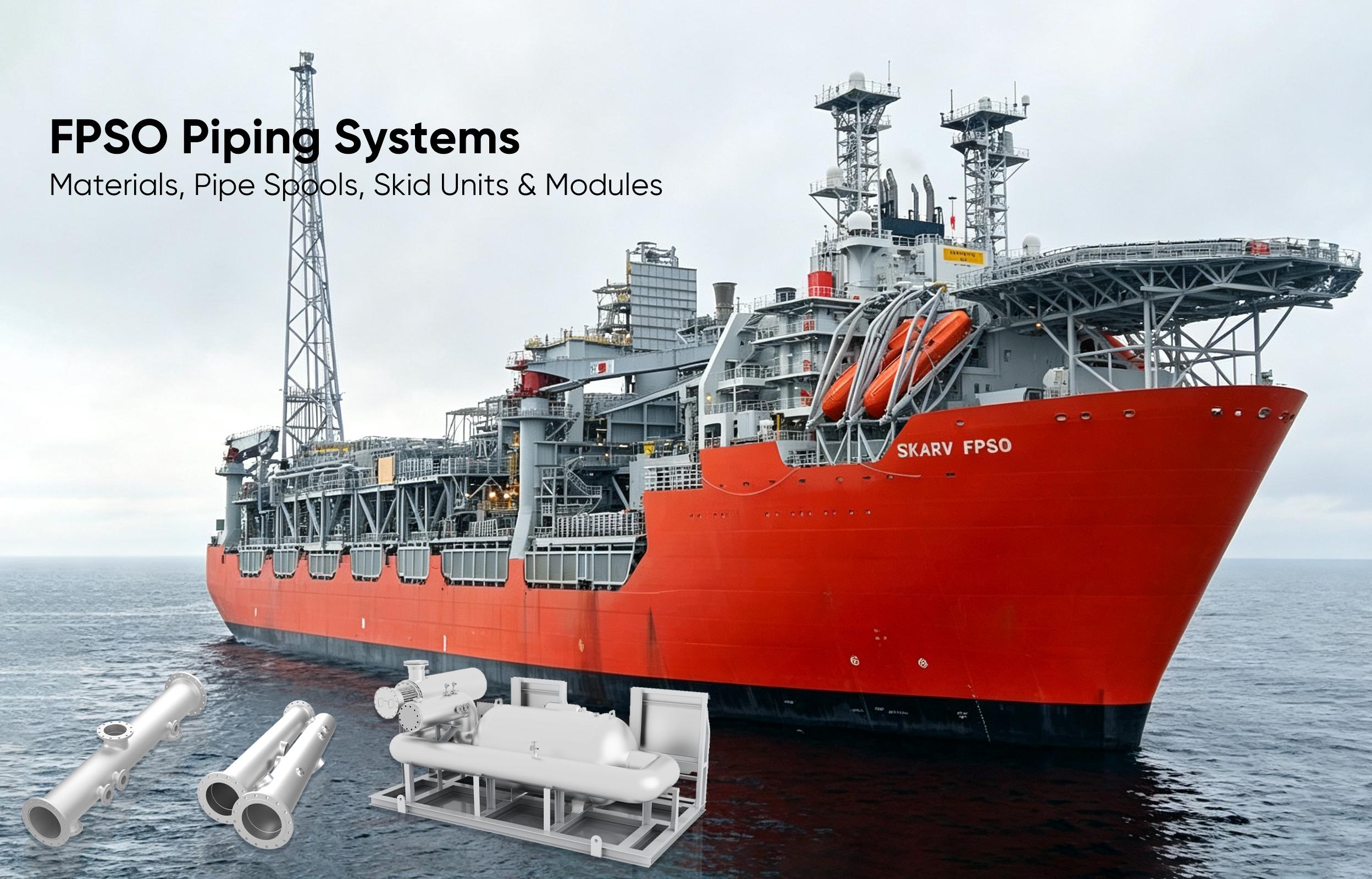
An FPSO piping system generally follows the production flow from the subsea wells to the topside process plant and then to storage or export.
A simplified process route is:
Subsea wells → subsea flowlines → risers → turret or riser interface → inlet piping → separation → gas treatment → oil treatment → storage → offloading
Different FPSO projects use different process configurations. The actual piping arrangement depends on the reservoir fluid, production rate, water cut, gas composition, field life, environmental conditions, and export strategy.
A typical FPSO piping network can include:
The system must connect these services while keeping sufficient space for inspection, operation, maintenance, and emergency response.
Production piping carries well fluids from the riser interface to the first-stage separation and processing equipment.
The fluid may contain crude oil, natural gas, produced water, sand, and other components. As a result, designers need to consider pressure drop, erosion, corrosion, slugging, temperature, and multiphase flow.
Production lines are often routed through pipe racks or dedicated process areas before reaching separators and other process equipment.
After separation and treatment, crude oil is transferred to cargo tanks.
Crude oil piping can connect:
Pipe sizing depends on flow rate, pressure loss, pump capacity, and the required transfer rate.
Gas piping transports separated gas to systems such as:
Gas services can involve high pressure and elevated temperatures. Piping design therefore needs suitable pressure ratings, materials, valves, supports, and relief protection.
Produced water is separated from the wellstream and normally sent to treatment equipment.
The piping may connect hydrocyclones, flotation units, pumps, tanks, treatment packages, and discharge systems.
Water chemistry can vary significantly between fields. Chlorides, dissolved gases, solids, and treatment chemicals can affect material selection and corrosion control.
Utility piping supports the operation of the FPSO rather than carrying the main production stream.
Common utility services include:
Although these lines are not part of the main production route, they must be coordinated closely with process piping and equipment layouts.
Material selection is based on the service conditions rather than using one material across the entire vessel.
Carbon steel is commonly considered for relatively conventional hydrocarbon and utility services where corrosion conditions can be controlled.
Advantages include:
The final selection depends on the design code, fluid properties, corrosion allowance, operating conditions, and project specifications.
Stainless steel is used where improved corrosion resistance is needed.
Common applications can include:
Different stainless-steel grades provide different levels of corrosion resistance and mechanical performance.
Duplex stainless steel combines high strength with strong resistance to many chloride-containing environments.
It may be considered for seawater, produced water, and other demanding services where conventional stainless steel may not provide the required performance.
Material selection should account for chloride concentration, temperature, oxygen conditions, weldability, and corrosion mechanisms.
Corrosion-resistant alloys can be used when the process fluid creates a demanding corrosion environment.
For large-diameter or high-cost piping, lined or clad solutions may provide a way to combine a structural carbon-steel layer with a corrosion-resistant internal surface.
DNV's submarine pipeline standard recognizes carbon-manganese steel, CRA, and lined/clad pipe as material options for subsea pipeline systems, with material selection and corrosion control forming part of the design process.
For FPSO piping, engineers normally review:
| Factor | Design consideration |
|---|---|
| Pressure | Design pressure, test pressure, pressure rating |
| Temperature | Minimum and maximum design temperatures |
| Fluid | Oil, gas, water, chemicals, multiphase fluid |
| Corrosion | Internal and external corrosion mechanisms |
| Erosion | Sand, solids, high-velocity flow |
| Fatigue | Vessel motion, vibration, pressure cycles |
| Environment | Seawater, humidity, marine atmosphere |
| Fire | Fire exposure and firewater requirements |
| Maintenance | Inspection and replacement requirements |
| Fabrication | Welding, NDT, heat treatment and testing |
| Weight | Topsides weight and structural limitations |
| Availability | Lead time and supply-chain considerations |
An FPSO pipe spool is a prefabricated section of piping manufactured to a defined dimensional drawing and later connected to other piping, equipment, valves, or modules.
A spool can contain:
Pipe spools are normally fabricated according to approved fabrication drawings and isometric drawings.
The goal is to move as much fabrication work as practical from the offshore construction site to a controlled fabrication facility.
A typical pipe spool fabrication workflow includes:
The piping model is converted into fabrication drawings showing dimensions, weld locations, materials, fittings, and connection details.
Pipes, fittings, flanges, valves, and other components are checked against material specifications and project documentation.
Pipe sections are cut to the required dimensions. Ends are prepared for welding according to the approved welding procedure.
Components are positioned and aligned before welding.
Dimensional accuracy is important because spools must connect correctly with equipment, pipe racks, skid units, and adjacent spools.
Qualified welding procedures and personnel are used according to project and applicable code requirements.
Depending on the service and specification, inspection can include:
Completed piping may undergo hydrostatic or pneumatic testing according to the applicable design code and project specification.
Piping may be flushed, blown, cleaned, dried, or otherwise prepared before installation and commissioning.
External coating, insulation, painting, tagging, and identification are completed as specified.
Finished spools are transported to the FPSO yard or offshore installation location and installed according to the construction sequence.
FPSO decks have limited working space. Offshore welding and assembly can be slow because of weather, access restrictions, simultaneous construction activities, and safety requirements.
Prefabricated pipe spools allow more work to be completed before the spool reaches the vessel.
This can provide several practical benefits:
For large FPSO projects, spool fabrication also creates a clear interface between engineering, procurement, fabrication, logistics, and installation teams.
A skid unit is a packaged equipment system installed on a structural frame.
Instead of installing each item separately, a skid can combine equipment, piping, valves, instruments, electrical components, and control systems into one package.
Typical FPSO skid units include:
A skid may be fabricated and tested at a workshop before delivery to the FPSO integration yard.
Skid piping must balance process requirements with transport and installation requirements.
Engineers need to consider:
The skid also needs clearly defined interfaces with the main FPSO piping systems.
An FPSO module is a larger integrated package that may include several equipment systems, pipe racks, structural steel, electrical systems, instrumentation, and associated piping.
Common modules can include:
Modular construction is useful because large sections of the topsides can be fabricated, outfitted, inspected, and tested away from the final installation location.
These terms describe different levels of integration.
| Item | Main purpose | Typical content |
|---|---|---|
| Pipe spool | Prefabricated piping section | Pipe, fittings, flanges, valves |
| Skid unit | Packaged process or utility system | Equipment, piping, valves, instruments, frame |
| Module | Large integrated topside package | Equipment, piping, structure, electrical and instrumentation |
| Pipe rack | Supports multiple piping systems | Structural steel and pipe supports |
| Piping system | Complete fluid-transfer network | Pipes, valves, fittings, supports and instruments |
A pipe spool is mainly a fabrication unit. A skid is a packaged functional system. A module is a larger integrated section of the FPSO topsides.
Gas treatment is an important part of many offshore oil and gas developments.
Produced gas can contain hydrocarbons, water vapor, carbon dioxide, hydrogen sulfide, and other components depending on the reservoir.
A gas treatment train may include:
Inlet separation → compression → cooling → dehydration → acid-gas treatment or removal → metering → fuel, reinjection or export
The exact arrangement varies by field requirements.
Piping around gas treatment equipment must accommodate pressure, temperature, vibration, condensate formation, corrosion, and potential high-velocity flow.
Compression systems also introduce vibration and dynamic loads. Proper support spacing, flexibility analysis, equipment nozzle assessment, and vibration control are therefore part of the piping design process.
The piping arrangement cannot be separated from the FPSO's station-keeping concept.
Mooring systems may include:
The choice of mooring arrangement affects riser routing, swivel arrangements, turret piping, vessel motions, and the interface between subsea systems and topside piping.
A turret-based FPSO, for example, can receive production fluids through risers connected to the turret and swivel system. The piping then transfers the fluids into the topside process system.
Historical FPSO designs have used both newbuild vessels and converted tankers, while mooring arrangements have included turret and spread systems.
Subsea pipelines and flowlines connect the offshore reservoir and subsea production system to the FPSO.
These systems may transport:
The interface can involve subsea trees, manifolds, flowlines, risers, flexible pipes, PLETs, PLEMs, and turret or riser systems.
Subsea pipeline design has different requirements from topside piping because the pipeline must withstand external pressure, hydrodynamic loading, seabed interaction, thermal expansion, global buckling, free spans, installation loads, and corrosion.
DNV-ST-F101 covers submarine pipeline systems across concept development, design, construction, operation, and abandonment, including material selection, corrosion control, welding, NDT, installation, and pre-commissioning.
An FPSO is not a fixed platform.
The vessel moves due to:
Piping must therefore be designed with vessel movement and structural deformation in mind.
Flexible connections, expansion arrangements, supports, and riser interfaces require careful engineering.
Process fluids can operate at temperatures far above or below ambient conditions.
Thermal expansion can generate forces and moments in piping. Engineers may use bends, offsets, loops, expansion joints where appropriate, and flexible routing to manage these effects.
Pumps, compressors, rotating equipment, pressure-reducing devices, and high-velocity gas flow can create vibration.
Piping systems connected to rotating equipment need adequate support and flexibility without transferring excessive loads to equipment nozzles.
FPSOs operate in a marine environment where external corrosion can occur on exposed piping and structures.
Internal corrosion can also occur because of:
Corrosion allowance, coatings, material selection, corrosion monitoring, insulation design, and inspection planning should be considered during design.
Topside equipment competes for limited deck space.
Every pipe, valve, support, platform, and structural member adds weight.
Piping layout therefore needs to balance:
Modern FPSO piping design commonly uses 3D plant modeling.
A coordinated model can include:
3D modeling helps engineering teams identify clashes before fabrication.
This becomes particularly useful during FPSO conversion projects, where existing vessel structures can limit available space.
A redeployment or conversion project can also require new piping to connect new process equipment to existing systems. Industry examples show how existing FPSOs and tankers can require integration piping, new equipment foundations, gas compression, and modified mooring or offloading systems.
A newbuild FPSO allows the hull, topsides, piping, and equipment arrangement to be developed as an integrated design.
Potential advantages include:
An existing tanker can provide an established hull and storage capacity.
However, conversion introduces additional engineering considerations.
These may include:
Existing tanker conversions have been used for FPSO projects, and technical assessments must consider that an FPSO experiences long-term offshore environmental loading that differs from normal tanker service.
The exact codes and standards for an FPSO project depend on the flag state, classification society, location, contract requirements, and applicable regulations.
Depending on the system, engineers may need to consider:
DNV maintains rules and standards covering ship and offshore units, and its Rules and Standards Explorer provides access to a large body of classification rules, standards, and recommended practices.
For subsea pipelines, DNV-ST-F101 provides a specific framework covering structural assessment, materials, corrosion control, fabrication, welding, NDT, installation, operation, and abandonment.
The applicable standard should always be confirmed against the project design basis rather than selected only because it is commonly used in the industry.
Quality control starts before fabrication.
A project may establish inspection and test plans covering:
For high-integrity piping systems, documentation is as important as physical inspection.
Typical records may include:
When selecting a pipe spool fabrication partner for FPSO projects, buyers should review more than production capacity.
Important areas include:
Can the supplier work from piping isometrics, 3D models, fabrication drawings, and project specifications?
Can every pipe and fitting be traced from receiving through fabrication and final inspection?
Check welding procedures, qualified personnel, NDT capability, and experience with the specified materials.
Spools must match equipment and field interfaces. Dimensional errors can cause delays during installation.
A strong fabrication system should provide a complete manufacturing record book or equivalent project dossier.
FPSO piping has different demands from standard onshore industrial piping. Experience with marine environments, modular construction, and offshore installation can reduce interface problems.
Several practices can improve project execution.
Use consistent drawing standards, weld numbering, material coding, and spool identification.
Move repetitive welding and assembly work into controlled workshop conditions where practical.
Integrate equipment, piping, instrumentation, and structural frames into skid units or modules when the project layout allows.
Tie-in points between new modules and existing piping should be defined early.
Piping, structural, equipment, electrical, and instrumentation teams should work from a coordinated model.
Spool weight affects lifting, transport, installation, and structural loading.
Spool fabrication should follow the offshore installation sequence rather than simply the order in which drawings are released.
Before fabrication or procurement, project teams can review:
FPSO projects continue to support offshore oil and gas developments where a floating production facility offers practical advantages over a fixed platform and separate export infrastructure.
At the same time, FPSO designs are becoming more integrated.
Gas treatment, gas compression, water treatment, subsea tiebacks, produced-water systems, energy systems, and modular topsides all create new piping interfaces.
The trend toward larger modules and greater prefabrication also increases the importance of accurate pipe spool fabrication, dimensional control, material traceability, and interface management.
For complex FPSO projects, the best piping solution is not simply the shortest pipe route. It is a system that can be fabricated, transported, installed, inspected, operated, maintained, and modified over the expected service life.
An FPSO piping system is the network of pipes, fittings, valves, supports, and connected equipment used to transport and process oil, gas, water, and utility fluids on a Floating Production Storage and Offloading vessel.
Common materials include carbon steel, stainless steel, duplex stainless steel, and corrosion-resistant alloys. Lined or clad pipe can also be used for selected demanding services. The correct material depends on fluid composition, pressure, temperature, corrosion, erosion, and project specifications.
An FPSO pipe spool is a prefabricated section of piping containing components such as straight pipe, elbows, tees, reducers, flanges, valves, and branch connections. It is fabricated before installation and connected with other spools or equipment during FPSO construction.
A pipe spool is primarily a prefabricated piping assembly. A skid unit is a packaged functional system that can contain equipment, piping, valves, instruments, controls, and a structural frame.
FPSO modules are large integrated sections of topside equipment and infrastructure. A module may include process equipment, piping, structural steel, electrical systems, instrumentation, platforms, and access systems.
Pipe spools allow much of the piping fabrication to be completed in a controlled workshop before installation. This can reduce offshore welding, improve dimensional control, simplify inspection, and support a more predictable construction sequence.
An existing tanker can be converted by assessing and modifying the hull, storage tanks, structural areas, process facilities, piping, utilities, mooring system, riser interfaces, offloading system, and other facilities required for long-term offshore production.
Subsea production flowlines and pipelines connect subsea wells or manifolds to risers. The risers then connect to the FPSO through a turret, swivel, or another riser interface. Topside piping carries the production fluids from this interface to process equipment.
Gas treatment is the processing of produced gas to remove water, unwanted components, liquids, or other contaminants and to prepare the gas for fuel use, reinjection, export, or other designated services.
Applicable requirements depend on the project, classification society, flag state, location, piping service, and contract. Project teams may need to use classification rules together with relevant ASME, API, ISO, IEC, and project-specific requirements.
A qualified supplier should be able to provide appropriate fabrication capability, material traceability, qualified welding procedures, NDT, dimensional inspection, pressure testing, coating or preservation, and complete quality documentation.
FPSO piping systems form the physical network between subsea production, offshore processing, storage, utilities, and export operations. Their design must account for the unusual combination of process requirements and floating-vessel conditions.
The selection of piping materials, pipe spools, skid units, and modules should therefore be made as part of the overall FPSO engineering strategy.
For offshore oil and gas operators, EPC contractors, shipyards, and equipment suppliers, early coordination between piping engineering, process design, structural engineering, procurement, fabrication, and installation teams can reduce interface problems later in the project.
A well-planned piping system is easier to fabricate, easier to install, easier to inspect, and easier to maintain throughout the FPSO's operating life.