

EN
Get In Touch

Super duplex stainless steel pipe is a higher-alloy version of duplex stainless steel pipe. Both combine austenitic and ferritic phases, giving them higher strength and better corrosion resistance than many conventional austenitic stainless steels and ferritic stainless steels.
The main difference is alloy content and corrosion performance. Super duplex stainless steels contain higher levels of chromium, molybdenum, and nitrogen than standard duplex grades. This gives super duplex steel better chloride resistance, higher resistance to pitting and crevice corrosion, and stronger resistance to stress corrosion cracking.
For general applications, standard duplex stainless steel pipe can provide a good balance of cost, mechanical strength, and corrosion resistance. For demanding marine, offshore, and oil and gas environments with high chloride exposure, higher pressure, or severe corrosion conditions, super duplex pipes are often selected.
| Feature | Duplex Stainless Steel Pipe | Super Duplex Stainless Steel Pipe |
|---|---|---|
| Metallurgical structure | Ferritic and austenitic | Ferritic and austenitic |
| Strength | High | Very high |
| Corrosion resistance | High | Very high |
| Chloride resistance | Good to high | Excellent |
| Stress corrosion cracking resistance | High | Very high |
| Pitting resistance | High | Higher |
| Typical applications | Chemical processing, water systems, heat exchangers, oil and gas | Offshore, marine, seawater, oil and gas, pressure vessels |
| Relative cost | Lower | Higher |
| Best suited for | General demanding environments | Severe chloride and corrosion environments |
Duplex stainless steel pipe is a stainless steel pipe with a two-phase microstructure made up of approximately ferritic and austenitic phases. This structure gives duplex stainless steel a combination of the mechanical strength of ferritic stainless steels and the corrosion resistance and toughness associated with austenitic stainless steels.
Compared with many standard austenitic grades, duplex stainless steel offers higher yield strength and good resistance to chloride-induced corrosion and stress corrosion cracking.
Super duplex stainless steel pipe is a higher-alloy duplex stainless steel pipe designed for more aggressive service conditions. It normally contains higher chromium, molybdenum, and nitrogen levels than standard duplex grades.
This alloy design provides high corrosion resistance, strong chloride resistance, and high mechanical strength. Super duplex steel is widely used where conventional stainless steel or standard duplex grades may not provide enough corrosion performance.
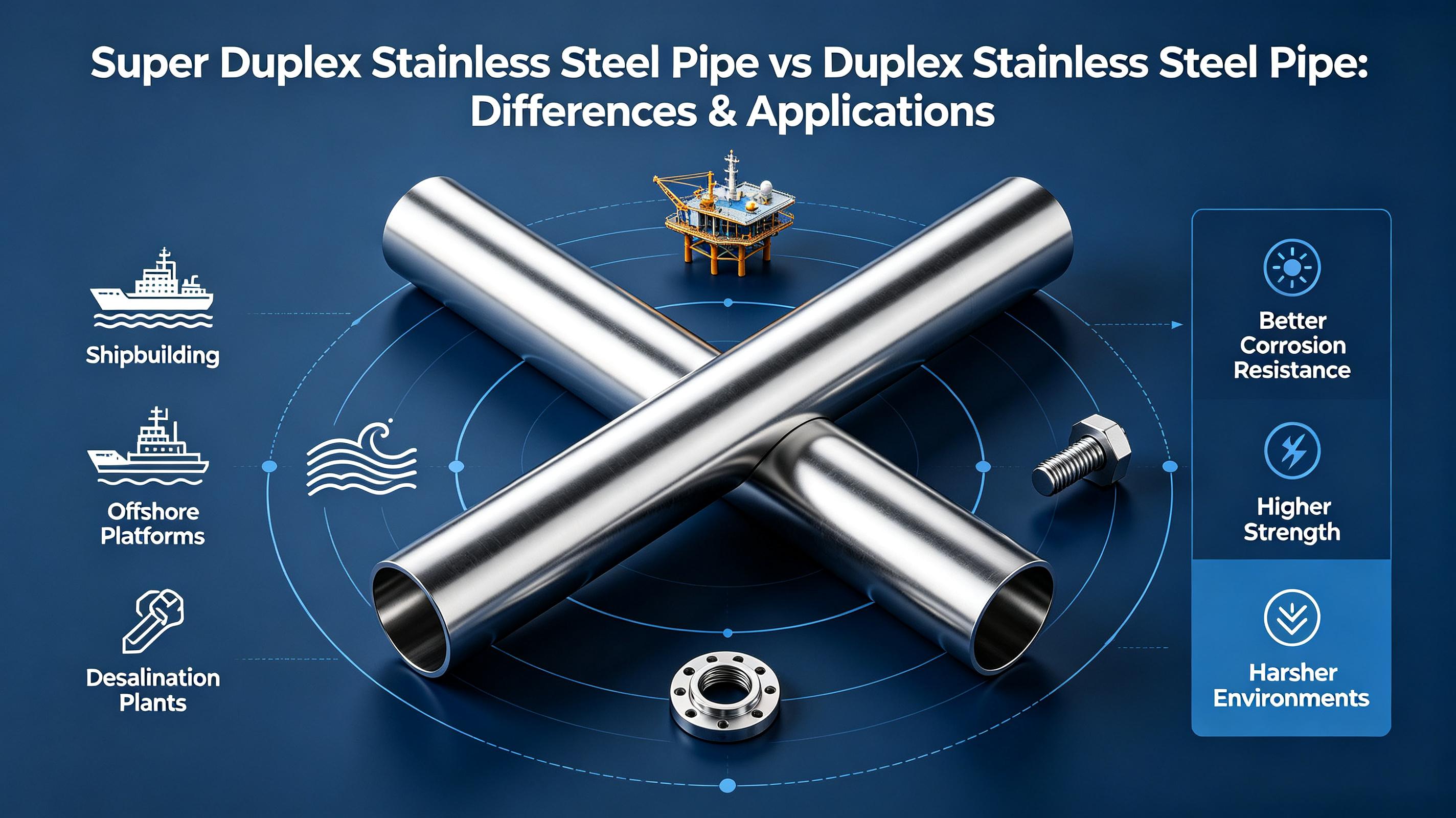
The difference between duplex and super duplex stainless steel mainly comes from alloy composition, corrosion resistance, strength, and the severity of the intended service environment.
Standard duplex stainless steel commonly contains around 21–23% chromium, with controlled additions of nickel, molybdenum, nitrogen, and other alloying elements depending on the grade.
Super duplex grades generally contain higher chromium and molybdenum levels and are designed to provide greater resistance to localized corrosion.
A typical comparison is:
| Alloy family | Typical chromium level | Typical molybdenum level | General performance |
|---|---|---|---|
| Standard duplex | About 21–23% | Usually lower | High strength and corrosion resistance |
| Super duplex | About 24–26% | Usually higher | Very high corrosion resistance and strength |
The exact composition depends on the specific grade and applicable standard.
Both duplex and super duplex stainless steels provide high strength.
Duplex stainless steel can have substantially higher yield strength than common austenitic stainless steels such as 304 and 316. This can allow engineers to reduce wall thickness in some piping applications while maintaining the required pressure rating.
Super duplex stainless steels generally provide even higher strength and corrosion performance.
However, pipe wall thickness should always be selected according to the applicable design code, pressure, temperature, corrosion allowance, fabrication method, and service conditions.
Chloride exposure is one of the main reasons engineers choose duplex and super duplex materials.
Chloride ions can contribute to pitting corrosion, crevice corrosion, and stress corrosion cracking in stainless steel. The higher chromium, molybdenum, and nitrogen content of super duplex grades improves their resistance to these forms of corrosion.
This makes super duplex stainless steel particularly useful in seawater and offshore environments.
One major advantage of duplex metallurgy is its strong resistance to stress corrosion cracking compared with many conventional austenitic stainless steels.
Stress corrosion cracking can occur when a susceptible material is exposed to a combination of tensile stress and a corrosive environment.
Duplex and super duplex grades are therefore frequently considered for systems exposed to chlorides, elevated temperatures, and high mechanical loads.
Super duplex normally provides a higher level of resistance for more aggressive environments.
Both material families provide high corrosion resistance, but super duplex is intended for more demanding environments.
A useful way to compare the two is through their pitting resistance.
The Pitting Resistance Equivalent Number, commonly known as PREN, is often used as a material comparison indicator. A simplified formula for many duplex stainless steels is:
PREN = %Cr + 3.3 × %Mo + 16 × %N
Higher PREN values generally indicate greater resistance to localized corrosion.
The formula is useful for comparing alloys, but it should not be used as the only basis for material selection. Actual performance depends on temperature, chloride concentration, pH, flow conditions, welding, surface condition, fabrication quality, and other factors.
Super duplex grades generally have a higher PREN than standard duplex grades.
The name "duplex" refers to the two-phase structure.
The material contains both:
The ferritic phase contributes to high strength and resistance to stress corrosion cracking.
The austenitic phase contributes to toughness, ductility, and corrosion resistance.
A suitable balance between the ferritic and austenitic phases is important. Poor heat treatment or incorrect welding procedures can disturb this balance and reduce material performance.
This is why solution annealing, controlled welding procedures, and appropriate post-weld inspection are important when manufacturing duplex and super duplex pipe systems.
Standard duplex stainless steel pipe is used across industries where engineers need a combination of strength, corrosion resistance, and reasonable material cost.
Duplex stainless steel pipe is widely used in oil and gas facilities.
Applications can include:
Duplex grades can be useful where carbon steel does not provide sufficient corrosion resistance and conventional austenitic stainless steel does not provide the required strength or chloride resistance.
Duplex stainless steel is also used in heat exchangers.
Its high strength and corrosion resistance can be useful in systems exposed to water, chlorides, process fluids, and elevated temperatures.
The exact grade should be selected according to the heat exchanger fluid, temperature, pressure, chloride level, and heat transfer requirements.
Duplex stainless steel can be used in certain pressure vessels where its high strength and corrosion resistance offer advantages over conventional materials.
Higher strength can help reduce required wall thickness in some designs. However, pressure vessel applications must comply with the applicable construction code and material requirements.
Duplex grades are suitable for many chemical processing systems where corrosion resistance and mechanical strength are required.
Typical applications include process piping, storage systems, pumps, tanks, and related equipment.
Super duplex stainless steel pipe is often selected when service conditions are more severe.
Offshore facilities are exposed to seawater, salt spray, high humidity, pressure, and demanding operating conditions.
Super duplex pipes can be used in:
Its combination of high strength and corrosion resistance makes super duplex steel attractive for offshore piping where weight, reliability, and corrosion control are important.
The marine industry uses duplex and super duplex stainless steels in systems exposed to seawater and chloride-containing fluids.
Super duplex pipes can be found in:
For seawater service, material selection should consider temperature, oxygen content, flow velocity, crevice conditions, biofouling, and welding quality.
Super duplex stainless steel is widely considered for demanding oil and gas applications.
Typical uses include:
Where chlorides and high pressure occur together, the combination of high strength and high corrosion resistance can make super duplex a practical material option.
Seawater contains a high concentration of chloride ions, which can increase the risk of localized corrosion.
Super duplex pipes offer strong chloride resistance because of their alloy chemistry.
However, super duplex is not automatically suitable for every seawater system. Factors such as stagnant water, deposits, crevices, temperature, oxygen concentration, and weld condition can affect corrosion behavior.
For this reason, seawater piping should be designed as a complete system rather than selecting a material based only on its PREN value.
Both duplex and super duplex materials offer high strength.
This makes them attractive for high-pressure piping systems where material strength affects pipe wall thickness and overall system weight.
Super duplex can be particularly useful when high pressure is combined with:
The final pipe specification must still be based on the applicable pressure design standard.
Duplex and super duplex stainless steels can operate in demanding temperature conditions, but they should not be treated as unlimited high-temperature materials.
At elevated temperatures, phase stability, embrittlement mechanisms, corrosion behavior, and mechanical properties need to be considered.
Long exposure within certain intermediate temperature ranges can cause undesirable changes in the ferritic phase of duplex alloys. Therefore, temperature limits and allowable service conditions should come from the applicable material specification, design code, and engineering assessment.
For high temperature applications, engineers should evaluate:
Duplex and super duplex stainless steels are often compared with austenitic stainless steels because all three are widely used in corrosion-resistant piping.
| Property | Austenitic Stainless Steel | Standard Duplex | Super Duplex |
|---|---|---|---|
| Microstructure | Mainly austenitic | Ferritic + austenitic | Ferritic + austenitic |
| Mechanical strength | Moderate to high | High | Very high |
| Chloride resistance | Grade dependent | High | Very high |
| Stress corrosion cracking resistance | Grade dependent | High | Very high |
| Pitting resistance | Grade dependent | High | Very high |
| Nickel content | Often higher | Generally moderate | Generally moderate |
| Material cost | Grade dependent | Often competitive | Higher |
| Typical service | General corrosion-resistant applications | Demanding industrial service | Severe chloride and offshore service |
This does not mean super duplex is always a better choice.
If the operating environment does not require its higher corrosion performance, standard duplex may offer a more cost-effective solution.
Both duplex and ferritic stainless steels contain a significant ferritic phase, but duplex stainless steel also contains a controlled austenitic phase.
This two-phase structure gives duplex steel a balance of strength, toughness, ductility, and corrosion resistance.
Compared with many ferritic stainless steels, duplex grades can provide better overall mechanical and corrosion performance for demanding piping applications.
Super duplex may be preferred when the application requires a higher level of corrosion resistance or mechanical performance.
Common reasons include:
The decision should be based on actual service conditions rather than the material name alone.
Standard duplex can be the better option when the application requires high strength and corrosion resistance but does not need the additional alloy content of super duplex.
It can provide a useful balance between:
For many industrial piping systems, duplex stainless steel offers enough performance without the additional cost of super duplex.
Super duplex stainless steel usually costs more than standard duplex because of its higher alloy content and more demanding manufacturing and fabrication requirements.
However, material price is only one part of total system cost.
A higher-strength alloy may allow thinner pipe walls in some designs. Better corrosion resistance may also reduce maintenance or replacement requirements.
A proper cost comparison should consider:
The lowest purchase price is not always the lowest lifecycle cost.
Welding requires careful control for both duplex and super duplex materials.
The welding process must maintain an appropriate balance between the ferritic and austenitic phases. Excessive heat input, unsuitable filler metal, or incorrect heat treatment can affect corrosion resistance and mechanical properties.
Important welding controls may include:
For super duplex pipe, fabrication quality is especially important because the material is often used in severe service environments.
Common duplex and super duplex grades include:
UNS S32205 / 2205 is one of the most widely used standard duplex grades.
The exact requirements depend on the relevant ASTM, ASME, EN, ISO, or project specification.
When purchasing duplex or super duplex pipes, buyers should confirm the material grade, product standard, dimensions, manufacturing method, heat treatment, testing requirements, and certification requirements.
Both seamless and welded pipe can be manufactured from duplex and super duplex stainless steels.
Seamless pipe is produced without a longitudinal welded seam and may be selected for certain high-pressure or demanding services.
Welded pipe is manufactured from plate or strip and formed and welded into pipe. It can offer advantages for large diameters and specific dimensional requirements.
The best choice depends on:
Neither manufacturing method is automatically superior for every application.
A practical material selection process should start with the operating environment.
Identify whether the pipe will carry:
Determine chloride concentration and whether the system has stagnant areas, deposits, or crevices.
High chloride exposure generally increases the value of a higher-alloy material.
Temperature affects corrosion behavior and material properties.
The design temperature should be reviewed together with pressure and chemical composition.
Review design pressure, operating pressure, external loads, vibration, thermal expansion, and other mechanical conditions.
The high strength of duplex and super duplex grades can be useful where mechanical loads are high.
If standard duplex provides sufficient corrosion resistance, it may be the more economical choice.
If the service involves severe chloride exposure or demanding offshore conditions, super duplex may provide a larger performance margin.
Material selection should also consider welding, heat treatment, forming, inspection, and availability of qualified fabricators.
The main benefits can be summarized as follows:
Duplex and super duplex materials offer higher strength than many conventional austenitic stainless steels.
Both provide strong resistance to many forms of corrosion.
Their alloy chemistry makes them suitable for many chloride-containing environments.
The duplex microstructure provides strong resistance to chloride-related stress corrosion cracking compared with many conventional austenitic grades.
High yield strength can allow reduced wall thickness in some engineered applications.
Good corrosion resistance and mechanical performance can support long service life when the alloy is correctly selected and fabricated.
Super duplex provides higher corrosion resistance and generally higher strength than standard duplex. However, it is not always the better choice. Standard duplex may be more cost-effective when its corrosion and strength performance is sufficient for the service conditions.
The main difference is alloy composition. Super duplex grades generally contain higher chromium, molybdenum, and nitrogen levels. This improves pitting resistance, chloride resistance, and resistance to stress corrosion cracking.
Yes. Super duplex stainless steel is widely considered for seawater applications because of its high chloride resistance and resistance to localized corrosion. The system still needs proper design, fabrication, and surface control.
Yes. Duplex stainless steel is widely used in oil and gas piping and equipment. Applications can include process piping, produced water systems, injection systems, and offshore facilities.
Offshore systems often face seawater, chlorides, pressure, mechanical loads, and demanding operating conditions. Super duplex combines high strength with high corrosion resistance, making it suitable for many offshore piping applications.
Generally, yes. Super duplex grades are designed to provide very high mechanical strength along with higher corrosion resistance. Actual mechanical properties depend on the specific grade, product form, heat treatment, and applicable standard.
Both duplex and super duplex have strong resistance to stress corrosion cracking compared with many conventional austenitic stainless steels. Super duplex generally provides higher resistance because of its higher alloy content and higher pitting resistance.
Yes. Selected duplex grades can be used for pressure vessels when permitted by the applicable pressure vessel code and material specification. Design pressure, temperature, corrosion conditions, fabrication, and inspection requirements must all be considered.
Common super duplex grades include UNS S32750 and UNS S32760. 2507 is a widely recognized super duplex stainless steel grade.
UNS S31803 and UNS S32205 are common duplex grades. 2205 is one of the most widely used duplex stainless steel grades.
They can be used in selected elevated-temperature applications, but temperature limits must be checked carefully. Long exposure to certain temperature ranges can affect the microstructure and toughness of duplex alloys.
Usually, yes. Super duplex contains higher levels of alloying elements and may require more demanding manufacturing and fabrication controls. The additional cost can be justified when the service environment requires higher corrosion resistance or strength.
The choice between duplex and super duplex stainless steel pipe should be based on the actual service environment.
Choose duplex stainless steel pipe when the project needs high strength, good corrosion resistance, chloride resistance, and resistance to stress corrosion cracking at a reasonable material cost.
Choose super duplex stainless steel pipe when the application involves more severe chloride exposure, seawater, offshore conditions, high corrosion risk, or demanding mechanical requirements.
In simple terms:
Duplex = high strength + high corrosion resistance + cost-effective performance
Super duplex = higher strength + higher chloride resistance + higher corrosion resistance for more severe service
For marine, offshore, oil and gas, heat exchangers, pressure vessels, and other demanding applications, the final selection should consider the complete combination of pressure, temperature, fluid chemistry, chloride concentration, mechanical loads, welding method, applicable standards, and expected service life.