

EN
Get In Touch

Heavy-wall high-pressure super duplex stainless steel pipes are designed for demanding services where high pressure, corrosion resistance, strength, and long service life are required. Their dual microstructure of austenitic and ferritic phases provides a useful combination of high yield strength, excellent resistance to chloride corrosion and stress corrosion cracking, and strong pitting resistance.
Compared with standard duplex grades, super duplex stainless steels generally offer higher alloy content and improved corrosion performance. This makes super duplex pipes suitable for oil and gas, offshore engineering, chemical processing, heat exchangers, pressure vessels, pulp and paper, and other process systems.
For high-pressure service, pipe wall thickness must be selected from design pressure, design temperature, material strength, corrosion allowance, fabrication method, and applicable piping or pressure-vessel codes. Heavy-wall construction can provide the required pressure capacity while maintaining the corrosion performance expected from duplex and super duplex materials.
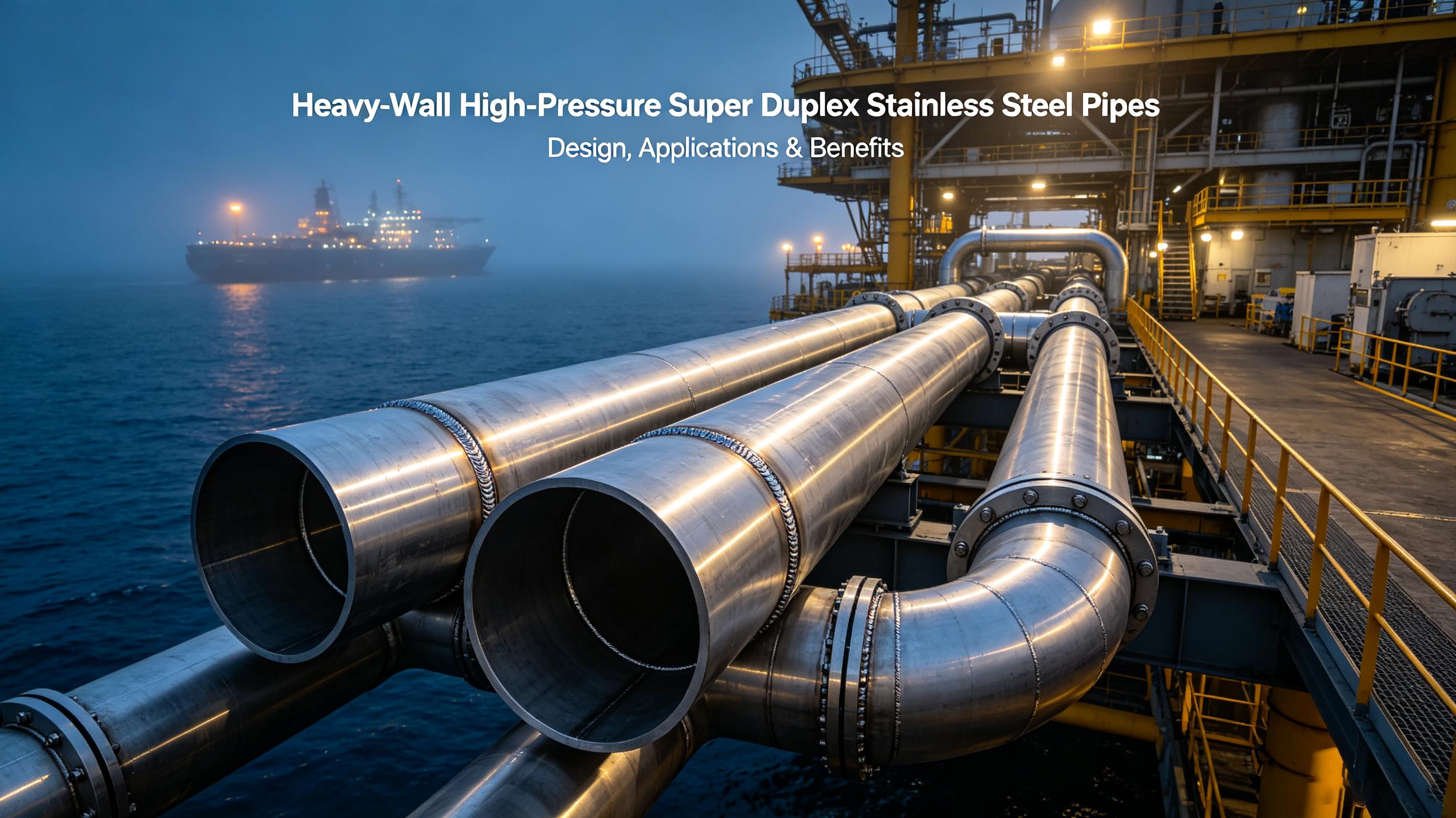
Heavy-wall high-pressure super duplex stainless steel pipes are thick-wall pipes manufactured from super duplex stainless steels for applications involving high internal pressure, corrosive media, or both.
"Heavy-wall" refers to a pipe with a relatively large wall thickness compared with its outside diameter. The exact wall thickness is not defined by one universal value. It depends on pipe size, pressure rating, design code, temperature, material grade, and application.
"Super duplex" refers to a family of duplex stainless steels with a microstructure containing both austenitic and ferritic phases. Typical grades include UNS S32750 and UNS S32760. These alloys have higher chromium, molybdenum, and nitrogen levels than many standard duplex grades.
The result is a material family that combines high mechanical strength with excellent corrosion resistance.
High-pressure piping often has to withstand mechanical loads while operating in environments containing chlorides, seawater, acids, hydrocarbons, or other aggressive chemicals. Material selection therefore affects both pressure performance and service life.
Super duplex stainless steels are attractive because they offer several properties in one material.
Super duplex grades have high yield strength compared with many conventional austenitic stainless steels. This allows engineers to achieve the required pressure capacity with a relatively efficient material section.
For a high-pressure pipe, yield strength is only one part of the design. Engineers also need to consider tensile strength, allowable stress, temperature effects, fatigue, external loads, welding, and the requirements of the applicable design code.
One of the main advantages of duplex and super duplex stainless steels is their resistance to stress corrosion cracking in many chloride-containing environments.
This is especially useful in offshore and oil and gas systems where seawater, chlorides, pressure, temperature, and mechanical stress can occur together.
Super duplex alloys should not, however, be treated as immune to corrosion. Actual performance depends on alloy grade, temperature, chloride concentration, fabrication quality, heat treatment, surface condition, and operating conditions.
Pitting corrosion can be a major concern in chloride-rich environments. Super duplex stainless steels contain relatively high levels of chromium and molybdenum, with nitrogen also contributing to corrosion performance.
This gives many super duplex grades excellent resistance to localized corrosion, including pitting and crevice corrosion.
The Pitting Resistance Equivalent Number, or PREN, is often used as an alloy comparison indicator. It is useful during preliminary material selection, but actual service performance should also be evaluated against the specific operating environment.
Heavy-wall construction is not simply a matter of choosing the thickest available pipe. The wall thickness should be calculated according to the design conditions and applicable standards.
Internal pressure creates hoop stress and longitudinal stress in the pipe wall. As design pressure increases, the required wall thickness generally increases.
A typical engineering workflow includes:
The actual calculation should be completed using the governing design code rather than a simple pressure-to-thickness rule.
Temperature affects material strength and corrosion behavior. A pipe suitable for high pressure at moderate temperature may require a different design at elevated temperature.
For this reason, pressure and temperature should always be considered together.
Super duplex stainless steels provide strong corrosion resistance, but corrosion allowance may still be required depending on the project specification and service environment.
Engineers should consider:
For some services, the corrosion resistance of the selected alloy may reduce the need for a large corrosion allowance. The decision should be based on engineering assessment rather than material name alone.
Both standard duplex and super duplex stainless steels contain ferritic and austenitic phases. The main difference is alloy chemistry and resulting performance.
| Property | Standard Duplex | Super Duplex |
|---|---|---|
| Strength | High | Very high |
| Corrosion resistance | Excellent | Higher in many aggressive environments |
| Pitting resistance | High | Very high |
| Chloride resistance | Good to excellent | Excellent |
| Stress corrosion cracking resistance | Excellent | Excellent |
| Typical service | Process piping, water systems, general chemical service | Offshore, seawater, oil and gas, high-demand process systems |
| Material cost | Generally lower | Generally higher |
| Design efficiency | High | Very high |
Super duplex materials usually cost more than standard duplex. However, the higher strength and corrosion resistance can make them a cost effective option when the full lifecycle of the piping system is considered.
The oil and gas industry uses high-pressure piping in production, processing, transportation, and offshore systems.
Super duplex pipes can be used in services such as:
In offshore environments, material selection must account for both pressure and corrosion. Seawater exposure and chloride-containing process fluids can increase the risk of localized corrosion.
Super duplex stainless steels provide a combination of high strength and corrosion resistance that suits many of these services.
Heat exchangers can expose materials to hot fluids, pressure differences, chlorides, and chemical contaminants.
Super duplex stainless steels may be selected for:
The material must be selected according to both sides of the heat exchanger. A material that performs well against one process fluid may not provide the same performance against another.
Chemical processing systems can involve corrosive fluids, elevated temperatures, pressure, and complex chemical mixtures.
Super duplex pipes can be considered for services involving:
The exact alloy should be matched to the chemical composition and operating conditions. Super duplex is not a universal replacement for every stainless steel or nickel alloy.
Pulp and paper plants contain several wet and chemically aggressive process areas. Stainless steel piping may be exposed to chlorides, process chemicals, elevated temperatures, and abrasive fluids.
Super duplex stainless steels can be considered for selected applications where high mechanical strength and corrosion resistance are needed.
Potential applications include:
Material selection should be based on the specific chemical environment rather than industry category alone.
Pressure vessels and associated piping must withstand internal pressure, temperature, cyclic loading, and corrosion.
Super duplex stainless steels can be used in selected pressure-vessel and process-equipment applications because of their high strength and corrosion resistance.
However, pressure vessels are subject to specific design and manufacturing requirements. The material grade, plate or pipe product form, welding procedure, heat treatment, inspection, and testing must comply with the applicable pressure-vessel standard and project specification.
Super duplex stainless steel pipes are available in both seamless and welded forms.
Seamless pipes are manufactured without a longitudinal weld seam. They are often considered for high-pressure applications where the project specification calls for seamless construction.
Advantages can include:
The final selection should still be based on the applicable standard, dimensions, pressure requirements, and inspection requirements.
Welded pipes are produced by forming and welding stainless steel plate or strip.
Advantages include:
Welding quality is particularly important for duplex and super duplex stainless steels. Incorrect heat input or inadequate post-weld control can affect the phase balance and corrosion performance of the weld area.
Duplex and super duplex materials require controlled fabrication practices.
The final microstructure should maintain an appropriate balance between the austenitic and ferritic phases. Excessive ferrite or excessive austenite can affect mechanical and corrosion properties.
Important fabrication controls may include:
The exact requirements depend on the grade, product standard, welding process, and project specification.
Solution annealed stainless steel has been heat treated at a suitable temperature and then cooled under controlled conditions to obtain the required metallurgical structure and properties.
For super duplex stainless steels, solution annealing helps restore the desired duplex microstructure after hot working or other manufacturing operations.
The temperature and cooling rate must be controlled. Poor heat treatment can lead to unwanted intermetallic phases, which may reduce toughness and corrosion resistance.
For heavy-wall products, heat treatment control is especially important because the thick section can affect heating and cooling behavior.
High-pressure piping projects often require extensive inspection and testing.
Depending on the application, testing may include:
Chemical composition is checked to confirm that the material meets the specified grade.
Testing can include:
For selected super duplex grades and applications, corrosion testing may be required to verify resistance under specified conditions.
Potential methods include:
Finished pipes or piping assemblies may undergo hydrostatic testing or other pressure tests according to the applicable standard and project requirements.
Super duplex stainless steels offer high yield strength, which supports demanding pressure applications.
They provide excellent resistance to many chloride-containing and corrosive environments.
Their duplex structure gives them strong resistance to chloride stress corrosion cracking compared with many conventional austenitic stainless steels.
High chromium, molybdenum, and nitrogen content supports strong resistance to localized corrosion.
Although super duplex material can have a higher initial purchase price, longer service life, reduced maintenance, and lower replacement frequency can make it a cost effective solution.
Because of their high strength, super duplex stainless steels may allow engineers to achieve required pressure ratings with less material than lower-strength alloys in some designs. The actual wall thickness must always be calculated according to the applicable code.
Super duplex pipes are well suited to demanding applications where pressure and corrosion occur together.
A good specification should define more than just "super duplex pipe."
Consider the following factors:
Common grades include UNS S32750 and UNS S32760. The correct grade depends on corrosion conditions, mechanical requirements, temperature, and project specifications.
Specify:
Choose between seamless and welded construction based on the pressure rating, diameter, standard, availability, and project requirements.
Confirm whether the pipe must be supplied solution annealed and identify the required heat-treatment condition.
Define the required chemical, mechanical, dimensional, NDT, corrosion, and pressure tests.
For high-pressure projects, documentation may include:
PREN is useful for comparison, but it does not describe every aspect of real-world corrosion performance.
A correctly selected alloy can still experience poor performance if welding, heat treatment, surface preparation, or handling is not properly controlled.
Heavy-wall pipe specifications should account for manufacturing tolerance when determining the minimum required wall thickness.
A high-pressure seawater line and a high-pressure hydrocarbon line may have very different material requirements.
The lowest initial material cost does not always produce the lowest lifecycle cost. Maintenance, downtime, corrosion damage, replacement, and fabrication should also be considered.
When choosing between standard duplex, super duplex, and conventional austenitic stainless steels, engineers should compare the complete set of requirements.
| Factor | Austenitic Stainless Steel | Standard Duplex | Super Duplex |
|---|---|---|---|
| Yield strength | Moderate to high | High | Very high |
| Chloride SCC resistance | Grade dependent | Very good | Excellent |
| Pitting resistance | Grade dependent | High | Very high |
| Material cost | Moderate to high | Moderate | Higher |
| High-pressure efficiency | Good | Very good | Excellent |
| Offshore seawater suitability | Grade dependent | Good to very good | Excellent for suitable grades |
| Fabrication requirements | Relatively familiar | More controlled | More controlled |
There is no single stainless steel grade that is best for every application. The correct choice depends on pressure, temperature, corrosion conditions, fabrication, standards, availability, and total project cost.
They are thick-wall pipes made from super duplex stainless steels for demanding services involving high pressure, corrosive media, or both. They combine high strength with strong resistance to pitting, chloride corrosion, and stress corrosion cracking.
Super duplex stainless steels have high yield strength and excellent corrosion resistance. This combination makes them suitable for many high-pressure systems, particularly where chloride exposure is also present.
Both contain austenitic and ferritic phases. Super duplex grades generally have higher alloy content and provide higher strength and better localized corrosion resistance than standard duplex grades.
Not in every application. Super duplex pipes are a strong option when high strength and corrosion resistance are needed. For less demanding services, conventional stainless steel or standard duplex may provide a more economical solution.
Yes. Super duplex pipes can be manufactured as both seamless and welded products, depending on size, wall thickness, standard, application, and project requirements.
Solution annealed means the material has undergone controlled heat treatment to obtain the required metallurgical structure and properties. For super duplex materials, this process helps maintain the desired balance between austenitic and ferritic phases.
Yes. They are widely considered for selected oil and gas and offshore applications where high strength, pitting resistance, and resistance to stress corrosion cracking are required.
Yes. Suitable super duplex grades can be used in selected heat exchanger and cooling-water applications, especially where chloride-containing fluids and corrosion resistance are concerns.
They can be. Their initial material price is often higher than standard duplex or some conventional stainless steels. However, high strength, corrosion resistance, service life, and reduced maintenance can make them cost effective over the full lifecycle of a system.
Wall thickness is calculated from design pressure, design temperature, material allowable stress, pipe dimensions, corrosion allowance, manufacturing tolerance, external loads, and the requirements of the applicable design code.
Requirements vary by project. Common tests include chemical analysis, tensile and yield strength testing, hardness, dimensional inspection, ultrasonic or other NDT methods, hydrostatic testing, and corrosion testing where specified.
Heavy-wall high-pressure super duplex stainless steel pipes provide a strong combination of mechanical strength and corrosion resistance. Their austenitic-ferritic microstructure, high yield strength, pitting resistance, and resistance to stress corrosion cracking make them suitable for demanding industrial services.
Applications include oil and gas, offshore systems, heat exchangers, chemical processing, pressure vessels, and pulp and paper equipment.
For a reliable design, engineers should select the material grade, wall thickness, manufacturing method, heat treatment, welding procedure, testing program, and applicable design standard as one complete system. When properly specified and fabricated, super duplex pipes can provide a durable and cost effective solution for high-pressure and corrosive environments.