

EN
Get In Touch

Choosing the right marine and offshore piping system supplier requires more than comparing pipe prices. The supplier should have proven experience with marine environments, a suitable range of piping materials and components, strong fabrication and testing capabilities, and a clear understanding of shipboard and offshore engineering requirements.
For most projects, evaluate a supplier based on these factors:
A supplier that can cover engineering, fabrication, testing, documentation, and installation support can reduce coordination work and help keep a marine project on schedule.
A marine and offshore piping system supplier is a company that provides piping products, fabricated pipe spools, fittings, supports, modules, or complete piping solutions for ships, offshore platforms, FPSOs, terminals, and other marine facilities.
Unlike a general industrial pipe supplier, a marine piping supplier needs to understand the conditions found at sea. These can include saltwater exposure, vibration, limited installation space, changing temperatures, pressure variations, corrosion, and strict inspection requirements.
The supplier may provide only piping materials or may offer a wider service package that includes engineering support, pipe spool fabrication, testing, module integration, installation, and commissioning.
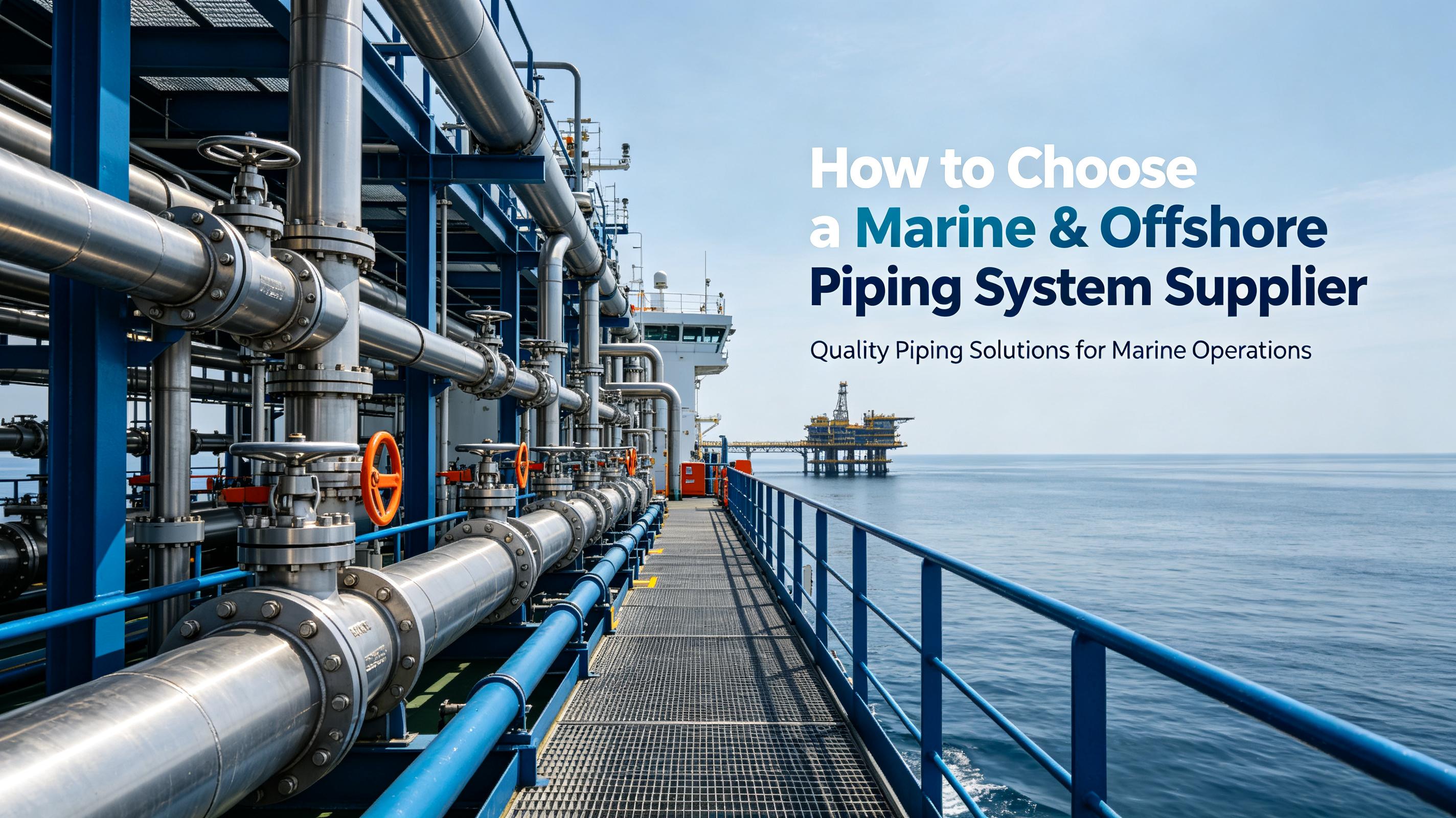
Marine piping systems operate in demanding conditions. A piping failure can affect vessel operation, cargo handling, cooling, fire protection, ballast operations, fuel systems, or other onboard functions.
The piping requirements also vary greatly between systems.
For example, a seawater cooling line may have different material and corrosion requirements from a fuel oil line. A ballast system may require different pipe sizes and arrangements from a high-pressure hydraulic system.
This means the supplier needs to understand the service conditions, not simply the pipe specification.
A good supplier should be able to connect material selection, fabrication, testing, documentation, and installation requirements into one coordinated process.
Start with the supplier's actual project experience.
Ask:
Experience with ordinary industrial piping does not always mean experience with marine piping.
Marine projects often have strict space limitations. Pipes may pass through multiple decks, machinery areas, bulkheads, and modules. Vibration and movement also need to be considered.
Offshore projects can add another layer of complexity. The system may be exposed to seawater, wind, waves, corrosive atmospheres, and difficult maintenance conditions.
Look for suppliers with experience that closely matches your application.
Material capability is another important selection factor.
Common materials for marine piping include:
The correct material depends on the fluid, temperature, pressure, corrosion conditions, and applicable project standards.
For example, seawater and other chloride-containing fluids can create demanding corrosion conditions. Duplex and super duplex stainless steels may be selected for applications where high strength and corrosion resistance are required.
A supplier with a wide material range can be useful when a project contains several different piping services.
However, a wide product catalog alone is not enough. The supplier should also demonstrate experience in fabricating and welding the specific materials.
Some marine and offshore applications require high pressure piping.
Examples can include:
For high-pressure service, review the supplier's ability to control wall thickness, dimensional accuracy, welding quality, testing, and material traceability.
Ask whether the supplier can provide:
The supplier should be able to demonstrate that the completed piping system meets the design pressure and project requirements.
Marine vessels contain many types of water systems.
These can include:
Each system can have different requirements.
A ballast system, for example, handles large volumes of seawater and can involve significant corrosion exposure. The piping arrangement must also work with pumps, tanks, valves, and other equipment.
Seawater cooling systems may require careful material selection because of chloride exposure.
A supplier should therefore understand the relationship between the pipe material and the fluid being transported.
For large marine and offshore projects, pipe spool fabrication can have a major effect on installation efficiency.
A pipe spool is a prefabricated section of piping that may include:
Instead of fabricating every connection onboard, many projects use shop-fabricated spools that are delivered to the construction or installation site.
A capable supplier should have:
Good prefabrication can reduce field welding and make installation more predictable.
Quality control should be built into the production process.
Ask the supplier how it manages:
Materials should be checked against purchase specifications. Material certificates should be available where required.
The supplier should have qualified welding procedures and qualified welders for the materials and service conditions involved.
Depending on the project, NDT may include:
Pipe spools need to match approved drawings and installation dimensions.
Even a small dimensional error can create problems during offshore or shipboard installation.
Completed piping may require hydrostatic, pneumatic, or other specified testing methods based on the system and applicable standards.
A strong documentation system should allow the project team to trace materials, welds, inspections, tests, and final acceptance records.
Marine piping projects often involve classification societies and other regulatory requirements.
Depending on the vessel, project, and flag state, requirements may involve organizations such as ABS, DNV, Lloyd's Register, Bureau Veritas, or other recognized bodies.
The supplier does not necessarily need to hold every certification in every market. What matters is whether it understands the standards and approval process applicable to your project.
Ask for evidence of previous work involving:
Early coordination can prevent approval problems later in the project.
A pipe supplier and a piping system supplier are not always the same thing.
If your project requires only standard pipes and fittings, a product-focused supplier may be enough.
If you need complete piping packages, a supplier with engineering and integration capability may provide more value.
Look for services such as:
This is especially useful for offshore projects where piping must fit within compact modules.
Marine projects often involve large quantities of pipe, fittings, and prefabricated components.
Before placing an order, check:
Capacity should be evaluated against your actual project schedule.
A supplier may offer competitive pricing but still create problems if it cannot produce and deliver the required volume on time.
Logistics can become complicated for marine and offshore projects.
Pipe spools and modules may be large and heavy. Transportation may require special handling.
Consider whether the supplier has convenient access to:
A factory close to a suitable port can simplify transportation for large offshore components.
For international projects, also check the supplier's experience with export packing, shipping documents, customs requirements, and international delivery.
The lowest quotation is not always the lowest project cost.
A more useful comparison includes:
Material cost + fabrication cost + testing cost + documentation cost + logistics + installation cost + potential rework
A supplier that provides accurate prefabricated pipe spools may reduce field fabrication.
A supplier with strong technical support may also help identify design or material issues before production.
When comparing quotations, make sure the scope is the same. Check whether the price includes:
This avoids comparing incomplete quotations.
Before production starts, request the supplier's inspection and test plan.
The plan should define:
For complex marine piping systems, clear inspection planning can reduce misunderstandings between the owner, shipyard, engineering contractor, inspector, and supplier.
Marine environments are different from most land-based industrial environments.
The supplier should understand factors such as:
Material selection should be based on the actual service environment.
For offshore applications, additional factors may include splash-zone exposure, atmospheric corrosion, offshore maintenance conditions, and long service periods.
Ask the supplier to explain why a particular material and surface treatment were selected rather than simply accepting a material name from a standard product list.
Marine and offshore piping rarely follows a single standard configuration.
Projects may require:
A supplier should have the equipment and engineering capability to handle project-specific requirements.
The ability to customize can be more valuable than maintaining a very large standard product catalog.
For larger projects, supplier involvement may continue after fabrication.
Installation support can include:
This can be especially useful when the piping supplier also fabricated the spools.
The same team can understand the fabrication records and design information when questions arise during installation.
A practical supplier evaluation can use the following criteria:
| Evaluation Area | What to Check |
|---|---|
| Marine experience | Shipbuilding, offshore, FPSO, marine projects |
| Material range | Carbon steel, stainless steel, duplex, super duplex, alloys |
| Pressure capability | Standard and high pressure applications |
| Water systems | Cooling, ballast, fire water, bilge and other systems |
| Pipe spool fabrication | Cutting, fit-up, welding, inspection and testing |
| Quality control | ITP, NDT, pressure testing and traceability |
| Classification | Experience with relevant classification societies |
| Engineering | Drawings, modeling, spool design and technical support |
| Capacity | Production volume and project resources |
| Logistics | Port access, export and heavy-component transportation |
| Documentation | Certificates, inspection reports and test records |
| Installation support | Site service, commissioning and troubleshooting |
| Customization | Special dimensions, materials and configurations |
| Lifecycle support | Spare parts, repairs and technical assistance |
Before signing a contract, ask the supplier these questions:
A low pipe price does not guarantee a low total project cost.
Fabrication, inspection, transport, installation, and rework can add substantial costs.
A pipe material that works well in one service may not be suitable for another.
Always consider the fluid and operating environment.
Marine piping is part of a larger system.
Pipes must connect correctly with pumps, tanks, valves, heat exchangers, equipment, and supports.
A supplier may sell a material but lack experience in welding and fabricating it.
This is particularly relevant for duplex and super duplex stainless steels.
Marine projects often require extensive records.
Documentation should be planned from the beginning rather than collected after fabrication.
Large pipe spools and modules can be difficult to transport.
Check logistics before finalizing the supplier.
After collecting supplier information, score each candidate against the same criteria.
A useful weighting can be:
The exact weighting should change based on the project.
For a high-pressure offshore project, technical capability and quality may deserve more weight.
For a standard shipbuilding project with a tight schedule, production capacity and delivery performance may become more important.
The goal is to find a supplier that fits the project's technical, commercial, and schedule requirements.
A strong supplier should combine marine experience, material knowledge, fabrication capability, quality control, engineering support, and reliable delivery.
For projects involving complex marine piping systems, it is useful to select a supplier that can manage more than individual pipe products.
A supplier capable of pipe fabrication, pipe spool prefabrication, testing, module integration, and installation support can provide a more coordinated solution.
This approach can reduce the number of interfaces between different contractors and make project management easier.
Look for proven marine and offshore experience, suitable material capability, pipe spool fabrication, quality control, testing, classification experience, production capacity, reliable delivery, and technical support.
Common materials include carbon steel, stainless steel, duplex stainless steel, super duplex stainless steel, copper alloys, and selected nickel alloys. The correct choice depends on the fluid, pressure, temperature, corrosion conditions, and project standards.
Marine environments can expose piping to seawater, chlorides, humidity, vibration, and temperature changes. Material selection should therefore consider corrosion resistance, mechanical strength, service temperature, pressure, and the expected operating life.
Yes. Many specialized suppliers can manufacture high-pressure piping and related components. Buyers should verify the supplier's applicable pressure range, material capability, welding procedures, inspection methods, and pressure-testing facilities.
A pipe spool is a prefabricated section of piping assembled from pipe, fittings, flanges, and other components. Pipe spools are usually fabricated in a controlled workshop and then transported to the shipyard, offshore facility, or construction site for installation.
Ships can have many piping systems, including seawater cooling, freshwater, fuel, ballast, bilge, fire-fighting, compressed air, hydraulic, drainage, and cargo piping systems.
A ballast system controls the amount and distribution of ballast water in a vessel. It helps manage draft, stability, trim, and loading conditions. The system normally includes ballast tanks, pumps, valves, piping, and related control equipment.
Review its quality management system, welding procedures, inspection and test plans, NDT capability, pressure-testing methods, material traceability, inspection records, project references, and final manufacturing documentation.
The better choice depends on project requirements. Consider technical capability, manufacturing capacity, location, logistics, international shipping experience, response time, documentation, and after-sales support rather than location alone.
Not necessarily. Compare the total project cost, including material, fabrication, inspection, testing, transportation, installation, and potential rework. A supplier with stronger technical and fabrication capabilities may provide a lower overall project risk even when its initial quotation is higher.
The quotation should clearly define the scope, including pipe, fittings, flanges, valves where applicable, fabrication, welding, NDT, pressure testing, surface treatment, documentation, packing, transportation, and other required services.
Selecting a marine and offshore piping system supplier should be based on the complete project requirement rather than product price alone.
Start by checking the supplier's marine experience. Then evaluate material capability, high-pressure performance, fabrication quality, testing, classification experience, production capacity, logistics, and technical support.
Pay particular attention to the actual service conditions. Marine environments can expose piping to seawater, chloride corrosion, vibration, pressure changes, and limited maintenance access.
For projects with multiple piping systems, a supplier with integrated fabrication and engineering capabilities can simplify procurement and installation.
The best supplier is not simply the one that sells pipe. It is the one that can provide the right materials, fabrication quality, documentation, delivery, and technical support for the complete marine or offshore application.
Choose a marine and offshore piping supplier based on capability, not price alone.
The main points are:
For complex projects, a supplier that can combine marine piping systems, prefabricated pipe spools, specialized materials, testing, and system integration can make procurement and project execution much easier.