

EN
Get In Touch

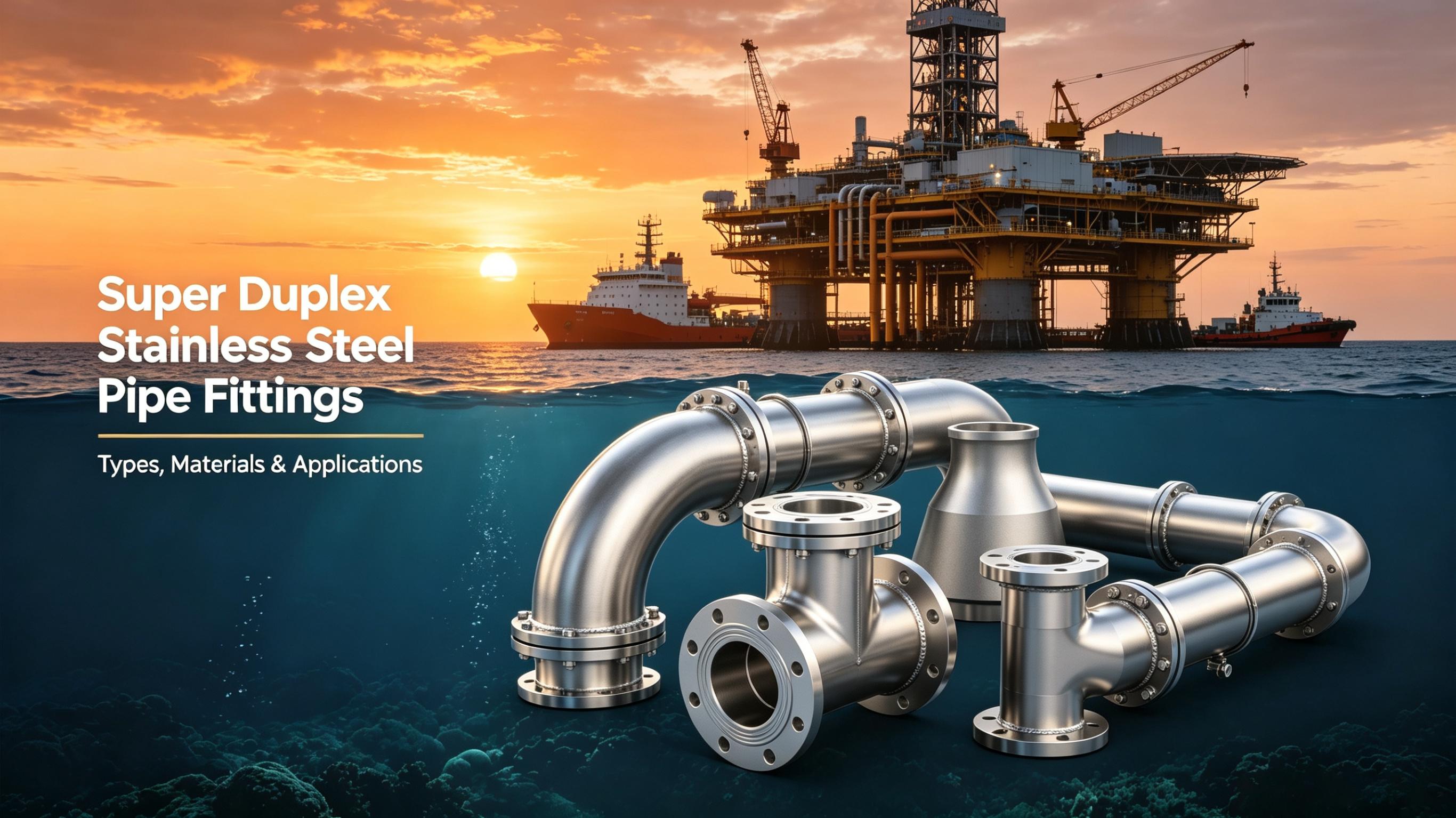
Super duplex stainless steel pipe fittings are high-alloy fittings made from a two-phase microstructure of ferrite and austenite. They combine the mechanical strength of ferritic stainless steels with the high corrosion resistance of austenitic stainless steels.
Compared with standard duplex steels, super duplex grades offer higher strength and better resistance to pitting, crevice corrosion, and stress corrosion cracking. They are widely used in oil and gas, offshore engineering, chemical processing, pressure vessels, heat exchangers, and other systems exposed to chlorides, high pressure, or demanding service conditions.
Common super duplex pipe fittings include elbows, tees, reducers, crosses, caps, stub ends, and flanges. Typical materials include UNS S32750 (2507) and UNS S32760.
Super duplex stainless steel pipe fittings are components used to connect, redirect, branch, reduce, or terminate pipes in industrial piping systems. They are manufactured from super duplex stainless steel, a high-alloy stainless steel with both ferritic and austenitic phases.
The two phases are normally present in roughly balanced proportions after proper solution annealing. This structure gives super duplex steels a useful combination of mechanical properties and corrosion resistance.
In simple terms, super duplex fittings are selected when a piping system needs:
Super duplex stainless steel belongs to the duplex stainless steel family. Duplex steels contain both ferrite and austenite, while conventional stainless steel families are generally dominated by one main phase.
Austenitic stainless steels are known for their corrosion resistance and toughness. Ferritic stainless steels offer good strength and resistance to some forms of corrosion. Duplex grades combine characteristics from both groups.
Super duplex stainless steel takes this concept further by using higher levels of chromium, molybdenum, and nitrogen than standard duplex grades.
This alloy design provides higher corrosion resistance and higher strength than many conventional stainless steel grades.
Typical super duplex grades include:
| Grade | UNS Number | Common Name | Typical Characteristics |
|---|---|---|---|
| Super Duplex 2507 | S32750 | 2507 | High strength, excellent chloride resistance, high pitting resistance |
| Super Duplex | S32760 | Zeron 100 | High corrosion resistance and strong mechanical performance |
| Super Duplex | S32550 | Ferralium 255 | Good strength and corrosion resistance |
The exact chemical composition, mechanical properties, heat treatment, and applicable product requirements depend on the material standard and grade.
Super duplex pipe fittings are often chosen when ordinary stainless steel does not provide enough corrosion resistance or mechanical strength.
Super duplex stainless steel generally has a higher yield strength than common austenitic stainless steels such as 304 and 316.
This high strength can allow engineers to design piping components with lower wall thickness in some applications, subject to the applicable design code and pressure requirements.
The result can be a reduction in material weight and, in some cases, lower overall piping costs.
Super duplex grades contain high levels of chromium and molybdenum. These alloying elements improve resistance to several forms of corrosion.
They are particularly useful in environments containing chlorides, seawater, and other aggressive fluids.
One of the main reasons for using duplex and super duplex stainless steel is their resistance to stress corrosion cracking.
Austenitic stainless steels can be vulnerable to chloride stress corrosion cracking under certain combinations of temperature, chloride concentration, tensile stress, and environmental conditions.
The duplex microstructure provides better resistance to this type of damage in many service environments.
Material selection should still consider temperature, chloride level, stress, welding, heat treatment, and the actual operating environment.
Super duplex stainless steel has a high pitting resistance equivalence number, commonly known as PREN.
PREN is used as an approximate indicator of resistance to localized corrosion. A commonly used formula for duplex stainless steels is:
PREN = %Cr + 3.3 × %Mo + 16 × %N
Higher PREN values generally indicate better resistance to pitting corrosion, although PREN should not be used as the only basis for material selection.
Super duplex grades normally have a PREN value above 40, depending on the grade and calculation method.
Both duplex and super duplex grades contain ferrite and austenite. The main difference is their alloy content and resulting corrosion resistance and strength.
| Property | Standard Duplex | Super Duplex |
|---|---|---|
| Microstructure | Ferrite + austenite | Ferrite + austenite |
| Alloy level | Moderate | Higher |
| Mechanical strength | High | Very high |
| Pitting resistance | High | Very high |
| Chloride resistance | Good to very good | Excellent |
| Stress corrosion resistance | Very good | Excellent |
| Typical PREN | Around 30–40 | Usually above 40 |
| Typical applications | Chemical, marine, oil and gas | Offshore, subsea, seawater, oil and gas |
The actual performance depends on the specific grade, manufacturing condition, welding procedure, temperature, and operating environment.
Super duplex fittings are available in many configurations to match different piping layouts.
Elbows change the direction of a pipe.
Common configurations include:
Long-radius elbows are widely used in industrial piping because they provide smoother flow and lower pressure loss than sharper bends.
A tee creates a branch connection from a main pipe.
Common types include:
Super duplex tees are used in process piping, seawater systems, offshore facilities, and oil and gas installations.
Reducers connect pipes with different diameters.
The two common forms are:
An eccentric reducer can be useful where engineers need to control liquid accumulation, maintain drainage, or avoid air pockets in horizontal piping.
A cross fitting provides four pipe connections. It is used where multiple branches meet at one point.
Crosses are less common than tees but can be specified for complex piping layouts.
Pipe caps close the end of a pipe or piping section.
They may be used for:
Stub ends are commonly used with lap joint flange assemblies.
They can simplify flange alignment and reduce the amount of expensive alloy material needed in certain piping configurations.
Flanges provide bolted connections between pipes, valves, pumps, vessels, and other equipment.
Common flange types include:
The flange type should be selected according to pressure, temperature, connection method, piping standard, and service conditions.
Super duplex fittings are normally manufactured from grades designed for demanding corrosion and pressure environments.
UNS S32750 is commonly known as Super Duplex 2507.
It contains high levels of chromium, molybdenum, and nitrogen. The grade offers high strength and strong resistance to chloride-related corrosion.
It is widely used for:
UNS S32760 is another widely used super duplex grade.
It offers high mechanical strength and strong resistance to pitting, crevice corrosion, and stress corrosion cracking.
It is used in demanding offshore, marine, chemical, and oil and gas applications.
UNS S32550 is a super duplex grade designed for high-strength and corrosion-resistant service.
Its applications include marine equipment, chemical processing equipment, pumps, valves, and industrial piping.
Always check the material certificate and applicable specification before treating a fitting as equivalent to another super duplex grade.
The correct standard depends on the fitting type, material, manufacturing process, dimensions, and application.
Common standards used for stainless steel and alloy pipe fittings include:
For example, ASTM A815 covers wrought ferritic, ferritic/austenitic, and martensitic stainless steel piping fittings, while ASTM A182 covers forged or rolled alloy and stainless steel pipe flanges, forged fittings, and valves.
ASME B16.9 covers factory-made wrought butt-welding fittings, while ASME B16.5 covers pipe flanges and flanged fittings.
The required standard should always be confirmed against the project specification and design code.
Manufacturing quality has a direct effect on the final performance of a fitting.
A typical manufacturing process may include:
Heat treatment is particularly important for duplex and super duplex stainless steels.
The material must be processed within an appropriate temperature range to maintain a suitable balance of ferrite and austenite.
Improper heat treatment can affect corrosion resistance, toughness, and mechanical properties.
The ferrite and austenite balance is an important quality factor.
Excessive ferrite or austenite can change the expected properties of the material.
For this reason, production and heat treatment need to be controlled carefully, especially for thick-wall fittings and welded components.
Super duplex pipe fittings are found in industries where corrosion, pressure, and mechanical loads place high demands on piping systems.
Oil and gas is one of the largest application areas for super duplex materials.
Fittings can be used in:
Super duplex materials are attractive in these applications because they combine high strength with resistance to chloride-containing environments.
Offshore equipment is exposed to seawater, salt spray, humidity, and changing temperatures.
Super duplex fittings are used in:
Chemical plants can contain fluids that cause pitting, crevice corrosion, or stress corrosion cracking.
Super duplex fittings can be used in process lines where conventional stainless steel does not provide sufficient resistance.
Super duplex stainless steel may also be used in piping connected to pressure vessels.
Its high strength can be useful in systems that operate at elevated pressure.
Material selection must consider the vessel design code, operating temperature, pressure, corrosion environment, and applicable material requirements.
Heat exchangers can expose materials to seawater, cooling water, chlorides, and elevated temperatures.
Super duplex materials can be used for selected piping, fittings, tubes, plates, or other components when their corrosion resistance and mechanical properties match the service requirements.
Desalination plants handle large volumes of seawater and concentrated brine.
The combination of high alloy content, high pitting resistance, and resistance to chloride corrosion makes super duplex stainless steel useful in selected desalination piping systems.
Choosing the right fitting requires more than matching the pipe diameter.
Confirm whether the project requires S32750, S32760, S32550, or another grade.
Do not assume that all super duplex materials have identical chemical compositions or performance.
The fitting must meet the required pressure-temperature rating.
This includes checking:
Chloride concentration can have a strong effect on material selection.
Seawater, brine, produced water, and some chemical solutions may require higher corrosion resistance than fresh water.
The pitting resistance equivalence number can provide a useful first comparison between grades.
However, actual corrosion testing and service data may be needed for demanding applications.
Important dimensions include:
Welding can change the local microstructure of duplex and super duplex steels.
The welding procedure should be qualified for the specific material and service.
Heat input, interpass temperature, shielding gas, filler metal, and post-weld treatment may all affect the final properties.
For industrial projects, buyers may request:
For offshore and oil and gas projects, additional inspection and certification requirements may apply.
316 stainless steel is widely used because of its good corrosion resistance, availability, and cost.
Super duplex is generally selected for more demanding environments where higher strength and greater resistance to chloride-related corrosion are needed.
| Factor | 316 Stainless Steel | Super Duplex Stainless Steel |
|---|---|---|
| Microstructure | Austenitic | Ferrite + austenite |
| Mechanical strength | Moderate | High |
| Chloride resistance | Good | Excellent |
| Stress corrosion cracking resistance | More limited in certain conditions | Generally much better |
| Pitting resistance | Good | Very high |
| Material cost | Usually lower | Usually higher |
| Typical demanding applications | General chemical and marine service | Offshore, subsea, seawater, oil and gas |
The best material is not always the highest-alloy material. Engineers should compare the complete lifecycle cost, design requirements, corrosion environment, fabrication requirements, and expected service life.
The main difference is the microstructure.
Austenitic stainless steels have an austenitic structure and are known for corrosion resistance, ductility, and toughness.
Ferritic stainless steels have a ferritic structure and can provide good corrosion resistance and strength at a lower alloy level.
Duplex and super duplex steels combine ferritic and austenitic phases.
This combination gives duplex materials a different balance of strength, toughness, weldability, and corrosion resistance.
For demanding chloride environments, super duplex stainless steel can offer a stronger performance profile than many conventional austenitic or ferritic stainless steels.
Super duplex stainless steel pipe fittings are elbows, tees, reducers, caps, flanges, stub ends, and other piping components made from high-alloy duplex stainless steel. They contain both ferrite and austenite and offer high strength and high corrosion resistance.
Super duplex stainless steel normally contains higher levels of alloying elements such as chromium, molybdenum, and nitrogen. It generally provides higher pitting resistance and higher corrosion resistance than standard duplex steels.
Oil and gas systems can expose piping to chlorides, seawater, produced water, high pressure, and corrosive fluids. Super duplex combines mechanical strength with resistance to pitting and stress corrosion cracking, making it suitable for many demanding oil and gas applications.
Yes. Super duplex stainless steels generally have strong resistance to chloride-induced stress corrosion cracking compared with many austenitic stainless steels. Actual performance depends on temperature, chloride concentration, stress, welding condition, and the specific alloy.
Super duplex grades generally have a pitting resistance equivalence number above 40, depending on their chemical composition and the formula used. PREN is useful for comparing pitting resistance but does not fully predict performance in every service environment.
UNS S32750 and UNS S32760 are two widely used super duplex grades. UNS S32550 is another super duplex grade used in selected industrial applications.
Yes. Super duplex stainless steels are widely used in seawater systems because of their strong resistance to chloride-induced pitting, crevice corrosion, and stress corrosion cracking. The exact grade and design should be selected according to seawater temperature, velocity, oxygen level, biofouling, and other service conditions.
Yes, but welding requires controlled procedures. Heat input, filler material, shielding, interpass temperature, and cooling conditions can affect the ferrite and austenite balance and the corrosion performance of the welded area.
Generally, yes. Super duplex stainless steel has substantially higher mechanical strength than 316 stainless steel. This higher strength can be useful for high-pressure and weight-sensitive piping designs.
Common standards include ASTM A815 for wrought duplex stainless steel fittings, ASTM A182 for forged stainless steel flanges and fittings, ASME B16.9 for butt-welding fittings, and ASME B16.5 for flanges and flanged fittings. The required standard depends on the fitting and project specification.
Super duplex stainless steel pipe fittings provide a combination of high strength, high corrosion resistance, and strong resistance to chloride-related damage. Their ferrite and austenite microstructure gives them a different property balance from conventional austenitic stainless steels and ferritic stainless steels.
Grades such as UNS S32750 and UNS S32760 are widely considered for oil and gas, offshore engineering, seawater systems, desalination, chemical processing, pressure vessels, and heat exchangers.
When selecting super duplex fittings, engineers should look beyond the material name. Grade, chemical composition, PREN, pressure, temperature, fitting dimensions, welding procedure, heat treatment, inspection, and service environment all need to be considered.
For demanding piping systems, properly specified super duplex fittings can provide the mechanical strength and corrosion resistance needed for long-term operation.