

EN
Get In Touch

Super duplex piping systems are used in FPSO and offshore engineering where piping must withstand chloride-rich seawater, high pressure, mechanical loads, and corrosive process fluids. Super duplex stainless steel combines an austenitic and ferritic microstructure, giving it high strength, high corrosion resistance, and good resistance to stress corrosion cracking.
Among the super duplex grades, super duplex 2507 is widely selected for demanding offshore applications. It is commonly used for seawater systems, firewater piping, cooling water, ballast systems, produced water, chemical processing, and other services where both strength and corrosion resistance are required.
For FPSO projects, material selection should consider chloride concentration, operating temperature, pressure, fluid chemistry, welding, heat treatment, corrosion allowance, inspection requirements, and applicable project or classification standards.
A super duplex piping system is a process or utility piping system manufactured from super duplex stainless steel and related components such as pipes, fittings, flanges, valves, and pipe supports.
Super duplex stainless steels contain both austenitic and ferritic phases. This duplex structure provides a useful combination of the properties normally associated with austenitic stainless steel and ferritic stainless steels.
Compared with standard duplex grades, super duplex grades generally offer higher alloy content, greater resistance to localized corrosion, and higher mechanical strength. This makes them suitable for severe corrosive environments found in offshore oil and gas, FPSO units, desalination plants, and chemical processing facilities.
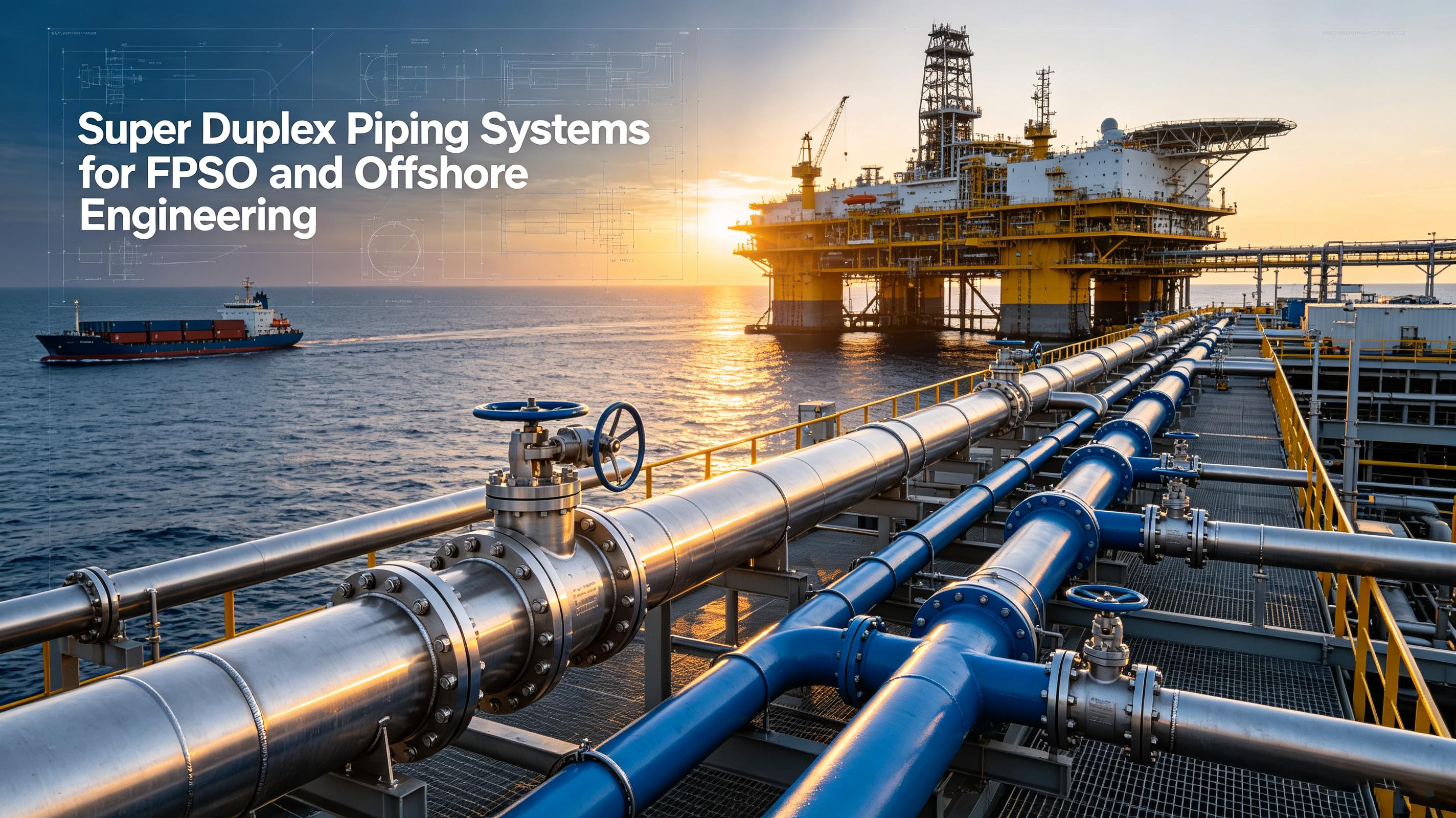
FPSO vessels operate in marine environments where piping is exposed to seawater, salt spray, chloride-rich fluids, process chemicals, temperature changes, vibration, and mechanical loads.
The piping material must therefore provide both corrosion resistance and mechanical performance.
Super duplex stainless steel is attractive because it offers:
The combination of strength and corrosion resistance is one of the main reasons super duplex materials are used in offshore piping.
Standard duplex stainless steel already provides a strong combination of corrosion resistance and mechanical strength. However, some offshore services demand a higher level of corrosion resistance.
Super duplex grades contain higher levels of chromium, molybdenum, and nitrogen than many standard duplex grades. This increases resistance to localized corrosion, particularly in chloride-containing environments.
| Property | Standard Duplex | Super Duplex |
|---|---|---|
| Microstructure | Austenitic + ferritic | Austenitic + ferritic |
| Mechanical strength | High | Very high |
| General corrosion resistance | High | Very high |
| Chloride resistance | Good to very good | Excellent |
| Pitting resistance | High | Higher |
| Stress corrosion cracking resistance | Good | Excellent |
| Typical offshore use | Seawater and process piping | More demanding seawater and process services |
The choice between standard duplex and super duplex should be based on actual service conditions rather than material grade alone.
Offshore piping can face several forms of corrosion. Seawater is particularly demanding because it contains chlorides that can contribute to localized corrosion.
Pitting corrosion creates small but deep cavities on the metal surface. Crevice corrosion can develop in narrow gaps where stagnant seawater or contaminated process fluid remains trapped.
Super duplex stainless steel has a high chromium, molybdenum, and nitrogen content that improves resistance to these forms of localized corrosion.
Its resistance is often evaluated using the Pitting Resistance Equivalent Number (PREN). Higher PREN values generally indicate greater resistance to pitting in chloride-containing environments, although actual performance depends on temperature, fluid chemistry, surface condition, fabrication, and operating conditions.
Offshore equipment can be exposed to tensile stress and chloride-rich fluids at the same time. Under suitable conditions, this can lead to stress corrosion cracking.
Super duplex stainless steel generally has better resistance to stress corrosion cracking than conventional austenitic stainless steel grades in many chloride-containing services.
This makes it attractive for piping exposed to seawater and other corrosive fluids.
However, material selection should still consider operating temperature, chloride level, stress, welding condition, and the specific service environment.
Super duplex 2507 is one of the best-known super duplex stainless steel grades for demanding applications.
It is commonly specified as UNS S32750 and is also associated with the 2507 grade designation. Another widely used super duplex grade is UNS S32760.
Super duplex 2507 offers a combination of:
Typical applications include seawater piping, firewater systems, cooling water systems, ballast systems, produced water systems, injection water systems, and selected process lines.
The final material grade should always be selected according to the applicable design code, project specification, fluid chemistry, temperature, pressure, and corrosion assessment.
Super duplex piping systems can be used across several FPSO and offshore systems.
Seawater systems are among the most common applications. They can include seawater cooling, seawater intake, seawater injection, and other marine utility services.
The chloride-rich environment creates a demanding corrosion condition. Super duplex provides high corrosion resistance while also offering high mechanical strength.
Firewater piping requires reliable performance and long-term resistance to the marine environment.
Super duplex can be considered for firewater piping where project specifications and corrosion assessments support its use.
FPSOs contain many heat-generating systems. Cooling water is used to control equipment and process temperatures.
Where seawater or chloride-containing cooling fluids are present, super duplex can provide a useful combination of corrosion resistance and mechanical strength.
Ballast systems and other seawater piping can be exposed to high chloride concentrations.
Super duplex materials can be suitable where the design requires strong resistance to pitting and crevice corrosion.
Produced water may contain salts, hydrocarbons, dissolved gases, and other corrosive compounds.
Material selection must be based on the actual produced-water chemistry, temperature, pressure, flow conditions, and expected contaminants.
FPSOs and offshore facilities may contain chemical injection and chemical processing systems.
Super duplex can be selected for some chemical services because of its high corrosion resistance. Compatibility should always be confirmed against the specific chemical composition and operating conditions.
Super duplex stainless steel is also used in desalination plants, particularly in seawater-related systems.
Reverse osmosis desalination systems can expose piping and components to concentrated chloride solutions and high pressures. Super duplex can provide a combination of corrosion resistance and strength that suits many high-pressure services.
Applications may include:
The same material-selection principles used for offshore piping also apply to desalination systems: fluid chemistry, chloride concentration, temperature, pressure, surface condition, welding, and fabrication quality must all be considered.
Austenitic stainless steel is widely used in process and marine applications because of its corrosion resistance, toughness, and fabrication characteristics.
However, conventional austenitic stainless steel may be more vulnerable to chloride-induced stress corrosion cracking and localized corrosion under certain conditions.
Super duplex stainless steel offers a different balance.
| Factor | Austenitic Stainless Steel | Super Duplex |
|---|---|---|
| Strength | Moderate to high | Very high |
| Corrosion resistance | High | Very high |
| Chloride resistance | Grade dependent | Excellent in suitable conditions |
| Stress corrosion cracking resistance | Grade and environment dependent | Generally stronger |
| Pitting resistance | Grade dependent | Very high |
| Material structure | Mainly austenitic | Austenitic + ferritic |
| Typical use | Broad industrial applications | Demanding marine and process services |
This does not mean that super duplex should replace austenitic stainless steel in every application. Austenitic grades can offer advantages in fabrication, availability, low-temperature toughness, and specific chemical environments.
The correct choice depends on the complete design and service requirements.
Ferritic stainless steels have a ferritic microstructure and can provide good corrosion resistance at a competitive cost for selected applications.
Super duplex combines ferritic and austenitic phases. This gives it a balance of high strength, toughness, and corrosion resistance that can be advantageous in demanding piping systems.
Compared with many conventional ferritic stainless steels, super duplex grades are designed for more severe corrosion environments and higher mechanical loads.
For offshore oil and gas projects, this combination can reduce the need to choose between strength and corrosion resistance.
Super duplex stainless steel performs well across many industrial temperature ranges, but it is not suitable for unlimited high-temperature service.
At elevated temperatures, phase stability and metallurgical changes must be considered. Prolonged exposure to certain temperature ranges can cause undesirable phases to form, which may reduce toughness and corrosion resistance.
For this reason, high temperature applications require careful material selection and engineering review.
Temperature limits should be based on the specific grade, applicable standard, design code, service conditions, and project requirements.
Manufacturing quality has a direct effect on super duplex performance.
Super duplex piping normally requires controlled manufacturing processes to maintain the desired balance between austenite and ferrite.
Solution annealing and controlled cooling are commonly used during manufacturing of super duplex products.
The purpose is to obtain the required metallurgical structure and reduce the risk of harmful phases.
Incorrect heat treatment can affect corrosion resistance, toughness, and mechanical properties.
Welding requires careful control of heat input, interpass temperature, shielding gas, filler metal, and cooling conditions.
The welded area must maintain suitable phase balance and corrosion performance.
For offshore piping, welding procedures should be qualified according to the applicable project specification and welding standard.
The internal and external surface condition can affect corrosion performance.
Contamination from carbon steel fabrication, improper grinding, iron particles, or unsuitable cleaning procedures can reduce surface corrosion resistance.
Pickling, passivation, cleaning, and inspection procedures should therefore be defined according to the material and project requirements.
A practical selection process should begin with the service rather than the material grade.
Determine whether the piping carries:
Chloride concentration has a major influence on localized corrosion risk.
Seawater and brine services require particular attention because chloride levels can vary significantly.
Higher temperature can increase corrosion rates and affect the resistance of stainless steels to localized corrosion and stress corrosion cracking.
Super duplex offers high mechanical strength, which can be useful for high-pressure piping.
The design engineer should calculate the required wall thickness according to the applicable piping code and project design conditions.
The assessment should consider:
Super duplex 2507 may be suitable for many demanding services, but it is not automatically the correct grade for every application.
Other super duplex grades and alternative materials may be considered based on the service environment.
Confirm requirements for:
The piping system should comply with the applicable material, piping, pressure equipment, offshore, and classification requirements.
For FPSO projects, the applicable rules may include requirements from the project owner, engineering contractor, classification society, and regulatory authorities.
A complete piping system includes more than straight pipe.
Typical components include:
All components should be compatible with the selected super duplex grade and service conditions.
Dimensional standards, pressure ratings, wall thickness, material certificates, and inspection requirements should be verified before installation.
For FPSO and offshore piping, quality control should cover the entire manufacturing chain.
Typical inspection activities may include:
The exact inspection plan depends on the pipe standard, component type, design code, project specification, and service.
Material certificates should provide traceability from the finished component back to the relevant manufacturing heat and production records.
For suitable offshore services, super duplex piping can provide several advantages.
Super duplex stainless steel has higher strength than many conventional austenitic stainless steels.
This can allow thinner wall designs in some applications, subject to the applicable design code and corrosion requirements.
Super duplex provides superior corrosion resistance in many chloride-containing environments.
It is particularly attractive where pitting and crevice corrosion are concerns.
Its duplex microstructure provides strong resistance to chloride-related stress corrosion cracking in many service conditions.
When properly designed, manufactured, welded, inspected, and maintained, super duplex piping can provide reliable service in harsh offshore environments.
Super duplex is not a universal solution.
It can have higher material and fabrication costs than standard carbon steel or lower-alloy stainless steels. Welding also requires tighter process control.
Poor fabrication practices can reduce the expected corrosion performance.
The material can also be sensitive to unsuitable heat treatment and excessive thermal exposure.
For these reasons, a material selection study should compare super duplex with standard duplex, austenitic stainless steel, nickel alloys, carbon steel with corrosion protection, and other technically suitable materials.
Carbon steel remains widely used in offshore piping because of its low initial material cost and established fabrication practices.
However, carbon steel normally needs corrosion protection, coatings, corrosion allowance, chemical treatment, or other protection methods in aggressive environments.
Super duplex has a higher material cost but provides intrinsic corrosion resistance.
For severe chloride-rich services, the total lifecycle cost can favor super duplex when reduced corrosion maintenance, longer service life, or reduced wall thickness provides a measurable benefit.
Technical content about super duplex piping should be supported by recognized standards, manufacturer documentation, material certificates, engineering specifications, and practical fabrication experience.
A reliable supplier should be able to provide traceable documentation for:
For FPSO and offshore projects, buyers should also confirm whether the supplier has experience with offshore project requirements, third-party inspection, export documentation, and classification-related documentation.
Super duplex piping is piping manufactured from super duplex stainless steel, which contains both austenitic and ferritic phases. It provides high strength and high corrosion resistance for demanding applications.
Super duplex is used in FPSO systems because it combines high mechanical strength with strong resistance to chloride-induced corrosion, pitting, crevice corrosion, and stress corrosion cracking.
Super duplex 2507 is a commonly used super duplex stainless steel grade associated with UNS S32750. It is widely considered for seawater, offshore, chemical processing, and other corrosive services.
Super duplex generally provides higher corrosion resistance and strength than standard duplex grades. However, the better material depends on the actual service conditions, design requirements, and project specifications.
Yes. Super duplex stainless steel generally provides strong resistance to chloride-induced stress corrosion cracking compared with many conventional austenitic stainless steels. Performance still depends on temperature, chloride concentration, stress, welding, and service conditions.
Yes. Super duplex is widely considered for seawater systems because of its high resistance to pitting and crevice corrosion and its good resistance to chloride-rich environments.
Yes. Super duplex can be used for selected heat exchangers, particularly where seawater, chloride-containing fluids, high pressure, or demanding corrosion conditions are present. The specific grade should be selected based on the process fluid, temperature, pressure, and heat-transfer requirements.
Super duplex can be used in some elevated-temperature applications, but temperature limits must be carefully evaluated. Long exposure to unsuitable temperatures can cause metallurgical changes that affect toughness and corrosion resistance.
Common applications include seawater piping, firewater, cooling water, ballast systems, produced water, injection water, chemical processing, and selected high-pressure services.
Super duplex generally offers higher mechanical strength and better resistance to chloride-induced stress corrosion cracking and localized corrosion than many conventional austenitic stainless steels. Austenitic grades may still be preferred for specific chemical, fabrication, temperature, or toughness requirements.
Buyers should verify the material grade, applicable standard, dimensions, pressure rating, chemical composition, mechanical properties, heat treatment, corrosion testing where required, NDT, PMI, material certificates, traceability, welding requirements, and third-party inspection requirements.
Super duplex piping systems are well suited to many FPSO and offshore engineering applications where piping must handle chloride-rich fluids, seawater, high pressure, and demanding corrosive environments.
The combination of corrosion resistance and strength makes super duplex attractive for seawater, firewater, cooling water, produced water, chemical processing, and other offshore services.
Super duplex 2507 is one of the most widely recognized options, but grade selection should always be based on the actual service conditions and applicable engineering standards.
Correct material selection is only one part of system reliability. Manufacturing quality, heat treatment, welding, surface preparation, inspection, testing, and traceability also affect the final performance of a super duplex piping system.