

EN
Get In Touch

NORSOK M-650 qualification confirms that a manufacturer has demonstrated the competence, equipment, manufacturing procedures, heat treatment controls, and testing capability needed to produce specified special materials in qualified product forms and dimensions.
For super duplex stainless steel pipes, NORSOK M-650 qualification is not simply a material certificate. It is a manufacturer and manufacturing-process qualification. The qualification is supported by a Qualification Test Record (QTR) that documents the manufacturing route, heat treatment, qualification testing, and other required information. The signed QTR front page is the formal proof of acceptance under the standard.
Super duplex stainless steel is a ferritic-austenitic stainless steel with high chromium, molybdenum and nitrogen content. It combines high strength with high corrosion resistance. These properties make super duplex pipes suitable for demanding oil and gas, offshore, chemical processing, desalination and other applications where ordinary carbon steel or some austenitic stainless steel grades may not provide the required performance.
NORSOK M-650 is a standard for the qualification of manufacturers of special materials. Its purpose is to verify that a manufacturer has suitable knowledge, experience, facilities, equipment and manufacturing controls to produce specified materials in the required shapes, sizes and properties.
The standard covers duplex stainless steels in all grades, product forms and dimensions. It also covers high-alloyed austenitic stainless steel, nickel-base alloy castings and titanium alloy castings, with additional provisions for certain other materials and manufacturing processes.
For super duplex pipes, this means that the purchaser is looking beyond the chemical composition of the steel. The qualification also considers how the manufacturer melts, forms, heat treats, tests and controls the material.
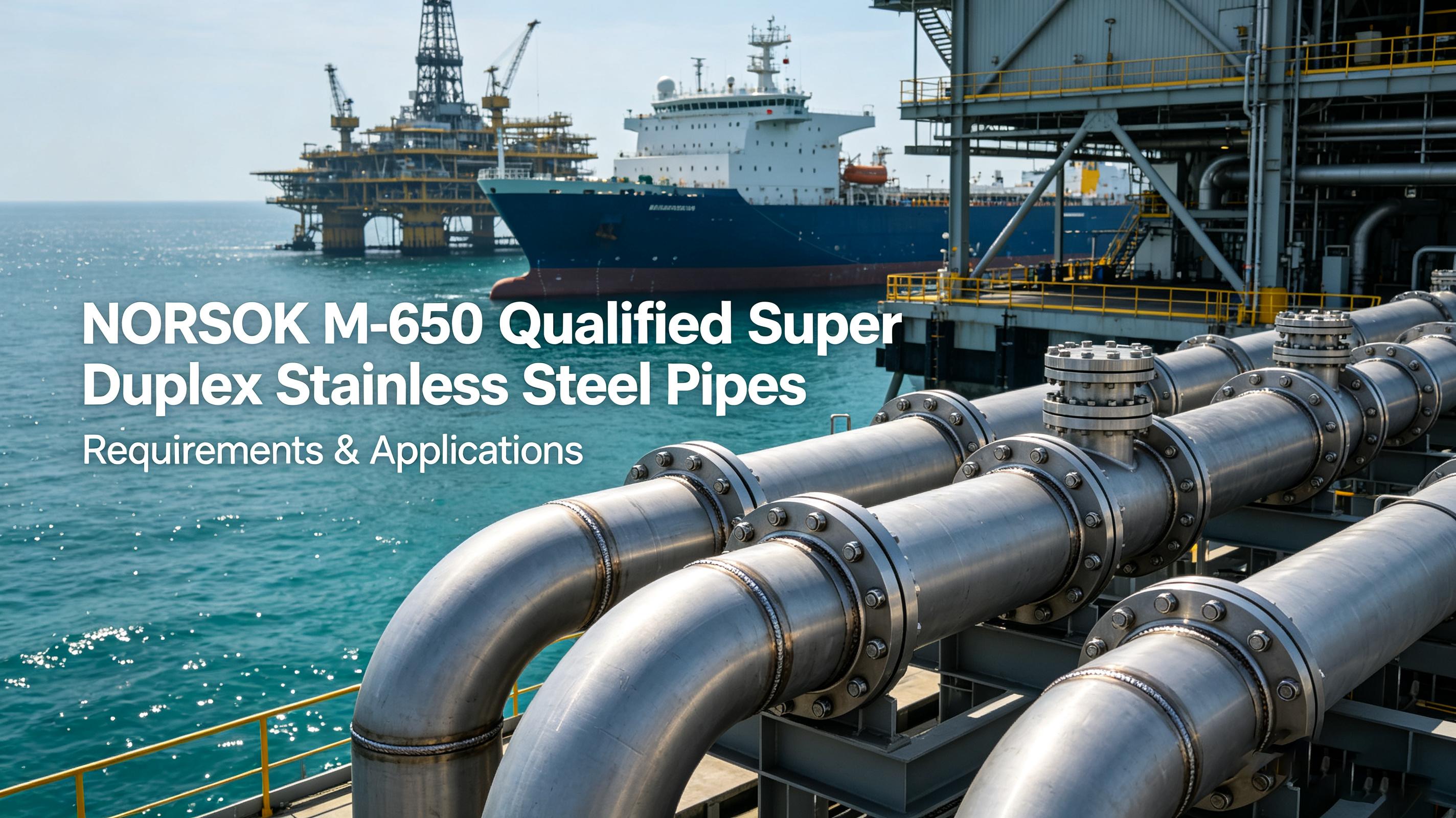
A NORSOK M-650 qualified super duplex stainless steel pipe manufacturer has completed a qualification process for a defined manufacturing route and range.
The qualification is based on several elements, including:
NORSOK M-650 states that the qualification exercise must be carried out in cooperation with a Qualifying Company. The Qualifying Company reviews the manufacturing process and documentation and accepts the resulting QTR when the requirements have been fulfilled.
This is why a supplier should not describe a pipe simply as "NORSOK M-650 material" without explaining the qualification scope.
A normal material certificate mainly provides information about a particular batch or product. It can include chemical composition, mechanical properties, heat treatment and test results.
NORSOK M-650 qualification addresses a broader question:
Can this manufacturer repeatedly produce the specified special material using a controlled and qualified manufacturing process?
The distinction is important for high-value projects.
A pipe may meet a material specification and still not mean that the manufacturer has a NORSOK M-650 qualification for the relevant manufacturing route, product form, thickness range and material grade.
The NORSOK M-650 FAQ also states that compliance is commonly expressed as being "NORSOK qualified" and that the signed QTR front page is the confirmation of fulfillment.
Super duplex steel combines two metallurgical phases:
This austenitic and ferritic structure gives duplex stainless steels a useful balance of strength and corrosion resistance.
Compared with many conventional austenitic stainless steel grades, super duplex grades can offer higher yield strength and strong resistance to chloride-containing environments.
Compared with ordinary ferritic stainless steels, duplex grades generally provide a better combination of toughness, corrosion resistance and mechanical performance.
Compared with carbon steel, super duplex stainless steel offers much higher resistance to many corrosive environments, although the material cost is normally higher.
One of the main advantages of duplex and super duplex stainless steels is their high mechanical strength.
This can allow engineers to consider thinner wall sections for some piping applications, subject to the applicable design code, pressure, temperature, corrosion allowance and project requirements.
High strength is particularly useful for:
Super duplex stainless steel is also known for its resistance to stress corrosion cracking compared with many conventional austenitic stainless steels.
This property is useful in chloride-rich environments and offshore applications.
However, corrosion performance depends on the grade, microstructure, heat treatment, surface condition, welding procedure, temperature, chloride concentration and operating environment.
Therefore, "super duplex" should not be treated as a guarantee of corrosion performance under every service condition.
The term standard duplex generally refers to 22% chromium duplex grades such as UNS S31803 and UNS S32205.
Super duplex generally refers to 25% chromium duplex grades with a PREN of at least 40. Examples identified by NORSOK M-650 include UNS S32505, UNS S32550, UNS S32750, UNS S32760 and UNS S39274.
| Feature | Standard Duplex | Super Duplex |
|---|---|---|
| Typical chromium level | Around 22% | Around 25% |
| Structure | Ferritic + austenitic | Ferritic + austenitic |
| Strength | High | Very high |
| Corrosion resistance | High | Very high |
| Chloride resistance | Good | Excellent for many services |
| Typical PREN | Often above 30 | ≥40 for the NORSOK 25Cr definition |
| Typical applications | General process and offshore piping | Severe offshore, seawater and oil & gas service |
The actual grade should always be selected from the project material specification rather than from the generic term "duplex and super duplex stainless steels."
The manufacturer needs relevant experience with the material type being qualified.
For duplex and super duplex materials, this includes knowledge of metallurgy, hot forming, welding, heat treatment and the effects of manufacturing parameters.
NORSOK M-650 also refers to evidence such as historical data for properties including tensile strength, impact toughness and corrosion resistance.
The qualification process evaluates whether the manufacturer has suitable facilities and equipment for the manufacturing route.
Depending on the pipe production process, this can involve:
The exact requirements depend on the product and manufacturing route.
A Manufacturing Summary documents the manufacturing route from the starting material through to the finished product.
It provides a controlled description of the manufacturing steps and parameters.
This is important because the properties of duplex stainless steel are strongly affected by processing conditions.
Heat treatment is one of the most important manufacturing controls for duplex and super duplex stainless steels.
The final microstructure needs to be controlled to obtain the required balance between ferrite and austenite and to avoid unwanted phases.
NORSOK M-650 requires manufacturers to establish a heat treatment procedure and verify the procedure. Verification can include furnace performance and temperature-related records.
For super duplex pipe, the heat treatment process should therefore be considered together with:
NORSOK M-650 requires qualification testing based on actual products.
The objective is to demonstrate that the proposed manufacturing route and production parameters can produce products meeting the specified requirements. It also verifies that the proposed production sampling represents the properties of the finished components.
The qualification testing includes production testing required by the applicable MDS or material specification plus additional qualification tests specified by NORSOK M-650.
NORSOK M-650 defines manufacturing parameters that affect the qualification range.
A change in certain essential variables can require re-qualification of the manufacturing process. These variables can include thickness, weight and other manufacturing conditions.
This is important when purchasing large-diameter, thick-wall or special-size super duplex pipes.
A manufacturer may have a qualification, but the purchaser still needs to check whether the requested pipe falls within the qualified range.
NORSOK M-650 applies to different product forms, and qualification is related to the manufacturing process and product being produced.
For duplex materials, the standard includes product forms such as:
The qualification scope should therefore be checked carefully.
For example, a manufacturer qualified for one product form should not automatically be assumed to have the same qualification for every other product form.
The same principle applies to dimensions and thickness.
The Qualification Test Record (QTR) is one of the most important documents in a NORSOK M-650 qualification.
The QTR contains information such as:
NORSOK M-650 requires the QTR to be accurate and specific. The signed QTR front page is the formal proof of acceptance.
No official NORSOK list of qualified manufacturers is maintained.
This is an important point for buyers.
The NORSOK M-650 FAQ states that there is no official NORSOK listing of manufacturers that have completed the qualification. Instead, the properly completed and signed QTR front page serves as the confirmation.
Therefore, buyers should request qualification documentation directly from the manufacturer and verify the scope with the project requirements.
NORSOK M-650 and NORSOK M-630 are often mentioned together in duplex stainless steel piping projects.
NORSOK M-630 provides material data sheets for piping materials and forms the basis for requirements and testing referenced by M-650.
NORSOK M-650 focuses on qualification of the manufacturer and manufacturing process.
In simple terms:
M-630 tells you what material requirements apply. M-650 verifies that the manufacturer and manufacturing process can produce the material to the required standard.
The NORSOK M-650 FAQ specifically identifies M-630 Material Data Sheet for Piping as the basis for requirements and tests in M-650 qualification.
The oil and gas industry is one of the main markets for super duplex stainless steel.
Applications can include:
The combination of high strength and corrosion resistance can be useful where weight, pressure and corrosion are all design concerns.
Offshore facilities are exposed to seawater, chloride-containing moisture and demanding operating conditions.
Super duplex pipe can be used for:
Super duplex materials are also used in selected heat exchangers, especially where chloride-containing water or seawater creates a corrosion concern.
The exact material selection depends on:
Super duplex stainless steel can be selected for pressure vessels, piping connections and related process equipment when high mechanical strength and corrosion resistance are required.
The vessel design itself must comply with the applicable pressure equipment code. NORSOK M-650 qualification should not be confused with pressure vessel design approval.
Super duplex stainless steel has good mechanical and corrosion properties, but it should not automatically be treated as a universal high temperature material.
Duplex stainless steels are sensitive to microstructural changes at elevated temperatures. Long exposure to unsuitable temperature ranges can affect toughness and corrosion performance.
For high temperature service, engineers should evaluate:
A material that performs well at normal process temperatures may not be the best choice for continuous high-temperature service.
Both super duplex and austenitic stainless steel can be used in corrosive process environments, but they have different strengths.
| Property | Austenitic Stainless Steel | Super Duplex Stainless Steel |
|---|---|---|
| Structure | Mainly austenitic | Austenitic + ferritic |
| Strength | Moderate to high | High |
| Chloride SCC resistance | Depends strongly on grade | Generally better than conventional austenitic grades |
| Yield strength | Generally lower | Generally higher |
| Seawater service | Grade dependent | Widely used in suitable applications |
| Nickel content | Often higher | Usually lower than many high-alloy austenitic grades |
| Manufacturing control | Established | Requires careful phase and heat treatment control |
High-alloy austenitic stainless steels can still be the better choice for some environments. Material selection should be based on the complete service condition rather than strength alone.
Carbon steel is widely used because it offers good mechanical properties and relatively low material cost.
Its limitation is corrosion resistance.
In corrosive environments, carbon steel may require:
Super duplex stainless steel has a higher initial material cost, but its corrosion resistance and high strength can make it attractive for demanding services.
A lifecycle cost assessment should consider the complete system rather than only the purchase price of the pipe.
Before placing an order, buyers should verify more than the phrase "NORSOK M-650 qualified."
Check the following:
Confirm the exact grade, such as UNS S32750 or UNS S32760, rather than relying only on the term "super duplex steel."
Confirm that the qualification covers the required pipe or tube product form.
Check:
Ask whether the qualification covers the actual manufacturing route proposed for your order.
Confirm the qualified heat treatment procedure and its applicable range.
Review the qualification test scope and production testing requirements.
Request the relevant QTR and check:
Finally, compare the supplier's qualification with the project specification, applicable MDS and purchaser requirements.
NORSOK M-650 is not a steel grade.
It is a qualification standard for manufacturers of special materials.
A supplier may manufacture several duplex grades but have a qualification covering only specific grades and manufacturing conditions.
Pipe, tube, plate, fittings and forgings can have different qualification scopes.
The qualification range matters.
A qualification for a thinner product should not automatically be assumed to cover a much thicker pipe.
A material certificate and a NORSOK M-650 QTR serve different purposes.
Purchasers remain responsible for ensuring that the manufacturer's qualification is suitable for the required essential variables and project conditions.
NORSOK M-650 is a standard for the qualification of manufacturers of special materials. It verifies that manufacturers have suitable competence, experience, facilities, equipment, manufacturing procedures and testing capability for specified materials and product forms.
No. NORSOK M-650 is a manufacturer and manufacturing-process qualification standard. Material requirements may be defined by applicable material specifications and NORSOK M-630 MDS requirements.
Yes. NORSOK M-650 covers duplex stainless steels, including 25Cr duplex grades commonly referred to as super duplex, across applicable product forms and dimensions.
QTR means Qualification Test Record. It documents the qualification exercise, including the manufacturing route, heat treatment, qualification testing and supporting documentation. The signed QTR front page is the formal proof of acceptance.
No. NORSOK does not maintain an official list of accepted manufacturers. Buyers should request and review the manufacturer's relevant QTR documentation.
Not necessarily. Qualification has defined limits and essential variables. Thickness, weight, manufacturing parameters and other conditions can affect the qualification range.
Not automatically. The manufacturer must have the relevant qualification for the applicable material, product form, manufacturing route and qualification range.
Heat treatment affects the ferrite-austenite balance and overall material properties. Incorrect processing can affect toughness and corrosion resistance. NORSOK M-650 therefore requires an established and verified heat treatment procedure as part of manufacturer qualification.
Yes. Super duplex stainless steel is widely considered for demanding oil and gas applications because it combines high strength with high corrosion resistance and good resistance to stress corrosion cracking in many service environments.
Not in every application. Super duplex offers high strength and strong resistance to chloride-related corrosion mechanisms, while some high-alloy austenitic grades may provide advantages for particular temperatures, corrosion environments or fabrication requirements.
For corrosive service, super duplex can offer much higher corrosion resistance than carbon steel. However, carbon steel can remain the more economical choice where corrosion control is manageable. The best material depends on pressure, temperature, corrosion conditions, design life and lifecycle cost.
NORSOK M-650 qualification gives purchasers a way to evaluate the manufacturer and manufacturing process, not just the steel chemistry.
For NORSOK M-650 qualified super duplex stainless steel pipes, buyers should confirm five points:
Super duplex stainless steel offers a strong combination of high strength, corrosion resistance and resistance to stress corrosion cracking. This makes it suitable for many demanding applications in oil and gas, offshore systems, seawater service, heat exchangers and process equipment.
At the same time, NORSOK M-650 qualification should be checked against the actual project specification. A manufacturer should not be considered suitable simply because it states "NORSOK M-650" on a website or quotation. The qualification scope and QTR documentation should match the material, product form, dimensions and manufacturing conditions required for the project.