

EN
Get In Touch

Skid-mounted systems are pre-assembled process units built on a structural frame for easier transport, installation, connection, and commissioning. On ships and offshore platforms, they can combine equipment such as pumps, valves, heat exchangers, piping, instrumentation, and control systems into one tested package.
A skid-mounted system can reduce site work, shorten project timelines, improve installation consistency, and support operator safety. Stainless steel and other corrosion-resistant materials are often selected for marine environments. The modular design also allows process equipment to be adapted to different vessel types, offshore platforms, and oil and gas applications.
A skid-mounted system is a packaged process or utility system assembled on a rigid base frame, known as a skid. Major components are installed, piped, wired, and tested before the unit reaches the final installation site.
Unlike conventional systems that are built piece by piece at the project location, a skid-mounted unit moves much of the design fabrication and assembly work into a controlled workshop environment.
A typical offshore skid may include:
The complete unit can then be transported to a shipyard, offshore platform, or industrial facility for final positioning and connection.
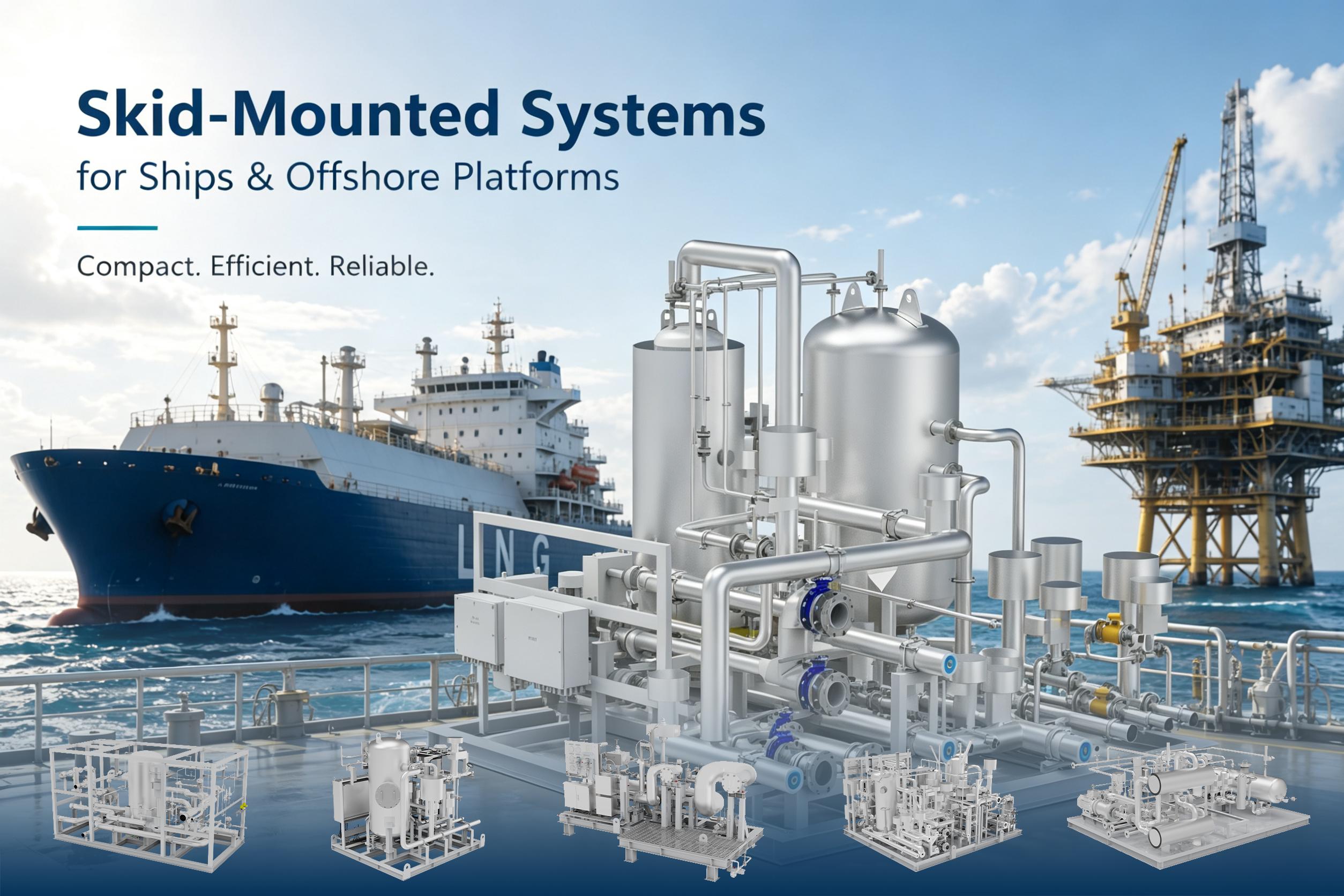
Space, weight, installation time, and access are major considerations in marine projects. Offshore construction can also be affected by weather, lifting restrictions, limited working areas, and vessel schedules.
Skid-mounted systems address these challenges by moving more work into the fabrication stage.
A pre assembled package can be inspected and tested before delivery. Once it arrives at the site, the installation team mainly needs to position the skid, connect utilities and process lines, complete electrical connections, and carry out final commissioning.
This approach can make project execution more predictable.
The exact configuration depends on the vessel or offshore process. Common systems include the following.
Fuel gas skids prepare and control gas before it reaches engines, boilers, or other consumers.
A typical fuel gas system may include:
For dual-fuel ships, the skid may be integrated with a wider gas supply system and engine control architecture.
Pump skids package pumps, piping, valves, instruments, and related equipment on one frame.
They can be used for:
The skid configuration allows the pump package to be tested before it is installed on board.
Heat exchangers are commonly integrated into packaged systems where fluid temperature must be controlled.
A heat exchanger skid may contain:
For offshore applications, the complete package can be designed around available deck space, lifting limits, and required flow rates.
Oil and gas facilities often use packaged process equipment for gas separation, filtration, heating, cooling, pressure control, or chemical treatment.
An offshore skid can combine several process stages into a single modular package. This reduces the amount of field fabrication required during offshore installation.
Utility systems can also be packaged as skid-mounted units.
Examples include:
A skid is more than a steel frame with equipment installed on it. Good skids design considers the complete process, mechanical, structural, electrical, and control requirements.
The frame supports the equipment and transfers operating and lifting loads.
It is normally designed for:
The frame may include lifting points, forklift pockets, access platforms, and connection points.
Piping connects the equipment into a functional process system.
Stainless steel may be selected where corrosion resistance, fluid compatibility, cleanliness, or temperature performance is required.
Pipe routing should provide adequate access for:
Valves control, isolate, or regulate fluid flow.
Depending on the process, the skid may contain:
Heat exchangers transfer heat between fluids without direct mixing. Their selection depends on flow rate, temperature, pressure, fluid properties, materials, and available space.
Modern mounted systems often include sensors, transmitters, control valves, local control panels, and communication interfaces.
The control systems can monitor parameters such as:
The system can also provide alarms and shutdown functions when operating conditions move outside predefined limits.
Skids design must consider more than normal industrial operating conditions. Marine and offshore equipment may experience vibration, movement, saltwater exposure, restricted access, and transportation loads.
Materials and coatings should be selected according to the operating environment.
Stainless steel can be suitable for parts exposed to corrosive fluids or marine conditions, although the specific grade should be selected according to the process and environmental requirements.
Other material considerations may include:
Offshore platforms have strict space and weight limits. Equipment arrangement therefore needs to be planned early.
A compact modular design can help make better use of available deck space while keeping maintenance access.
Ships and offshore platforms are exposed to vibration and movement. Equipment, piping, supports, and skid frames need to be checked for relevant static and dynamic loads.
Pipe supports should prevent excessive movement while allowing the piping system to operate safely under thermal expansion and contraction.
The skid must be suitable for transporting and installation.
Design should consider:
A well-designed skid can be lifted and positioned with less site modification.
The design fabrication process normally starts with process requirements and equipment specifications.
A typical workflow includes:
This sequence allows different engineering disciplines to coordinate before fabrication begins.
One of the main benefits of pre assembled systems is that a large portion of the work can be completed before the equipment reaches the project site.
| Factor | Pre Assembled Skid | Site Fabrication |
|---|---|---|
| Workshop assembly | High | Lower |
| Site welding | Reduced | Higher |
| Installation time | Usually shorter | Usually longer |
| Factory inspection | Easier | More limited |
| Quality control | Controlled environment | Site-dependent |
| Transport | Requires planning | Less packaged |
| Modular expansion | Easier | More complex |
| Offshore installation | More organized | More field work |
The best choice depends on project size, equipment dimensions, transport restrictions, site conditions, and cost.
Fabrication and site preparation can happen in parallel. While foundations or supporting structures are being prepared, the skid can be assembled and tested in the workshop.
This can reduce the amount of work remaining at the final site.
A skid-mounted approach can reduce field labor, welding, temporary facilities, and installation hours.
It can also reduce rework when the package is properly engineered and tested before shipment.
Workshop fabrication provides better control over:
Quality checks can be performed before the package leaves the fabrication facility.
Equipment is arranged as a complete process unit. Operators can access the relevant instruments, valves, and equipment from a planned layout.
This can simplify operation and maintenance.
Reducing offshore fabrication can reduce exposure to welding, lifting, working at height, and other construction activities.
Access platforms, walkways, valve locations, and maintenance areas can also be designed into the skid before delivery.
A modular design makes it easier to add or replace process packages.
For projects with changing capacity requirements, additional skids can sometimes be incorporated without redesigning an entire plant or vessel system.
Oil and gas facilities commonly use packaged systems because many processes require several pieces of equipment to work together.
Applications include:
For offshore platforms, packaging process equipment on skids can reduce the amount of fabrication required on the platform.
The package can be designed around the platform's process requirements, available space, lifting capacity, hazardous-area classification, and maintenance strategy.
Stainless steel is widely used in marine and offshore equipment where corrosion resistance and fluid compatibility are important.
The correct grade depends on the application. Common considerations include:
For more demanding marine environments, duplex or super duplex stainless steel may be considered where their mechanical and corrosion properties match the application.
Material selection should always be based on engineering requirements rather than material name alone.
State of the art skid systems increasingly combine mechanical equipment with digital monitoring and automated control.
Modern packages may include:
These features can provide operators with better visibility into equipment status and operating conditions.
However, technology should support the process rather than add unnecessary complexity. A practical skid design should remain accessible for operation, inspection, maintenance, and troubleshooting.
Offshore installation presents special challenges. Equipment may need to be lifted onto a platform or vessel with limited deck access.
A skid-mounted package can be designed around the installation sequence from the beginning.
Important factors include:
Standardized connection points can make final installation more efficient.
A professional skid fabrication project should include inspection and testing at multiple stages.
Typical activities include:
Materials are checked against approved specifications and certificates.
Welding procedures and welder qualifications should meet the project requirements. Inspection may include visual examination and non-destructive testing.
Equipment and piping positions are checked against approved drawings and 3D models.
Applicable piping and equipment are pressure tested according to the approved procedures and relevant standards.
Valves, instruments, pumps, control systems, alarms, and shutdown functions can be tested before shipment.
Factory acceptance testing allows the client and engineering team to verify package functions before the skid is transported to the vessel or offshore platform.
When selecting a supplier, look beyond equipment price.
Consider the supplier's ability to handle the complete project from engineering through fabrication and testing.
Key questions include:
A supplier with integrated engineering and fabrication capabilities can reduce coordination between different contractors.
The terms "skid-mounted" and "modular" are related but not identical.
A skid-mounted system is normally built around a base frame. The frame allows the complete package to be moved as a unit.
A modular system refers more broadly to a functional package designed as one module. A module may be skid-mounted, containerized, or integrated into a larger structural framework.
In marine and offshore projects, the two approaches are often combined.
A modular design can define the process package, while the skid provides the physical structure needed for fabrication, transportation, and installation.
A skid-mounted system is a packaged process or utility system assembled on a structural base frame. Equipment, piping, valves, instruments, and control systems can be installed and tested before the package is delivered to the final site.
They reduce onboard fabrication and installation work. More equipment can be assembled and tested before delivery, which can help shorten installation time and improve quality control.
An offshore skid is a packaged equipment system designed for installation on an offshore platform or vessel. It is engineered for marine environmental conditions, lifting, transportation, space restrictions, and offshore operation.
A skid can contain pumps, compressors, heat exchangers, filters, valves, piping, instruments, electrical equipment, and control systems. The exact configuration depends on the process.
Stainless steel can be suitable for offshore applications where corrosion resistance and fluid compatibility are required. The appropriate grade should be selected based on the actual environment, fluid, temperature, pressure, and applicable specifications.
They can be cost effective because they move more fabrication and testing into a controlled workshop environment. Reduced field labor, shorter installation time, and less site welding can help reduce total project costs.
The package may be transported by truck, ship, barge, or other suitable methods. The skid frame, lifting points, center of gravity, dimensions, and sea fastening should be considered during the design stage.
Yes. Skid-mounted systems are widely suited to oil and gas applications such as gas processing, fuel gas supply, chemical injection, filtration, metering, heating, cooling, and water treatment.
A skid is generally a packaged system mounted on a base frame. A module is a broader term for a functional packaged section of a facility. An offshore module may contain one or more skids and additional structural elements.
Testing may include material verification, dimensional inspection, weld inspection, pressure testing, instrument checks, electrical tests, control system checks, alarm testing, shutdown testing, and factory acceptance testing.
Skid-mounted systems provide a practical way to package process equipment for ships, offshore platforms, and oil and gas facilities. By combining equipment, piping, instrumentation, and control systems on a prepared frame, they can move much of the construction work from the site to a controlled fabrication environment.
A well-engineered skid considers process requirements, materials, structural loads, vibration, corrosion, lifting, transportation, installation, operation, and maintenance from the start.
For marine projects, the right modular design can help improve quality, reduce site work, support operator safety, and keep project timelines under control. The final solution should always be based on the vessel or platform requirements, applicable standards, operating conditions, and the specific process equipment involved.