

EN
Get In Touch

Marine module integration is the process of combining skid units, prefabricated pipe spools, pipe racks, equipment, valves, instruments, electrical systems, and other components into a coordinated marine module before delivery to the vessel or offshore facility.
A well-planned integration approach can reduce onboard fabrication, shorten installation time, improve quality control, and simplify system commissioning. It also requires careful attention to weight, dimensions, piping alignment, access, lifting, structural loads, utilities, and long-term operation.
Marine module integration is the engineering, fabrication, assembly, testing, and coordination of multiple equipment and piping systems into a single transportable module.
A marine module may include:
Instead of installing every component separately on a vessel or offshore platform, manufacturers can complete a large part of the work in a controlled fabrication environment.
The finished module can then be transported to the shipyard, offshore site, or final installation location.
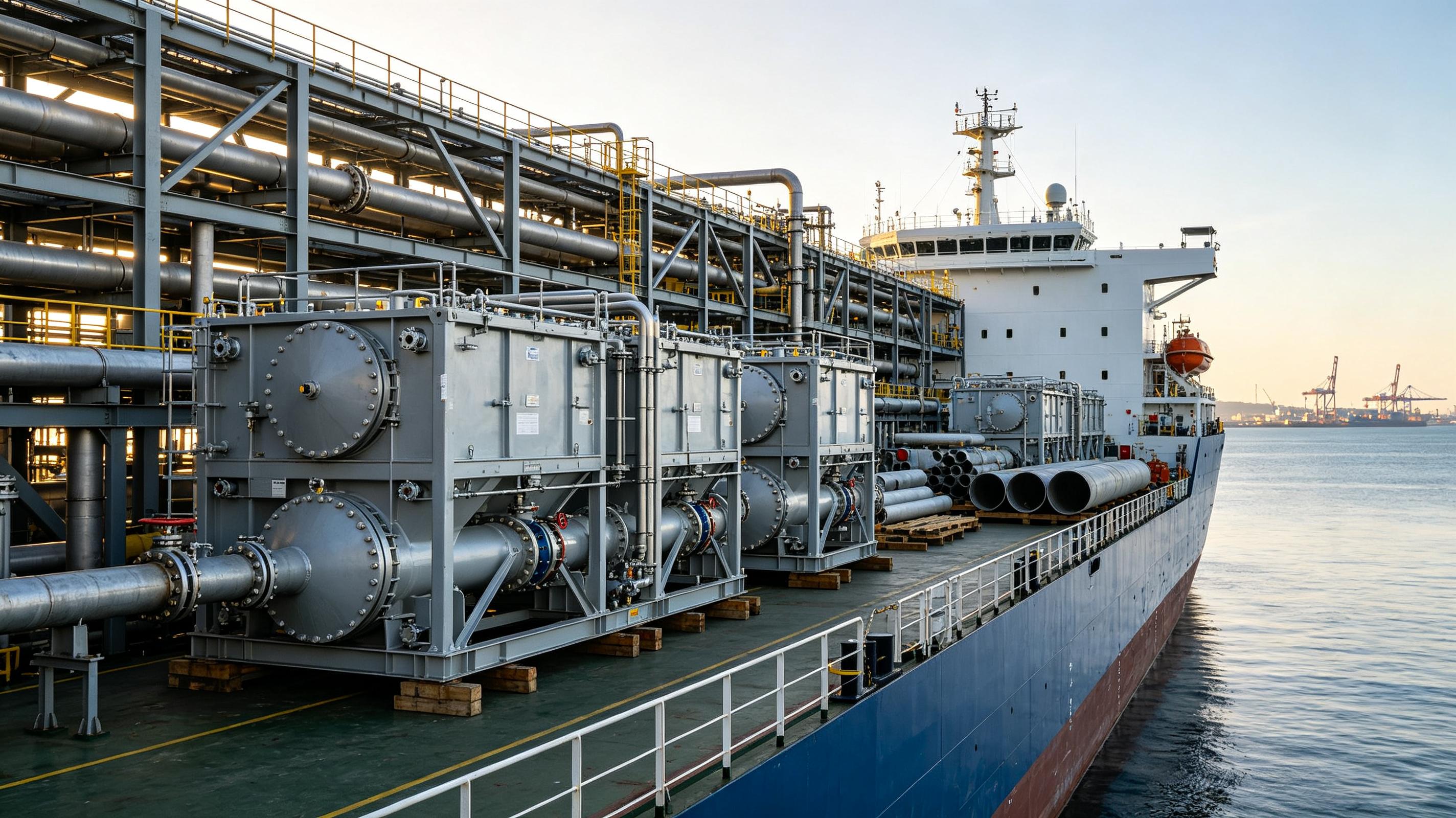
Marine module integration covers more than simply assembling equipment.
It brings together mechanical, piping, structural, electrical, instrumentation, and control requirements within one module.
The main activities normally include:
Each part must fit the others before the module is delivered.
For example, a pipe spool may have the correct dimensions based on the piping drawing but still interfere with a structural beam, cable tray, valve handle, or maintenance walkway. Module integration helps identify these conflicts before the module reaches the vessel.
A skid unit is a compact assembly of equipment, piping, valves, instruments, and structural support mounted on a common base frame.
Skids are widely used in marine and offshore applications because they can be fabricated and tested before installation.
Typical marine skid units include:
Fuel gas skids can contain filtration, pressure regulation, valves, instruments, piping, and control equipment.
They are used to prepare and regulate fuel gas before it enters the engine or other gas-consuming equipment.
Gas supply systems may include pressure control, flow measurement, heating, filtration, and safety equipment.
The exact configuration depends on the fuel type and operating conditions.
Pump skids combine pumps with piping, valves, instruments, and supporting structures.
Common applications include:
Water treatment modules may integrate filtration, pumps, dosing equipment, membranes, tanks, and control systems.
A water tank may also be connected to the skid when additional storage capacity is required.
Pipe spools are prefabricated sections of piping manufactured according to approved drawings and specifications.
A typical pipe spool may contain:
Pipe spool fabrication is normally completed before final module assembly.
This approach allows cutting, fit-up, welding, inspection, non-destructive testing, and pressure testing to take place in a controlled workshop environment.
During module integration, pipe spools are positioned and connected to equipment, skids, headers, tanks, and other piping sections.
Accurate pipe spool fabrication helps improve installation efficiency.
The main benefits include:
For complex marine projects, even a small dimensional error can create problems during final assembly. Spool drawings, 3D models, and fabrication inspection therefore need to be coordinated before production.
Pipe racks provide structural support for groups of process and utility pipelines.
They may also carry:
A pipe rack must support the weight of the piping system while allowing enough space for installation, inspection, maintenance, thermal movement, and drainage.
Marine pipe racks also need to account for vessel movement and environmental loads.
Important design factors include:
Pipe arrangement should also leave enough space for valves and instruments that require regular inspection or operation.
The three components should not be designed as separate items.
They form part of an integrated module.
For example, a marine process module may contain a pump skid at the lower level, several pipe spools connecting the pump to a water tank, and a pipe rack carrying process and utility lines above the equipment.
The layout must consider:
Equipment → Skid → Pipe Spools → Pipe Rack → Utility Systems → Control and Electrical Systems
A change to one part can affect the others.
Moving a pump, for example, may change the suction pipe length. That change may affect the pipe rack arrangement, valve position, support locations, access space, and cable tray routing.
This is why system integration should begin during the design stage rather than after fabrication.
System integration ensures that individual components operate as one coordinated system.
Mechanical integration focuses on physical connections.
Piping integration checks:
Electrical and control integration checks:
The final objective is not simply to make the components fit. The complete module should be ready for functional testing and commissioning with minimal modification at the installation site.
The process starts with engineering drawings, equipment data, piping specifications, structural requirements, and installation constraints.
A 3D model can be used to coordinate:
Design reviews can identify clashes before fabrication begins.
Equipment is installed on its skid or structural base.
The fabrication team checks dimensions, connections, orientation, support points, and access requirements.
Pipes are cut, fitted, welded, inspected, and tested according to the project specification.
Where required, welds may undergo non-destructive testing such as radiographic testing, ultrasonic testing, magnetic particle testing, or liquid penetrant testing.
Pipe rack structures are fabricated and inspected before or during module assembly.
Support locations should match the final piping model and spool drawings.
Skids, pipe spools, pipe racks, equipment, and supporting systems are assembled together.
The team checks:
Depending on the module, testing may include:
Factory acceptance testing may also be performed before shipment.
The completed module is prepared for lifting, transportation, and installation.
Weight distribution, lifting points, center of gravity, structural strength, and transportation routes should be verified.
After installation, the module is connected to the vessel or offshore facility.
Final checks confirm that mechanical, piping, electrical, instrumentation, and control interfaces operate as designed.
Water tanks are common in marine systems and can be integrated into larger modules.
Depending on the application, a water tank may store:
Tank integration requires attention to volume, material, connection size, pump arrangement, access, drainage, ventilation, and structural support.
The tank must also be considered as a major weight item.
A full water tank can add substantial operating weight to a module. This affects structural design, lifting calculations, support design, and vessel stability considerations.
More fabrication can be completed before the module reaches the vessel.
This can reduce onboard welding, fitting, painting, and mechanical installation.
Workshop fabrication provides better access to equipment and controlled working conditions.
Inspection can be performed at different stages instead of waiting until the module reaches the installation site.
A completed or partially completed module can be installed as one integrated unit.
This can help reduce the amount of work required at the shipyard or offshore location.
Module integration brings multiple disciplines together.
Mechanical, piping, structural, electrical, and instrumentation teams can work from a coordinated model and set of drawings.
Many systems can be tested before delivery.
Early testing helps identify interface problems before final installation.
Good module layout can provide clear access to valves, instruments, pumps, filters, and other service items.
This matters for long term operation because maintenance work must be carried out safely and efficiently.
Weight should be tracked throughout design and fabrication.
The center of gravity affects lifting, transportation, installation, and vessel stability.
Compact design is useful, but equipment should not be packed so tightly that maintenance becomes difficult.
Operators need enough room to inspect and service components.
Marine piping may experience vibration, thermal expansion, and movement caused by vessel motion.
Pipe supports and routing should accommodate these conditions.
Pumps, compressors, engines, and other rotating equipment can generate vibration.
Piping, supports, equipment foundations, and structural frames should be checked as part of the overall design.
Marine environments expose equipment and structures to moisture, salt, and corrosive conditions.
Material selection, surface treatment, coating systems, drainage, and inspection access should be considered during module design.
A module may connect to several systems outside the module boundary.
These interfaces should be clearly defined.
Typical interface points include:
Clear interface documentation reduces problems during final installation.
| Factor | Integrated Marine Module | Traditional Site Fabrication |
|---|---|---|
| Fabrication location | Controlled workshop | Vessel or site |
| Pipe spool production | Mostly prefabricated | More field fabrication |
| Quality control | Easier to standardize | More dependent on site conditions |
| Onboard welding | Reduced | Higher |
| Installation | Module-based | Component-based |
| Testing | More testing before delivery | More testing after installation |
| Schedule control | Generally easier | More affected by site conditions |
| Space management | Planned during engineering | Adjusted during installation |
| Long-term maintenance | Can be designed into layout | May require later modifications |
Module boundaries should be defined during the early engineering stage.
Do not wait until fabrication to decide which components should be integrated.
Mechanical, piping, structural, electrical, and instrumentation teams should work from coordinated design information.
This reduces clashes and redesign.
Using defined connection points, flange standards, electrical interfaces, and instrumentation requirements can simplify module assembly.
Pipe spool fabrication can begin after the relevant engineering information is approved.
Early spool production can help maintain the overall project schedule.
3D model reviews and constructability checks can identify access, maintenance, lifting, and piping issues before manufacturing.
Testing requirements should be included in the module design.
Test points, drains, vents, temporary connections, and access should be considered before fabrication.
Marine module integration can be used across many vessel and offshore applications, including:
The exact module configuration depends on the vessel type, process requirements, fuel type, classification requirements, and available installation space.
Marine modules may need to comply with applicable classification society rules, flag-state requirements, project specifications, and international standards.
Depending on the project, requirements may involve organizations such as:
Material certificates, welding procedures, welder qualifications, inspection records, pressure test reports, dimensional inspection reports, and equipment documentation may form part of the final project documentation package.
The applicable requirements should always be confirmed for the specific vessel and project.
A suitable supplier should have experience across more than one fabrication discipline.
Consider the following:
Check whether the supplier can handle module layout, piping design, structural design, equipment integration, and interface management.
Review experience with skid units, pipe spools, pipe racks, pressure piping, structural frames, and equipment installation.
Ask about pressure testing, leak testing, electrical testing, instrumentation testing, and factory acceptance testing.
Relevant marine and offshore project experience can provide a better understanding of vessel access, lifting restrictions, classification requirements, and installation conditions.
A professional project should have traceable quality records, material certificates, inspection reports, test records, drawings, and as-built documentation.
For complex marine systems, support should continue beyond fabrication.
Technical assistance, spare parts, maintenance guidance, troubleshooting, and system upgrades can all support long term operation.
Marine module integration is the process of combining equipment, skid units, pipe spools, pipe racks, structural components, electrical systems, and instrumentation into a coordinated module for marine or offshore installation.
A skid unit is a packaged system in which equipment, piping, valves, instruments, and related components are mounted on a common structural base. It can be tested and transported as an integrated unit.
Pipe spools allow piping sections to be fabricated and inspected before final installation. This can reduce onboard welding and fitting work and improve dimensional control.
A pipe rack supports groups of pipes and may also carry cable trays and utility lines. Its design must account for piping loads, thermal movement, vibration, access, and marine operating conditions.
Yes. A water tank can be integrated with pumps, valves, piping, instruments, and control equipment. The design must consider tank capacity, material, connections, structural support, access, and operating weight.
System integration connects mechanical, piping, electrical, instrumentation, and control systems so they operate as one coordinated system.
The main benefits include reduced onboard fabrication, better quality control, easier testing, faster installation, improved coordination, and better control of project interfaces.
Much of the fabrication, assembly, inspection, and testing can be completed before the module reaches the vessel or offshore site. This reduces the amount of work that must be performed during final installation.
Key considerations include weight, center of gravity, dimensions, lifting, transportation, piping routing, equipment access, vibration, corrosion, structural loads, maintenance, and interfaces with external systems.
A module is expected to operate for many years. Providing access to valves, pumps, instruments, filters, tanks, and other service components can make future inspection and maintenance easier.
Marine module integration combines skid units, pipe spools, pipe racks, equipment, structural components, and control systems into a coordinated package.
The value of this approach comes from moving more work into a controlled fabrication environment. Pipe spools can be prefabricated and tested. Skid units can be assembled before delivery. Pipe racks can be coordinated with equipment and piping. A water tank and other large components can be incorporated into the overall module layout.
Effective system integration also requires careful planning of interfaces, weight, access, lifting, testing, and commissioning.
For marine and offshore projects, a well-integrated module can reduce site work, improve fabrication control, and provide a more organized path from engineering to installation and long term operation.