

EN
Get In Touch

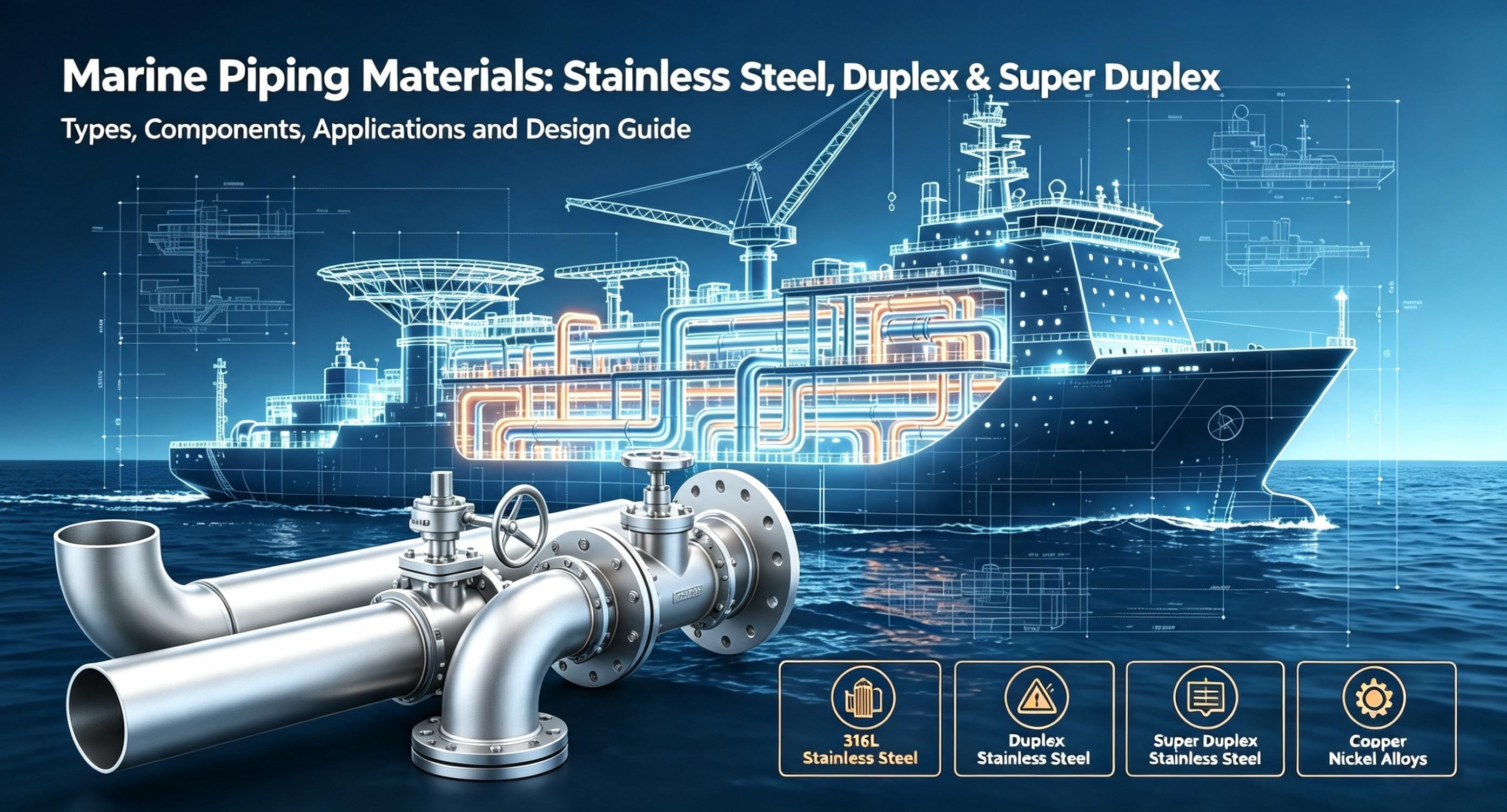
Marine piping materials must withstand seawater, humidity, pressure, temperature changes, vibration, and long operating periods. 316L stainless steel, duplex stainless steel, super duplex stainless steel, carbon steel, galvanized steel, and copper nickel alloys are commonly considered for different marine applications.
For general corrosion-resistant marine piping, 316L stainless steel is widely used. Duplex and super duplex stainless steels are better suited to demanding marine environments where higher strength and stronger resistance to chloride-related corrosion are required. Carbon steel and galvanized steel remain practical choices for selected utility and low-corrosion services.
The right material depends on the fluid, pressure, temperature, wall thicknesses, corrosion exposure, welding requirements, classification rules, and expected service life.
Marine piping materials are metals and alloys selected to manufacture pipes, pipe fittings, valves, and other components used in a ship or offshore piping system.
Unlike many land-based systems, marine piping operates in environments where saltwater, moisture, temperature variation, vibration, and limited installation space can affect material performance. Material selection therefore needs to consider both the fluid inside the pipe and the external marine environment.
Common piping materials include:
Each material has different levels of corrosion resistance, strength, fabrication requirements, cost, and service life.
A marine piping system can carry seawater, freshwater, fuel, lubricating oil, chemicals, compressed air, cargo, steam, or gas. These services expose piping components to different operating conditions.
A suitable material needs to match the actual service.
For example:
Poor material selection can lead to corrosion, leakage, premature replacement, or reduced service life.
316L stainless steel is one of the most widely used stainless steel grades in marine applications.
Its molybdenum content provides better resistance to chloride exposure than many standard austenitic stainless steels.
Typical characteristics include:
316L stainless steel is often considered for:
However, 316L is not immune to seawater corrosion. Long-term exposure to warm, highly chlorinated, or stagnant seawater can still cause pitting and crevice corrosion.
For severe seawater service, duplex or super duplex stainless steel may provide a better material option.
Duplex stainless steel combines austenitic and ferritic microstructures.
This gives duplex grades a combination of:
Duplex stainless steel can allow thinner pipe walls in some applications because of its higher strength.
This can help reduce:
The final design still needs to consider pressure, temperature, corrosion allowance, fabrication requirements, and applicable standards.
Super duplex stainless steel is designed for demanding corrosion environments where both strength and corrosion resistance are required.
It generally contains higher levels of chromium, molybdenum, and nitrogen than conventional duplex grades.
Super duplex can offer excellent resistance to:
This makes it suitable for demanding marine applications and offshore projects.
Typical applications include:
Super duplex is often selected when a standard stainless steel grade does not provide the required combination of corrosion resistance and mechanical strength.
| Property | 316L Stainless Steel | Duplex Stainless Steel | Super Duplex Stainless Steel |
|---|---|---|---|
| Corrosion resistance | Good | Very good | Excellent |
| Chloride resistance | Good | Very good | Excellent |
| Strength | Moderate | High | Very high |
| Seawater service | Selected applications | Suitable for demanding service | Highly suitable for demanding service |
| Weldability | Excellent | Requires controlled procedures | Requires controlled procedures |
| Material cost | Moderate | Higher | Higher |
| Typical use | General marine piping | Offshore and demanding piping | Severe marine/offshore service |
There is no single material that is best for every piping system.
The choice should be based on service conditions rather than material grade alone.
Carbon steel is widely used in marine piping because it provides good mechanical strength, availability, and cost efficiency.
It can be suitable for applications such as:
Carbon steel does not have the inherent corrosion resistance of stainless steel.
When exposed to seawater or humid marine environments, it may require:
For this reason, carbon steel is generally not selected as a direct replacement for stainless steel in highly corrosive seawater service.
Galvanized steel consists of steel protected by a zinc coating.
The zinc layer provides sacrificial protection and can extend the service life of steel components in suitable environments.
Galvanized steel may be used for selected:
Its suitability depends on the fluid, temperature, water chemistry, and surrounding environment.
Galvanized surfaces may not be appropriate for every marine service, especially where high temperatures, chemical compatibility, or specific cleanliness requirements apply.
Copper nickel alloys, often called Cu-Ni alloys, have long been used in seawater systems.
Common grades include 90/10 and 70/30 copper nickel.
These alloys offer good resistance to:
They are commonly considered for:
Copper nickel alloys can provide a long service life when properly selected, fabricated, and operated.
The external environment is an important part of material selection.
A steel pipe installed inside a dry machinery space may face very different conditions from a pipe exposed directly to seawater.
Marine corrosion can include several forms.
Pitting is a localized form of corrosion that creates small holes or cavities in a metal surface.
It is a particular concern for stainless steel exposed to chloride-containing environments.
Crevice corrosion can occur in narrow gaps where seawater or moisture becomes trapped.
Typical locations include:
The risk depends on material grade, environment, temperature, oxygen availability, and system design.
Carbon steel can experience more uniform material loss when exposed to water and oxygen.
Coatings, corrosion allowances, and suitable operating conditions can help manage this risk.
High flow velocity can increase material loss, especially when the fluid contains suspended particles or when the material is not suitable for the service.
This makes flow velocity an important consideration when selecting pipe fittings, valves, and pipe materials.
Different vessel areas require different material selections.
Engine rooms contain engines, generators, pumps, heat exchangers, fuel systems, cooling systems, and other equipment.
Piping in these areas may be exposed to:
Carbon steel, stainless steel, duplex stainless steel, and other alloys may all be used depending on the system.
Seawater systems have high chloride exposure and can present a strong corrosion challenge.
Possible materials include:
The actual selection depends on seawater temperature, flow velocity, oxygen content, biological activity, pressure, and system design.
Fuel piping may use carbon steel or stainless steel depending on the fuel type and system requirements.
For LNG and other low-temperature fuel systems, materials must also maintain suitable mechanical properties at low temperatures.
Cargo piping requirements depend strongly on the cargo.
Chemical, oil, LNG, and other cargoes can require different:
Pipes are only one part of a complete marine piping system.
Pipe fittings and valves need to be compatible with the pipe material and service conditions.
Common steel fittings include:
Valves may include:
A stainless steel pipe system should not be designed by selecting the pipe grade alone. The complete assembly needs to be considered.
For example, a corrosion-resistant stainless steel pipe connected to an unsuitable fitting or valve can create a weak point in the system.
Material compatibility should consider:
A double wall pipe contains an inner pipe and an outer pipe or enclosure.
The inner pipe carries the fluid, while the outer layer provides secondary containment.
Double wall piping is used in selected applications where leakage control is important.
Common applications include:
Material selection for double wall pipe should consider both the primary pipe and the outer containment structure.
For cryogenic services, the material must also maintain suitable toughness and mechanical performance at low temperatures.
High pressure systems require careful consideration of material strength, pipe dimensions, connection design, and wall thickness.
A high-pressure piping system may use:
The required wall thicknesses depend on factors such as:
Higher-strength materials such as duplex and super duplex stainless steel may allow thinner walls in some designs while maintaining the required pressure capability.
However, wall thickness should always be determined according to the applicable design standard and project specification.
A practical material selection process can follow these steps.
Determine whether the piping carries:
The fluid determines the basic corrosion and compatibility requirements.
Determine the design pressure and temperature.
High-pressure or high-temperature systems may require higher-strength materials and specific wall thicknesses.
Consider whether the pipe is installed:
Consider:
The pipe, fittings, valves, flanges, gaskets, and other components should be compatible.
Some stainless steel and duplex grades require controlled welding and fabrication procedures.
This is particularly important for super duplex stainless steel, where welding conditions can affect the final microstructure and corrosion performance.
The initial purchase price is only one part of the total cost.
A material with better corrosion resistance may have a higher initial cost but provide a longer service life and lower maintenance requirements.
| Service Condition | Possible Materials | Main Considerations |
|---|---|---|
| General utility piping | Carbon steel | Cost, strength, corrosion protection |
| Freshwater | Carbon steel, stainless steel, galvanized steel | Water quality and corrosion |
| Seawater | Duplex, super duplex, copper nickel alloys | Chloride corrosion and flow velocity |
| General marine service | 316L stainless steel | Corrosion resistance and fabrication |
| Demanding seawater | Super duplex, copper nickel alloys | Pitting and crevice corrosion |
| High-pressure service | Duplex, super duplex, suitable carbon steel | Strength and wall thickness |
| LNG-related service | Suitable stainless steel and cryogenic alloys | Low-temperature toughness |
| Fuel oil | Carbon steel, stainless steel | Temperature, pressure and compatibility |
| Offshore process piping | Duplex, super duplex, stainless steel, carbon steel | Pressure, corrosion and service conditions |
The answer depends on the application.
The final selection should be confirmed through engineering calculations, material standards, corrosion assessment, and project specifications.
Material selection has a direct effect on the expected service life of a piping system.
However, material grade alone does not determine service life.
Other factors include:
For example, 316L stainless steel can provide long service in many marine applications, but severe chloride exposure can still result in localized corrosion.
Duplex and super duplex grades can provide stronger resistance in selected environments, but they also require proper fabrication and installation.
There is no single best material for every marine piping system. 316L stainless steel is widely used for general corrosion-resistant applications. Duplex and super duplex stainless steels are often selected for higher-strength or more demanding chloride environments. Copper nickel alloys are also widely considered for seawater systems.
316L stainless steel can be suitable for selected seawater applications, but it is not immune to chloride-related corrosion. Pitting and crevice corrosion can occur under aggressive conditions. For severe seawater service, duplex, super duplex, or copper nickel alloys may be more suitable.
Both are stainless steels with a mixed austenitic-ferritic structure. Super duplex generally has higher alloy content and provides higher resistance to pitting and crevice corrosion than standard duplex grades. It is often selected for more demanding marine and offshore applications.
Carbon steel provides good strength, availability, and cost efficiency. It is commonly used for selected fuel, utility, compressed air, fire-fighting, and other piping systems. Where corrosion exposure is high, protective coatings, corrosion allowance, or a more corrosion-resistant material may be required.
Copper nickel alloys are commonly used for seawater systems because they provide good resistance to seawater corrosion, marine fouling, and erosion-corrosion. Typical applications include seawater cooling and condenser systems.
A double wall pipe provides primary containment and secondary containment. It is commonly used in selected LNG, fuel gas, and hazardous-fluid applications where leak protection and monitoring are required.
Wall thicknesses are determined by design pressure, temperature, pipe diameter, material strength, corrosion allowance, manufacturing tolerance, and applicable design standards. Higher-strength materials may allow thinner walls in some applications.
Not necessarily in every situation, but pipe fittings should be compatible with the pipe material and service. Stainless steel piping commonly uses compatible stainless steel fittings to maintain corrosion resistance and mechanical performance.
Engine rooms may contain carbon steel, stainless steel, duplex stainless steel, galvanized steel, and other materials. The selection depends on the system, fluid, temperature, pressure, corrosion exposure, and equipment requirements.
Chloride-containing seawater is a major factor. Pitting can develop at localized weak points on a metal surface, while crevice corrosion can occur in narrow gaps where seawater or moisture becomes trapped. Material selection, surface condition, design, and operating conditions all affect corrosion risk.
Service life can be improved through suitable material selection, correct wall thickness, proper welding, corrosion protection, good drainage, compatible fittings and valves, controlled operating conditions, regular inspection, and appropriate maintenance.
The main factors include fluid type, pressure, temperature, corrosion exposure, pipe diameter, wall thickness, welding requirements, classification rules, installation environment, maintenance requirements, and expected service life.
The right marine piping materials depend on the operating environment and the service requirements of each piping system.
316L stainless steel provides a practical combination of corrosion resistance and fabrication performance for many marine applications. Duplex stainless steel offers higher strength and improved chloride resistance, while super duplex stainless steel is suited to more demanding marine and offshore environments.
Carbon steel, galvanized steel, and copper nickel alloys also have important applications when their properties match the operating conditions.
For a complete marine piping system, material selection should cover not only the steel pipe, but also pipe fittings, valves, flanges, supports, and other components. Pressure, temperature, wall thickness, corrosion risk, and expected service life should be assessed together.
The best material is not simply the one with the highest corrosion resistance. It is the material that provides the required performance, fabrication reliability, service life, and overall project value for the specific marine application.