

EN
Get In Touch

Marine pipe spools are prefabricated sections of piping manufactured from straight pipe, elbows, tees, reducers, flanges, valves, and other spool components. They are fabricated and inspected in a workshop before being delivered to the vessel or offshore construction site for installation.
The pipe spool fabrication process normally includes material receiving, cutting, forming, fit-up, welding, inspection, testing, surface treatment, marking, and final dimensional checks. Using prefabricated pipe spool assemblies can reduce site work, improve quality control, and save time during marine and industrial construction.
Pipe spools are widely used in marine engineering, shipbuilding, offshore projects, oil and gas facilities, and other industrial piping systems where accurate fabrication and reliable installation are required.
A marine pipe spool is a preassembled section of piping manufactured according to an engineering drawing or spool drawing. It normally contains several connected piping components and is designed to be installed as one unit or as part of a larger piping system.
Depending on the project, pipe spools consist of:
The main purpose of pipe spool fabrication is to move as much piping work as possible from the construction site to a controlled environment in a professional fabrication facility.
This approach is widely used in shipyards, offshore yards, petrochemical plants, refineries, and other industrial applications.
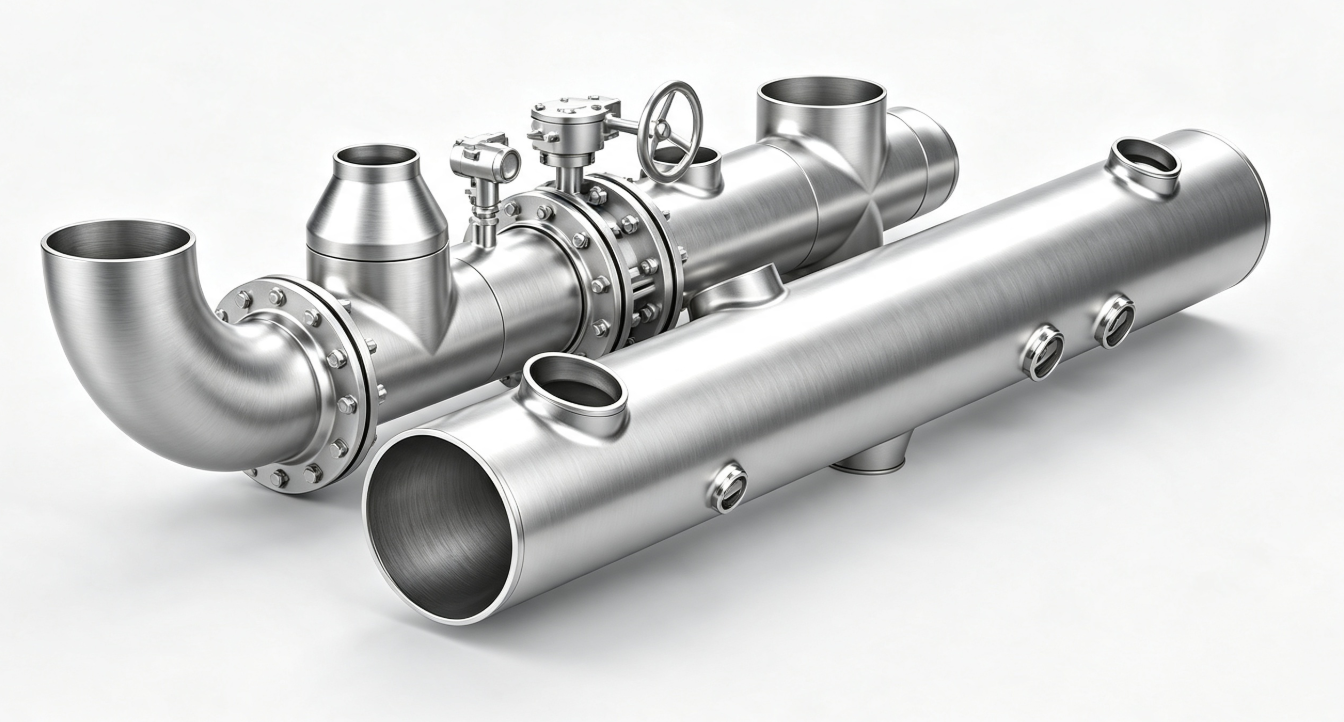
Pipe spools connect equipment, piping sections, valves, tanks, pumps, heat exchangers, and other components within a complete piping system.
In marine engineering, pipe spools can be found in systems such as:
In offshore and oil and gas projects, larger and more complex spools may connect process equipment, storage facilities, pumps, separators, manifolds, and other process units.
Understanding the pipe spooling components is important before looking at fabrication.
The pipe forms the main flow path.
Depending on the service, materials can include:
Stainless steel is often selected where corrosion resistance is required, particularly in marine environments or process services.
Pipe fittings change the direction, size, or configuration of a piping line.
Common fittings include:
Fittings must match the pipe material, dimensions, pressure rating, and applicable standards.
Pipe fittings flanges and other flange components provide detachable connections between piping sections and equipment.
Flanges are commonly used where regular inspection, maintenance, or equipment removal is required.
The flange type and pressure class depend on the piping specification and design conditions.
Valves control or isolate fluid flow.
Common types include:
Valve position, orientation, accessibility, and connection type need to be checked during spool fabrication.
Branch connections allow one pipe to connect to another pipe or equipment line.
They may use:
The branch configuration is normally defined in the engineering drawings and piping specifications.
A spool drawing provides the fabrication information needed to manufacture an individual spool.
Depending on the project, a spool drawing may show:
Accurate spool drawings help fabricators assemble the correct components in the correct sequence.
For complex projects, the drawings may be generated from 3D CAD or piping design software.
The pipe spool fabrication process can vary by project, material, and application. A typical workflow includes the following stages.
Raw materials are received and checked against the material requirements.
The fabricator may verify:
Material traceability is especially important for stainless steel, duplex, super duplex, and other alloy piping.
Pipe is cut to the required dimensions according to the spool drawings.
Cutting methods may include:
Cut edges may require cleaning, beveling, or machining before welding.
Pipe ends are prepared for welding.
The required bevel geometry depends on:
Correct preparation helps achieve the required weld penetration and joint quality.
The fabricator positions the pipe and fittings according to the spool drawings.
Fit-up checks can include:
This stage is important because dimensional errors can make installation difficult later.
After fit-up, the joints are welded using an approved welding procedure.
Depending on the material and project requirements, welding processes may include:
For alloy piping, welding procedures must account for the material properties and service requirements.
After welding, the spool is inspected according to the project quality plan.
Inspection may include:
The exact inspection scope depends on the piping class, material, service, and applicable standards.
Quality control covers more than checking finished welds.
A good fabrication system controls the entire production process.
Typical quality checkpoints include:
Confirm that the correct material is used for each spool.
Check pipe length, angles, flange orientation, and overall spool dimensions.
Confirm that welding procedures, qualified welders, consumables, and preheat or heat treatment requirements are followed.
Complete the required non-destructive testing and inspection.
Maintain records connecting the material heat number, weld number, welder, inspection results, and spool identification.
Maintain:
This documentation helps demonstrate that the piping spools that meet the project requirements have been fabricated and inspected correctly.
Testing confirms that fabricated spools are suitable for their intended service.
Hydrostatic testing uses water or another approved liquid to test the piping system at a specified pressure.
It can help identify:
The test pressure and duration must follow the applicable design code and project specification.
Pneumatic testing uses air or another gas.
Because compressed gas contains stored energy, pneumatic testing requires appropriate safety controls and procedures.
It may be used where hydrostatic testing is impractical or where project specifications allow it.
NDT allows welds and components to be inspected without damaging the spool.
Common methods include:
VT — Visual Testing
Used to inspect visible weld and component conditions.
PT — Liquid Penetrant Testing
Used to detect surface-breaking defects.
MT — Magnetic Particle Testing
Used to detect surface and near-surface discontinuities in suitable ferromagnetic materials.
UT — Ultrasonic Testing
Used to examine internal weld conditions.
RT — Radiographic Testing
Uses X-rays or gamma radiation to examine internal weld characteristics.
The required NDT method and percentage depend on the piping class, material, service, and applicable standards.
After fabrication, the spool may undergo pressure or leak testing.
The test should verify the relevant:
All test results should be documented as part of the quality records.
After testing and inspection, the spool may receive surface treatment.
The treatment depends on the material and service.
For carbon steel, it may include:
For stainless steel, surface treatment may include:
Surface treatment can help protect the piping against the intended corrosion environment.
A prefabricated pipe spool is manufactured in a workshop before being transported to the installation location.
Traditional site fabrication requires more cutting, fit-up, and welding at the construction site.
The two approaches can be compared as follows:
| Factor | Prefabricated Pipe Spool | Site Fabrication |
|---|---|---|
| Fabrication location | Workshop | Construction site |
| Working environment | Controlled environment | Variable |
| Site welding | Reduced | Higher |
| Dimensional control | Easier to control | More difficult |
| Quality inspection | Centralized | Spread across site |
| Material management | Factory controlled | Site controlled |
| Installation | Faster | More fabrication required |
| Site work | Reduced | Higher |
| Safety exposure | Lower site welding exposure | More site welding exposure |
The actual benefits depend on project planning, spool size, transportation limitations, and installation conditions.
One of the main reasons for using prefabricated spools is to reduce the amount of fabrication required during installation.
Instead of receiving individual pipes and fittings and assembling them at the vessel or construction site, the contractor receives completed spool assemblies.
This can reduce:
As a result, the installation team can focus more on positioning, alignment, connecting, and testing the completed spools.
This approach often saves time and reduces the amount of site work.
After fabrication and inspection, the completed spools are transported to the shipyard, vessel, offshore platform, or industrial facility.
A typical installation sequence includes:
Each spool is checked against the installation drawings and spool number.
The spool is moved using suitable lifting and transportation equipment.
Large marine spools require careful handling to prevent deformation or damage.
The spool is placed in the designated installation location.
The spool is aligned with adjacent piping, equipment, and supports.
Where required, field welds connect the spool to adjacent piping sections.
The installed connection is inspected according to the project requirements.
The completed piping system may undergo pressure testing, leak testing, flushing, cleaning, or other commissioning activities.
Modern vessels and offshore facilities contain highly integrated piping networks.
Complex piping systems may have:
Pipe spool fabrication helps divide these large systems into manageable sections.
Instead of fabricating an entire piping network at the installation site, the system is divided into individual spools that can be manufactured, inspected, transported, and installed in sequence.
Pipe spools are not limited to shipbuilding.
They are also widely used in:
In industrial piping systems, spool fabrication can help standardize production and improve coordination between engineering, procurement, fabrication, and construction teams.
For projects with large quantities of repeated piping assemblies, factory fabrication can also simplify production planning.
The material used for a pipe spool depends on the service.
Common options include:
Suitable for many general industrial and marine services when corrosion protection is properly addressed.
Used where stronger corrosion resistance is required.
Used for demanding services requiring a combination of strength and corrosion resistance.
Used for severe chloride and seawater environments and selected high-performance marine applications.
Often used for seawater systems because of its resistance to seawater corrosion.
Material selection should consider the complete piping assembly rather than the pipe alone.
When evaluating pipe spool fabricators, consider more than production capacity.
Important factors include:
Can the fabricator work with spool drawings, 3D models, piping layouts, and project specifications?
Can the company fabricate carbon steel, stainless steel, duplex, super duplex, and other required materials?
Does the fabricator have qualified welding procedures and qualified welders for the required materials?
Can the fabricator provide the required NDT, dimensional inspection, pressure testing, and documentation?
Can the facility handle the required spool sizes, quantities, and delivery schedule?
Can material heat numbers and weld records be traced throughout production?
Does the fabricator understand shipbuilding, offshore engineering, classification requirements, and marine installation conditions?
Can completed spools be safely packaged, marked, and delivered according to the installation sequence?
Factory fabrication provides several practical benefits.
Fabrication takes place in a dedicated workshop rather than a crowded construction area.
Inspection and fabrication processes can be standardized.
Completed spools reduce the amount of welding required during installation.
Installers can position and connect completed sections rather than fabricating every section on site.
Raw materials and spool components can be controlled in one fabrication location.
Less cutting, grinding, fit-up, and welding are required at the installation location.
Spool production can proceed in parallel with other construction activities.
Several problems can affect fabrication and installation.
Small dimensional errors can cause problems when connecting adjacent spools.
Solution: Use dimensional inspection throughout fabrication rather than only at final inspection.
Using the wrong pipe or fitting grade can create serious quality problems.
Solution: Maintain material identification and traceability from receiving through fabrication.
Incorrect flange rotation can make equipment or pipe connections difficult.
Solution: Check flange orientation against the spool drawing during fit-up.
Poor welding can lead to leakage or failure.
Solution: Use qualified welding procedures, qualified welders, and appropriate inspection.
Missing records can delay project acceptance.
Solution: Maintain quality documents throughout fabrication rather than reconstructing them at the end.
A reliable pipe spool program should connect engineering, fabrication, inspection, logistics, and installation.
Recommended practices include:
These practices help ensure that fabricated spools arrive at the installation site ready for the next construction stage.
Marine pipe spools are prefabricated sections of piping manufactured from pipes, fittings, flanges, valves, and other components. They are fabricated and inspected before installation on ships or offshore structures.
Pipe spools consist of one or more sections of pipe combined with components such as elbows, tees, reducers, flanges, valves, branch connections, and other specified fittings.
The pipe spool fabrication process generally includes material inspection, cutting, beveling, fit-up, welding, dimensional inspection, NDT, pressure testing, surface treatment, marking, and final inspection.
Pipe spooling components include straight pipe, elbows, tees, reducers, flanges, valves, branch fittings, couplings, and other components required to create a prefabricated piping assembly.
A prefabricated pipe spool is a completed piping section manufactured in a controlled workshop environment before being transported to the construction site for installation.
Pipe spools reduce the amount of fabrication required on board a vessel or at an offshore construction site. They can reduce site welding, improve quality control, and help installation teams save time.
A spool drawing provides the dimensions, component locations, weld information, material requirements, and other fabrication details needed to manufacture an individual piping spool.
Testing may include visual inspection, dimensional inspection, NDT, hydrostatic testing, pneumatic testing, and leak testing. The exact requirements depend on the piping service, project specifications, design code, and classification requirements.
Marine pipe spools may be manufactured from carbon steel, stainless steel, duplex stainless steel, super duplex stainless steel, copper nickel alloys, and other materials selected for the intended service.
Fabrication work such as cutting, fit-up, welding, inspection, and testing can be completed in the workshop. The finished spool is then transported to the site, where installers mainly perform positioning, alignment, connection, and final testing.
Yes. Pipe spools are widely used in oil and gas facilities, refineries, petrochemical plants, offshore platforms, and other industrial facilities. They are particularly useful for projects with large and complex piping networks.
Quality control covers material verification, dimensional checks, welding, NDT, pressure testing, traceability, and documentation. A structured quality control process helps ensure that piping spools that meet the project requirements are released for installation.
Marine pipe spools provide a practical way to move much of the piping fabrication process from the construction site to a controlled workshop environment.
The process starts with approved spool drawings and verified materials. Fabricators then cut, prepare, fit, and weld the components before completing dimensional inspection, NDT, pressure testing, surface treatment, and final quality checks.
Using a prefabricated pipe spool can reduce site welding and other site work, improve production control, and help installation teams save time. This is especially useful for ships, offshore facilities, oil and gas projects, and other industrial piping systems with complex piping layouts.
For marine and offshore projects, successful spool fabrication depends on accurate engineering, suitable materials, qualified welding, reliable inspection, full traceability, and careful installation planning.