

EN
Get In Touch

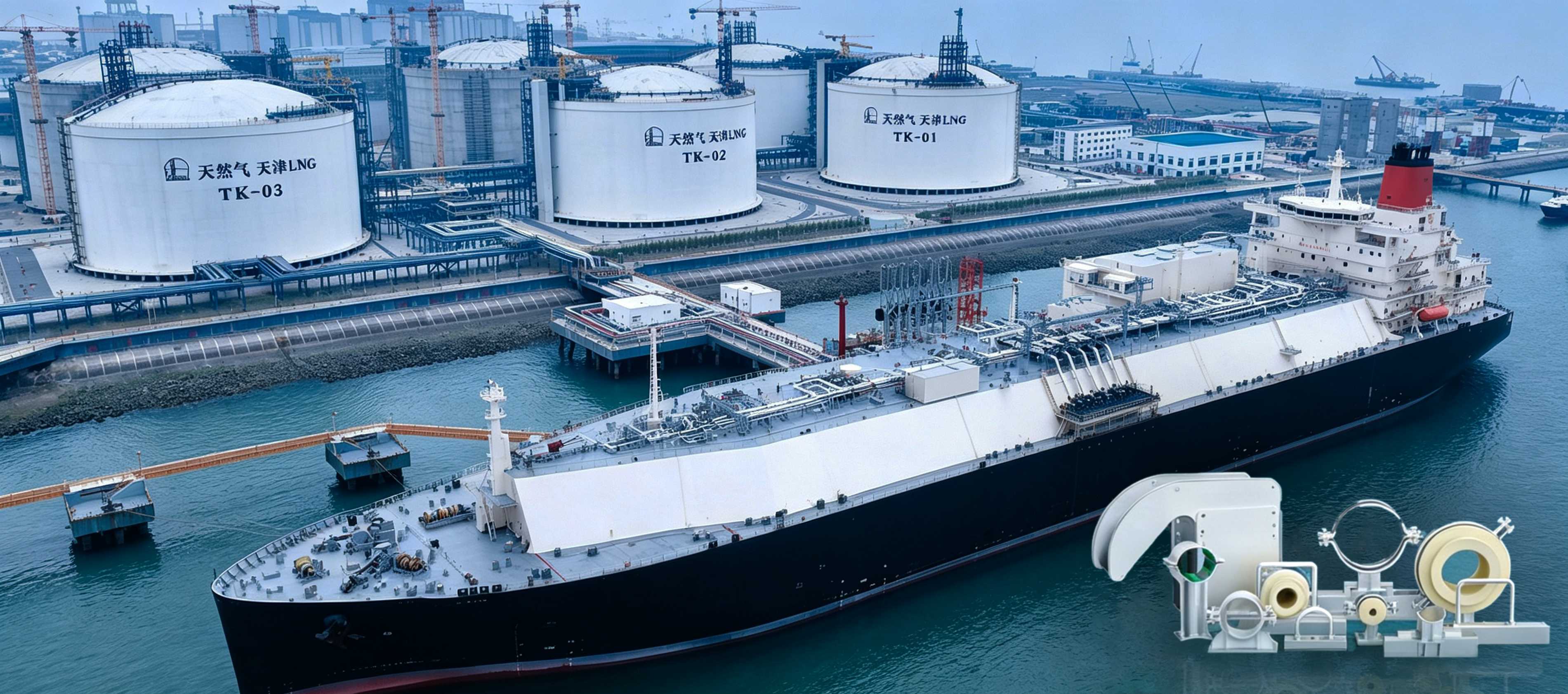
Marine pipe supports and saddles are structural components used to hold, guide, align, and protect pipes installed on ships and offshore structures. They help maintain stable pipe runs, distribute loads, reduce vibration, and support the long-term operation of marine piping systems.
Common types include fixed supports, guides, hangers, clamps, U-bolts, spring supports, and pipe saddles. Among these options, stainless steel supports are widely used because they offer excellent corrosion resistance in marine environments.
Marine pipe supports are devices designed to carry the weight of pipes and maintain their position throughout a vessel or offshore platform.
A pipe saddle is a support structure placed beneath a pipe to distribute the load over a larger surface area. In many applications, saddles support both the pipe and any additional loads generated by the transported medium, insulation, thermal expansion, and vessel movement.
Unlike standard industrial installations, marine piping must operate under constantly changing conditions. Rolling, pitching, vibration, pressure fluctuations, and temperature changes all affect piping performance.
As a result, marine pipe supports must be designed to withstand:
Every piping system contains pipes, fittings, valves, pumps, and equipment. Without proper support, the system can experience excessive stress, movement, and premature wear.
Marine pipe supports help:
Long pipe runs often require multiple support points to prevent pipe deflection and sagging.
Proper support spacing also helps reduce stress on flanges, pumps, valves, and other connected equipment.
The most basic function of a pipe support is carrying the pipe's weight.
The total load may include:
The support structure must safely transfer these loads to the vessel's deck, bulkhead, or structural framework.
Marine systems often operate near:
These machines generate vibration that can be transferred to connected piping.
Properly designed supports reduce vibration and help prevent fatigue damage.
Pipes expand and contract as temperatures change.
Without proper support, thermal movement can lead to:
Guides, anchors, and spring supports help accommodate thermal expansion while maintaining pipe stability.
Maintaining alignment is especially important in long piping systems.
Improper alignment can create:
Pipe supports keep piping components in their intended position throughout the vessel's operating life.
Several support designs are used in marine applications.
The selection depends on the pipe size, material, location, and operating conditions.
Fixed supports completely restrain pipe movement.
They prevent displacement in multiple directions and are commonly installed at specific locations within the piping system.
Typical applications include:
Pipe guides allow movement in one direction while restricting movement in other directions.
They are commonly used in systems affected by thermal expansion.
Typical applications include:
Pipe hangers suspend piping from overhead structures.
They are often used when floor or deck supports are unavailable.
Common hanger types include:
U-bolts wrap around the pipe and secure it to a structural member.
They are commonly used because of their simple design and ease of installation.
U-bolts are often combined with support plates or pipe saddles.
Spring supports compensate for vertical pipe movement caused by thermal expansion.
They maintain relatively constant support forces while allowing movement.
They are commonly found in:
Pipe saddles provide support underneath the pipe.
Instead of concentrating the load at one point, the saddle distributes the load over a larger contact area.
Because saddles support the pipe from below, they are often selected for:
Material selection depends on the operating environment, temperature, pressure, and corrosion requirements.
Stainless steel is one of the most common materials used for marine pipe supports.
Advantages include:
Common grades include:
Suitable for many general applications.
316L stainless steel contains molybdenum, which improves resistance to chloride corrosion.
It is frequently used in:
Carbon steel is widely used because it is economical and easy to fabricate.
However, it usually requires protective coatings when used in marine environments.
Common protection methods include:
Duplex stainless steel combines high strength with excellent corrosion resistance.
It is often used in demanding offshore applications where conventional stainless steel may not provide sufficient performance.
Super duplex stainless steel offers higher resistance to chloride-induced corrosion.
Typical applications include:
Although the terms are sometimes used interchangeably, they perform different functions.
| Feature | Pipe Supports | Pipe Saddles |
|---|---|---|
| Primary function | Support and restrain piping | Support the pipe from below |
| Pipe movement | May restrict movement | May allow limited movement |
| Contact area | Smaller | Larger |
| Best application | General piping | Heavy or large-diameter piping |
| Load distribution | Localized | More evenly distributed |
Pipe saddles are especially useful when supporting large-diameter pipes that carry significant loads.
Several factors should be evaluated during support selection.
Larger pipes generate higher loads and may require additional support points.
Engineers should consider:
Different materials have different mechanical properties.
Common piping materials include:
Material selection influences support design and load calculations.
Temperature changes affect pipe expansion.
High-temperature systems may require:
Pressure affects pipe wall thickness and total system weight.
High-pressure piping systems often require stronger support structures.
Support design differs depending on where the piping is installed.
Typical marine installation areas include:
Environmental conditions should always be considered during the design stage.
Support spacing depends on:
Insufficient supports may lead to sagging.
Excessive supports can restrict thermal movement.
Engineers must balance both considerations.
Engine rooms contain numerous piping systems operating in limited spaces.
Supports must accommodate:
Cargo piping often transports liquids or gases under controlled conditions.
Support structures must maintain system integrity during loading and unloading operations.
Fuel systems may experience temperature variations and pressure changes.
Proper support helps maintain alignment between pumps, valves, and fuel supply lines.
Offshore installations are exposed to:
In these environments, stainless steel and duplex stainless steel supports are frequently used.
Insufficient support spacing can cause pipes to bend over time.
Solution: Recalculate support intervals and add additional support points.
Poorly supported piping may experience vibration-induced fatigue.
Solution: Use vibration-resistant support designs.
Marine environments accelerate corrosion.
Solution: Select suitable materials such as stainless steel or apply protective coatings.
Restricting pipe movement may create excessive stress.
Solution: Use guides, spring supports, or expansion compensation devices.
Improper support placement may transfer loads to pumps, valves, or equipment nozzles.
Solution: Verify alignment during installation and inspection.
Recommended practices include:
Modern shipbuilding increasingly uses:
As piping systems become more integrated, support systems are also becoming more standardized.
Digital modeling allows engineers to coordinate pipes, supports, valves, and equipment before fabrication begins.
This approach reduces installation conflicts and improves construction efficiency.
Marine pipe supports are structural components used to carry, guide, align, and stabilize pipes installed on ships and offshore structures.
A pipe saddle is a support placed beneath a pipe to distribute the load over a larger surface area.
Pipe supports include a wide range of support devices such as anchors, guides, clamps, hangers, and saddles. Pipe saddles are a specific type of support designed to carry the pipe from below.
Stainless steel offers excellent resistance to corrosion, high humidity, and seawater exposure. It also provides a long service life with relatively low maintenance.
Common materials include carbon steel, stainless steel, 316L stainless steel, duplex stainless steel, and super duplex stainless steel.
Support locations are determined by factors such as pipe size, weight, material, temperature, operating pressure, and pipe length.
Long pipe runs generate larger bending forces and are more likely to sag. Additional support points help maintain alignment and reduce mechanical stress.
They are commonly used in engine rooms, fuel systems, cargo systems, cooling systems, fire-fighting systems, ballast systems, and offshore modules.
Saddles support pipes by distributing loads across a larger contact area. This reduces localized stress and helps protect the pipe.
Engineers should evaluate pipe size, material, operating temperature, operating pressure, environmental conditions, support spacing, corrosion resistance, maintenance requirements, and installation location.
Marine pipe supports and saddles provide the structural foundation for safe and reliable piping systems.
Whether supporting short pipe sections or long pipe runs, the correct support design helps maintain alignment, control vibration, distribute loads, and extend service life.
By selecting suitable materials such as stainless steel and matching the support type to the operating conditions, shipbuilders and offshore engineers can improve the performance and durability of marine piping installations.