

EN
Get In Touch

Marine piping systems are networks of pipes, fittings, valves, supports, and prefabricated pipe spools used to transfer liquids, gases, fuel, seawater, and other fluids on ships and offshore facilities. Common marine piping systems include fuel oil, cooling water, ballast, bilge, fire-fighting, cargo, compressed air, and fuel gas systems. Marine piping design considers pipe size, pressure, temperature, corrosion resistance, vibration, thermal expansion, installation space, material compatibility, and applicable classification requirements.
A marine piping system is an engineered arrangement of pipes and piping components that transports fluids or gases between tanks, machinery, equipment, and other systems on a vessel or offshore installation.
A typical marine piping system may include:
Unlike many land-based piping systems, marine piping operates in a compact and moving environment. Ships are exposed to vibration, wave motion, saltwater, temperature changes, and limited installation space. Piping systems must therefore be designed around both fluid service and vessel operating conditions.
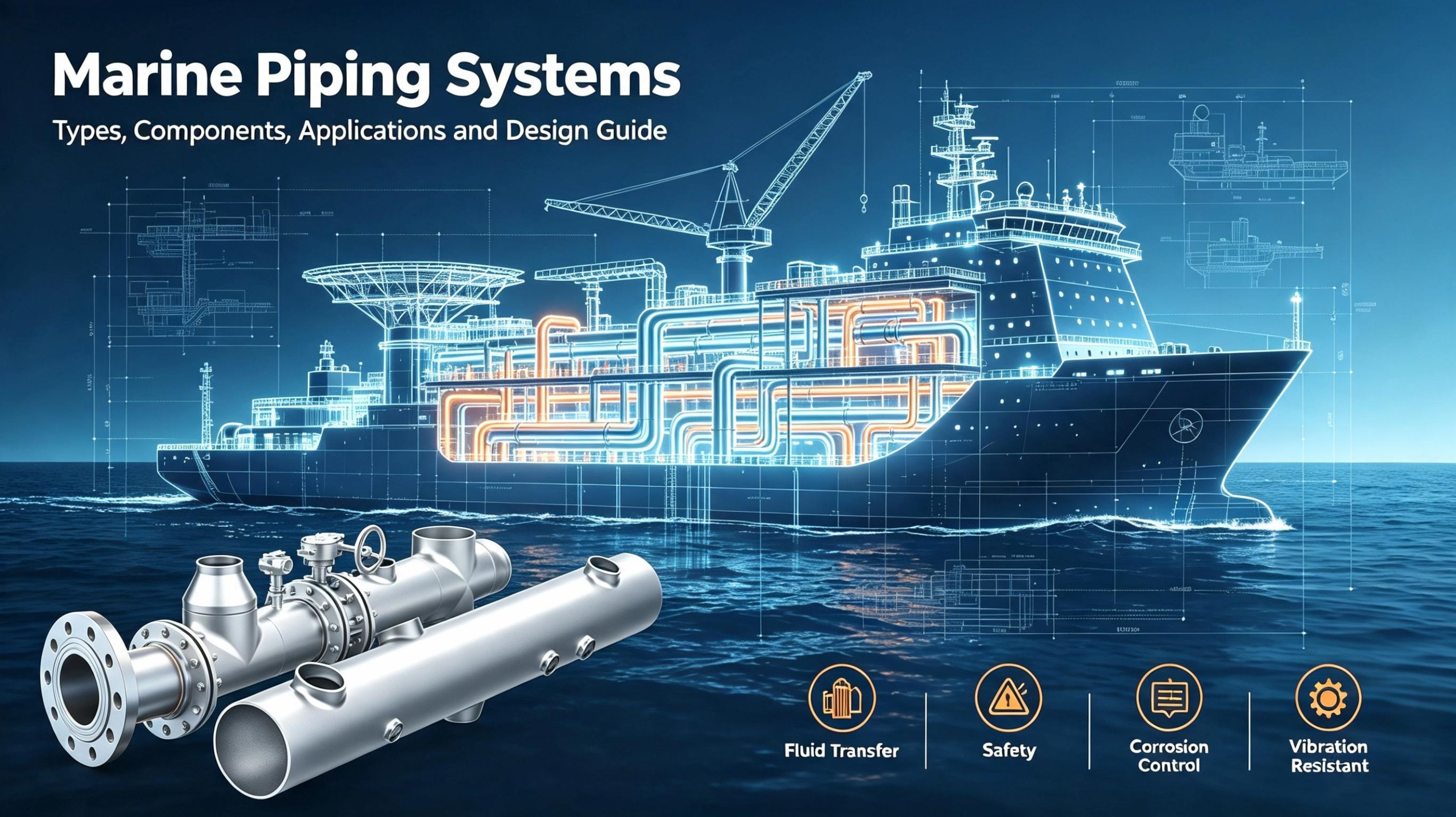
Marine piping covers many different services. The exact arrangement depends on the vessel type, propulsion system, cargo, fuel, and operating profile.
Fuel oil piping transfers fuel from storage tanks to settling tanks, service tanks, treatment equipment, engines, boilers, and other consumers.
A fuel oil system may include:
Heavy fuel oil may require heating to reduce viscosity and support proper pumping and injection. Pipe material, insulation, heating arrangements, valve selection, and pressure rating should match the fuel service.
Gas-fueled vessels require piping systems designed for gaseous fuels such as LNG.
A fuel gas system may connect:
Fuel storage → fuel preparation → fuel gas supply → engine or other consumer
For LNG-fueled vessels, some sections of the system may operate at cryogenic temperatures. A double wall pipe may be used where secondary containment is required by the system design and applicable marine rules.
A fuel gas piping system can include:
Ballast piping transfers seawater between ballast tanks and the sea or between different tanks.
Typical components include:
Ballast piping is exposed to seawater and therefore requires suitable corrosion protection and material selection.
Bilge systems collect and remove water and other liquids from machinery spaces, cargo areas, and other compartments.
A typical bilge system includes:
The arrangement must prevent unwanted backflow and allow drainage from designated spaces.
Cooling systems remove heat from engines, generators, compressors, and other equipment.
Common arrangements include:
Seawater lines need good resistance to corrosion and marine fouling. Freshwater circuits may require different materials and treatment methods.
Fire-fighting piping supplies water to fire hydrants, hoses, sprinkler systems, water mist systems, and other fire protection equipment.
The system normally includes:
Fire-fighting piping is designed around the vessel's fire protection arrangement and applicable classification and statutory requirements.
Cargo piping is used to load, transfer, discharge, or process liquid or gaseous cargo.
The design varies widely between:
Cargo service can impose specific requirements on pipe material, valve construction, cleanliness, insulation, temperature control, and leak protection.
Compressed air systems supply air to:
Starting-air piping may operate at relatively high pressure, so pipe sizing, wall thickness, fittings, valves, and pressure testing need to match the system design.
Marine vessels also contain piping associated with exhaust gas, drains, vents, overflow, and tank systems.
These systems may experience:
Material selection and support design should account for these conditions.
A marine piping system is more than a network of straight pipes. Its performance depends on the complete piping assembly.
Seamless stainless steel pipe is widely used in marine and offshore applications where corrosion resistance, mechanical strength, and clean internal surfaces are required.
Stainless steel can be selected for services involving:
Common grades include 304/304L, 316/316L, duplex stainless steel, and super duplex stainless steel. The correct grade depends on the fluid, temperature, chloride exposure, pressure, welding requirements, and applicable specifications.
For demanding offshore environments, duplex and super duplex stainless steels can offer higher strength and improved resistance to chloride-related corrosion compared with many conventional stainless steel grades.
A pipe fitting changes the direction, size, or connection arrangement of a piping line.
Common marine fittings include:
Fittings must match the pipe material, dimensions, pressure class, connection method, and service conditions.
For example, a stainless steel pipe system should use compatible fittings to maintain corrosion resistance and mechanical performance throughout the piping assembly.
Valves control, isolate, regulate, or prevent the flow of fluids.
Marine piping systems may use:
Valve selection depends on the fluid, pressure, temperature, flow rate, required shut-off function, installation position, and operating method.
In fuel and gas systems, valve design may also need to address fire safety, leakage control, remote operation, and emergency shutdown requirements.
Flanges provide detachable connections between pipes, valves, equipment, and other components.
A flanged connection can simplify:
The flange type, pressure rating, facing, gasket, bolt material, and dimensions must be compatible with the piping system.
Marine pipes cannot simply be suspended from equipment or bulkheads without proper support.
Pipe supports help:
The support arrangement should consider pipe weight, fluid weight, insulation, operating temperature, dynamic loads, vibration, and vessel movement.
A pipe spool is a prefabricated section of piping manufactured according to engineering drawings before delivery to the shipyard or installation site.
A pipe spool may contain:
Pipe spools are normally fabricated in a controlled workshop environment. Depending on the project, fabrication can include cutting, beveling, fit-up, welding, inspection, non-destructive testing, pressure testing, surface treatment, and final dimensional inspection.
Using pipe spools can reduce the amount of cutting, fit-up, and welding required during vessel construction.
A double wall pipe consists of an inner pipe and an outer pipe or enclosure. The outer layer provides secondary containment around the primary piping.
This arrangement is used in applications where leakage control and secondary containment are required.
Typical applications include:
The space between the inner and outer pipes may be monitored or ventilated depending on the system design.
| Feature | Single-Wall Pipe | Double Wall Pipe |
|---|---|---|
| Primary fluid containment | Yes | Yes |
| Secondary containment | No | Yes |
| Leak monitoring | Limited | Can be integrated |
| Construction | Simpler | More complex |
| Installation space | Lower | Higher |
| Typical use | General services | Fuel, gas and selected hazardous services |
Double wall pipe should not be selected simply because it provides an additional pipe layer. The design needs to consider the fluid, pressure, temperature, ventilation, leak detection, support arrangement, inspection access, and applicable marine rules.
Material selection depends on the service rather than one material being suitable for every marine application.
Stainless steel is used where corrosion resistance and durability are required.
Typical applications include:
Duplex stainless steel combines high strength with good corrosion resistance.
It is often considered for:
Super duplex stainless steel provides high alloy content and strong resistance to chloride-containing environments.
It can be suitable for demanding offshore and marine applications where both strength and corrosion resistance are required.
Carbon steel remains common in many marine piping applications because of its strength, availability, and cost.
It may require:
The final selection should be based on the service specification and project requirements.
Good marine piping design starts with the operating conditions.
Pipe diameter affects:
Pipe sizing should therefore be based on the required flow rate and allowable pressure loss.
The piping system must withstand the expected operating pressure and applicable design pressure.
The pressure rating of the complete assembly should be considered, including:
All components should be selected and rated according to the applicable design standard and project specification.
Temperature affects material strength, thermal expansion, insulation, gasket selection, and valve performance.
Cryogenic services such as LNG require materials and components suitable for very low temperatures.
High-temperature services also require attention to thermal expansion and support loads.
Marine environments contain saltwater and high levels of humidity. Corrosion protection should therefore be considered from the early design stage.
Depending on the application, measures may include:
Ship engines, pumps, compressors, and other rotating equipment can create vibration.
Poorly supported piping may experience fatigue, noise, joint damage, or excessive movement.
Support spacing and connection design should therefore be checked against operating conditions.
Pipes change length when their temperature changes.
Long piping runs may require:
The design must allow movement without placing excessive loads on equipment nozzles or pipe connections.
Ships have limited space. Pipes often need to pass through machinery spaces, decks, bulkheads, and equipment areas.
The design must consider:
A compact design is useful, but maintenance access should not be sacrificed.
Piping should be arranged so that trapped liquid or gas can be safely drained or vented where required.
This is especially important for:
Welding quality affects the performance and service life of pipe spools.
The fabrication procedure may include:
For stainless steel and duplex materials, fabrication controls should also address heat input, cleanliness, shielding gas, interpass temperature, and post-weld treatment where specified.
Pipe spool fabrication moves much of the pipe assembly work from the shipyard to a controlled factory environment.
Instead of sending loose pipes, fittings, and valves to the shipyard for extensive assembly, a manufacturer can produce completed pipe spools before delivery.
Engineering → Material Procurement → Cutting → Beveling → Fit-Up → Welding → Inspection → Testing → Surface Treatment → Packing → Delivery → Installation
Each stage has a defined purpose.
Fabrication starts with approved drawings, material specifications, dimensions, weld details, and identification requirements.
Pipe, fittings, flanges, valves, and other components are checked against the project specification. Material certificates and identification records are maintained where required.
Pipes are cut to the required dimensions. Pipe ends may be beveled to prepare them for welding.
Pipe sections and fittings are aligned according to the fabrication drawings.
Qualified welding procedures and welders are used according to the project requirements.
Welds and dimensions are inspected. Non-destructive testing may include visual inspection, radiographic testing, ultrasonic testing, magnetic particle testing, or liquid penetrant testing, depending on the material and project requirements.
Pipe spools may undergo pressure or leak testing according to the applicable specification.
Depending on the material and service, surface treatment may include:
Completed pipe spools are identified, protected, packed, and delivered according to the installation sequence where required.
Factory fabrication can offer several practical benefits for shipbuilding and offshore projects.
Factory fabrication provides controlled working conditions for cutting, welding, inspection, and surface treatment.
Completed pipe spools can reduce the amount of welding required inside the vessel.
Inspection records, material traceability, weld records, and dimensional checks can be managed before shipment.
Ready-to-install pipe spools can reduce the amount of pipe assembly required at the construction site.
When pipe spools and other materials are delivered according to the installation schedule, shipyards may reduce the amount of loose pipe, fittings, and other components stored on site.
Different vessels require different combinations of piping systems.
| Vessel Type | Typical Piping Systems |
|---|---|
| Container Ship | Fuel, ballast, bilge, cooling, fire-fighting, compressed air |
| LNG Carrier | Cargo, LNG fuel, gas supply, ballast, cooling, fire-fighting |
| Chemical Tanker | Cargo, tank cleaning, heating, ballast, fuel, fire protection |
| Oil Tanker | Cargo, fuel, ballast, tank heating, fire-fighting |
| LPG Carrier | Cargo, gas, refrigeration, fuel, ballast, fire protection |
| Offshore Vessel | Fuel, seawater, cooling, hydraulic, process and utility piping |
| FPSO | Process, produced water, seawater, utility, fuel, fire-fighting and high-pressure piping |
The final piping arrangement depends on the vessel design, cargo, machinery, fuel type, operating profile, and project specifications.
Marine piping is normally designed, fabricated, inspected, and tested according to the requirements applicable to the vessel and its classification.
Major classification societies include:
Requirements can cover areas such as:
The exact requirements depend on the vessel type, piping service, material, pressure, temperature, and applicable class rules.
Choosing a marine piping supplier involves more than comparing product prices.
Consider the following areas.
Check whether the supplier can manufacture the required:
For demanding marine and offshore projects, check experience with:
A supplier with pipe spool fabrication and module integration capability can provide more than individual piping components.
This can reduce the number of separate fabrication and assembly activities that need to be managed at the shipyard.
Check whether the supplier can support:
Confirm that the supplier has experience working with the classification society and standards required for the project.
For marine and offshore projects, material certificates, weld records, inspection reports, testing documents, and product traceability should be properly managed.
For large projects, production capacity, logistics, packaging, delivery schedules, and after-sales support should also be evaluated.
A traditional project may require a shipyard to purchase pipes, fittings, valves, supports, and other components from several suppliers.
These components then need to be stored, sorted, cut, welded, inspected, and assembled at the shipyard.
An integrated manufacturing approach can move more of this work into a controlled factory environment.
A supplier can provide:
Raw Materials → Piping Components → Pipe Spool Fabrication → Module Integration → Testing → Delivery
This reduces the number of separate activities that the shipyard needs to coordinate.
For large marine projects, this approach can help reduce:
It can also make production planning easier when pipe spools and modules are delivered according to the construction sequence.
YADA Green Energy Solutions provides marine and offshore piping products and integrated engineering services for shipbuilding and offshore projects.
Its product portfolio covers stainless steel seamless pipes, pipe fittings, valves, pipe spools, double wall pipes, pipe supports and saddles, channel walls and pipe racks, skid units, and related marine equipment.
YADA also provides factory pipe prefabrication, pipe spool fabrication, module integration, installation, and commissioning services.
For offshore projects, its capabilities include heavy-wall and high-pressure super duplex stainless steel piping, pipe fittings, prefabricated pipe spools, skid units, and pipe rack solutions.
The company operates manufacturing facilities in Zhejiang and Jiangsu, with a combined annual production capacity of up to 100,000 tons across its product range. Its qualifications include certifications and approvals from major marine classification societies, as well as ASME accreditation and NORSOK M-650 qualification.
For projects that require more than individual piping components, YADA can combine manufacturing, pipe spool fabrication, prefabrication, module integration, and project support into an integrated supply model.
The main types include fuel oil, fuel gas, ballast, bilge, cooling water, fire-fighting, cargo, compressed air, exhaust, drain, vent, and utility piping systems.
Common materials include carbon steel, stainless steel, duplex stainless steel, and super duplex stainless steel. The appropriate material depends on the fluid, temperature, pressure, corrosion environment, and project requirements.
A double wall pipe provides primary fluid containment together with secondary containment. It is commonly considered for LNG, fuel gas, and selected hazardous-fluid piping applications where leak protection and monitoring are required.
A marine pipe spool is a prefabricated section of piping made from pipes, fittings, flanges, valves, and other specified components. It is normally fabricated and inspected before being delivered for installation.
Pipe spool fabrication refers to manufacturing individual pipe spools according to engineering drawings. Pipe prefabrication is a broader term that describes factory-based preparation and assembly of piping before site installation. Pipe spool fabrication is therefore one common form of pipe prefabrication.
Seamless stainless steel pipe can provide corrosion resistance, mechanical strength, and good performance in demanding fluid services. Specific grades are selected based on the application and project requirements.
A pipe fitting is mainly used to connect pipes or change their direction, size, or configuration. A valve is used to start, stop, isolate, regulate, or prevent fluid flow.
Factory pipe spool fabrication can reduce on-site welding and assembly. It can also improve fabrication control, simplify material management, support quality inspection, and reduce installation work at the construction site.
Major classification societies include DNV, ABS, Lloyd's Register, Bureau Veritas, ClassNK, CCS, KR, RINA, and IRS. Applicable requirements depend on the vessel and piping service.
Evaluate the supplier's manufacturing capacity, material range, pipe spool fabrication capability, engineering support, quality system, classification experience, testing capability, delivery capacity, and ability to provide integrated project services.
Marine piping systems connect tanks, machinery, equipment, and process systems that allow a vessel or offshore facility to operate.
A complete system may include seamless stainless steel pipe, pipe fittings, valves, pipe supports, pipe spools, and double wall pipe for selected fuel or hazardous-fluid applications.
The right design depends on the fluid, pressure, temperature, corrosion environment, vibration, thermal expansion, installation space, vessel type, and applicable classification requirements.
For large shipbuilding and offshore projects, pipe spool fabrication can move much of the fabrication work away from the construction site. This can reduce on-site welding, material handling, storage, and installation work.
Factory pipe prefabrication also allows components to be inspected, tested, treated, and prepared before they reach the installation site. For projects with large quantities of piping, this approach can help improve production planning and site coordination.