

EN
Get In Touch

Liquid cargo systems on chemical and gas carriers are designed to load, transport, store, and unload liquid cargo safely and efficiently. A typical system combines cargo tanks, pumps and pipelines, valves, manifolds, instrumentation, safety devices, and control systems.
For chemical and gas carriers, the right handling system depends on the cargo properties, tank arrangement, pressure and temperature requirements, transfer rates, and vessel design. A well-designed system helps ensure smooth operations, reduce cargo losses, improve loading and unloading process control, and minimize the risk of leaks, contamination, overpressure, and unsafe exposure.
A liquid cargo system is the integrated equipment and piping arrangement used to transfer liquid cargo between a vessel, terminal, storage facilities, and other connected systems.
The system normally includes cargo tanks, pumps and pipelines, valves, manifolds, filters, measurement devices, control systems, and safety equipment. On chemical and gas carriers, the design must also account for cargo compatibility, vapor behavior, pressure, temperature, corrosion, and the specific requirements of the cargo.
Liquid cargo systems support many types of cargo, including chemicals, liquefied gases, petroleum products, vegetable oils, and other liquid products. Each cargo may require different materials, equipment, and operating procedures.
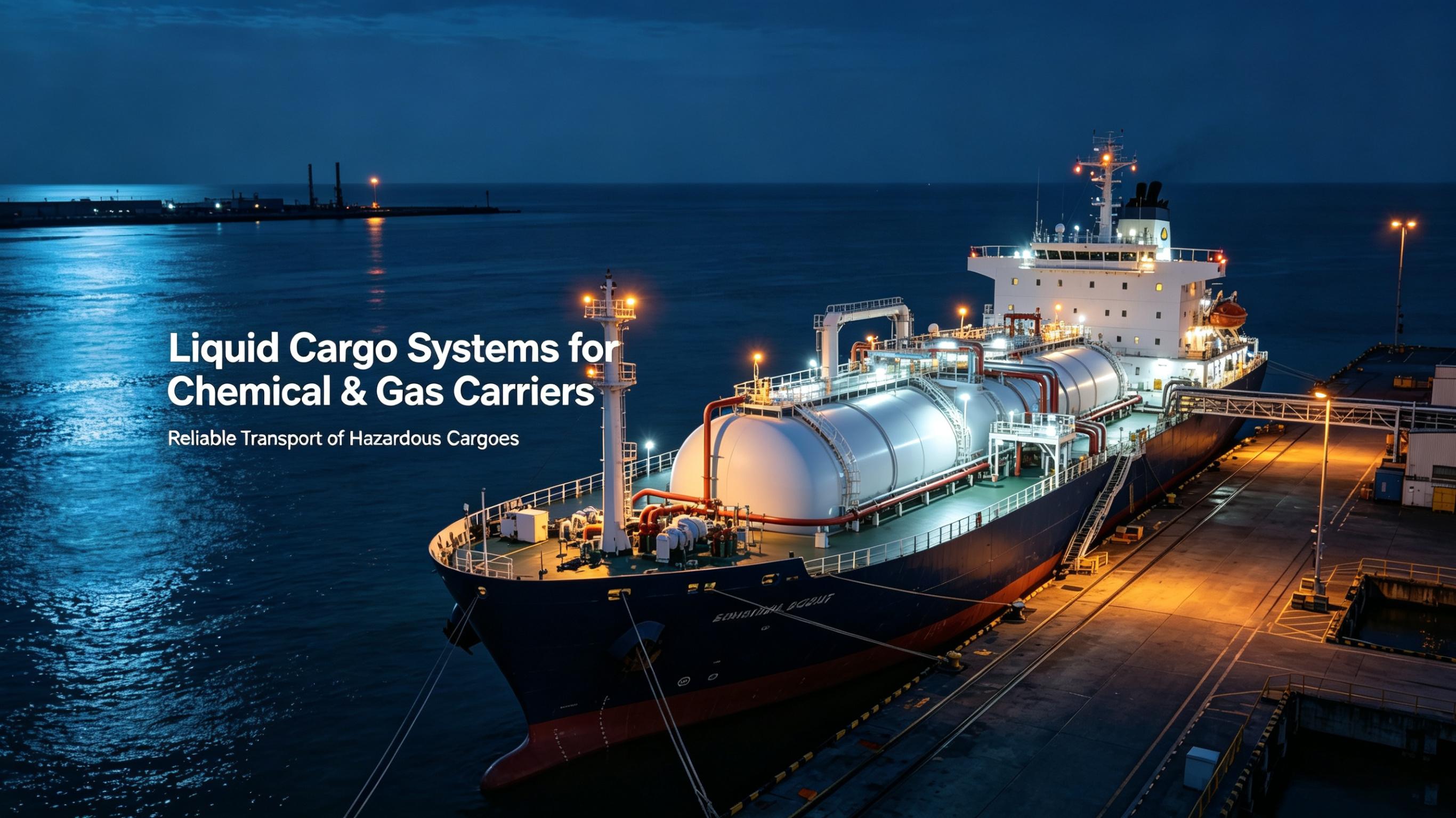
Liquid cargo handling is one of the main shipboard cargo operations. Large volumes of cargo may need to move between tanks and shore facilities within a limited port stay.
A reliable system helps operators control flow rates, pressure, temperature, and tank levels during transfer. It also supports safe coordination between the vessel and terminal.
The main goals are:
For shipowners and operators, the design should balance safety, performance, maintenance requirements, and total operating cost. A cost effective system is not simply the system with the lowest purchase price. Equipment life, maintenance, energy use, downtime, and cargo losses should also be considered.
A liquid cargo handling system consists of several connected systems. Their configuration changes according to the vessel type and cargo.
Cargo tanks provide the main containment space for liquid products.
Chemical carriers may have multiple tanks because different products need to be transported separately. Tank materials and coatings must be selected according to cargo compatibility.
Gas carriers use specialized cargo containment systems designed for liquefied gases. Depending on the cargo and vessel type, tanks may operate at low temperature, controlled pressure, or both.
Tank design can also affect pumping performance, cargo segregation, tank cleaning, and unloading efficiency.
Cargo pumps move liquid cargo from one location to another.
Common arrangements include:
Pump selection depends on cargo viscosity, density, temperature, pressure, required flow rate, and tank arrangement.
For example, a low-viscosity liquid may be suitable for a centrifugal pump, while a higher-viscosity product may require a different pumping arrangement.
Cargo pipelines connect tanks, pumps, manifolds, valves, and shore connections.
Pipeline design considers:
Material selection is particularly important for chemical cargo. Stainless steel and other corrosion-resistant materials are often selected when the cargo can attack conventional carbon steel.
Valves control cargo flow and isolate individual sections of the system.
Depending on the application, a system may use:
Actuated valves can be integrated with the vessel's control system. This allows operators to open, close, or isolate sections of the handling system from a central location.
Cargo manifolds provide the connection between the ship's cargo pipelines and shore transfer equipment.
A manifold arrangement may include separate connections for different cargo tanks or products. Correct identification and isolation of each line help prevent cross-connection and contamination.
The manifold area also needs suitable drainage, access, inspection, and emergency isolation arrangements.
Modern handling systems use sensors and instruments to monitor cargo conditions in real time.
Typical measurements include:
Real time monitoring allows operators to identify abnormal conditions before they develop into larger problems.
The loading and unloading process must be planned around the vessel, cargo, terminal, and transfer equipment.
Before cargo transfer begins, ship and shore teams normally confirm the cargo type, quantity, transfer sequence, communication method, emergency procedures, valve line-up, and equipment condition.
The compatibility of the cargo with tanks, pipelines, pumps, seals, and other wetted components should also be confirmed.
The correct valves are opened or closed according to the transfer plan.
Unused lines are isolated where required. Drain points, vents, pumps, and measurement equipment are checked before transfer starts.
Incorrect valve line-up can send cargo to the wrong tank or create unwanted pressure conditions, so this stage requires careful verification.
Cargo transfer normally starts at a controlled rate.
Operators monitor pressure, flow, tank level, and pump performance. The transfer rate may then be increased when the system reaches stable operating conditions.
Communication between the vessel and terminal should continue throughout the operation.
During loading and unloading cargo, operators watch for changes in pressure, temperature, flow, tank levels, and equipment condition.
If an abnormal condition appears, the transfer rate can be reduced or the system can be stopped according to the operating procedure.
This approach supports safe and efficient cargo operations while minimizing the risk of spills, overfilling, equipment damage, and unexpected shutdowns.
When the required cargo quantity has been transferred, the relevant valves are closed in the planned sequence.
Remaining cargo in pipelines may need to be drained, stripped, recovered, or returned to the appropriate tank. The exact procedure depends on cargo characteristics and vessel design.
Chemical cargoes can vary widely in toxicity, corrosiveness, viscosity, flammability, and chemical compatibility.
As a result, chemical carriers often require careful cargo segregation and material selection.
Pipe, valve, pump, gasket, seal, coating, and tank materials should be compatible with the cargo.
A material that works well with one chemical may not be suitable for another. Material compatibility should therefore be checked against the actual cargo specification rather than based only on general material categories.
Different chemicals may need separate tanks and independent pipelines.
Segregation reduces the possibility of contamination and unwanted chemical reactions. It also makes the vessel more flexible when carrying different types of cargo.
Tank cleaning can be an important part of chemical cargo operations.
Cleaning requirements depend on the previous cargo, next cargo, tank coating, residues, and environmental requirements. Proper cleaning can reduce contamination and help prepare tanks for the next loading operation.
Some chemicals can cause rapid corrosion if the wrong material is selected.
The handling system should therefore consider corrosion resistance during pipe, valve, pump, tank, and fitting selection. Inspection and maintenance programs should also account for the cargo being carried.
Gas carriers have additional requirements because liquefied gases can have low boiling points and may be handled under controlled pressure and temperature conditions.
The cargo system may include:
The exact arrangement depends on the gas being transported and the carrier design.
For liquefied gases, temperature and pressure control are closely connected. A change in cargo temperature can affect vapor pressure, tank pressure, and cargo handling conditions.
Pumps and pipelines should be designed as one integrated system rather than as separate components.
Pipeline pressure loss affects pump selection and energy consumption. Pipe diameter affects flow velocity and pressure drop. Pump capacity affects transfer time and system control.
An efficient design considers the complete flow path.
For example, engineers may review:
This helps avoid both undersized and oversized equipment.
An undersized pipeline may create excessive pressure loss and limit cargo transfer rates. An oversized system may increase material, installation, and maintenance costs without providing a useful operational benefit.
Automation has become increasingly common in modern cargo handling systems.
A centralized control system can collect data from pumps, valves, tanks, flow meters, pressure sensors, and other instruments.
Operators can use this information to monitor cargo operations in real time.
Common functions include:
Automation does not remove the need for trained operators. Instead, it gives operators better information and faster access to system status.
Safety should be considered from system design through daily operation.
Important measures include:
Tank level monitoring and high-level alarms help prevent excessive filling.
Automatic shutdown arrangements may also be used where required by the vessel design and applicable rules.
Leak detection systems can help identify abnormal conditions in cargo lines, tanks, and connected equipment.
Early detection helps operators isolate the affected section and minimize the risk of cargo release.
Emergency shutdown systems allow cargo transfer to be stopped quickly when an unsafe condition occurs.
The shutdown system should be coordinated between shipboard and terminal equipment where required.
Pressure relief and pressure monitoring systems protect tanks and pipelines from excessive pressure.
Design pressure should be established according to the vessel's operating conditions and applicable standards.
Gas carriers and vessels handling hazardous or volatile cargo may require fixed or portable gas detection equipment.
Detection systems provide an early warning when hazardous concentrations are present.
Equipment alone cannot ensure safe cargo operations.
Crew members need suitable training in cargo procedures, equipment operation, emergency response, communication, and the characteristics of the cargo being handled.
A cost effective liquid cargo system should deliver reliable performance over its expected service life.
Several factors can improve overall economics.
Pumps, valves, pipes, and instruments should match the actual cargo and operating range.
Overspecification can increase capital costs. Underspecification can result in poor performance and premature failures.
Where practical, prefabricated pipe sections, skids, and modular handling units can reduce onboard fabrication work.
Factory fabrication also allows more inspection and testing before installation on the vessel.
Optimized pipe sizing and layout can reduce unnecessary pressure losses.
Lower system resistance can improve pump efficiency and reduce energy consumption.
Pumps, valves, instruments, and other key components should be accessible for inspection and service.
Poor access can increase maintenance time and vessel downtime.
Monitoring equipment condition can help identify abnormal pump vibration, temperature, pressure, or performance.
This supports planned maintenance rather than relying only on emergency repairs.
Liquid cargo handling is closely connected to wider maritime logistics.
A ship's cargo system affects how quickly cargo can move between the vessel and shore storage facilities. Faster and more predictable transfer can support better berth utilization and terminal planning.
For terminals handling large volumes, even small improvements in transfer efficiency can affect overall cargo throughput.
Efficient cargo handling therefore depends on coordination between:
The vessel and terminal should be treated as one transfer chain during planning and operation.
When selecting or designing a handling system, engineers should review the following factors:
| Design factor | Why it matters |
|---|---|
| Cargo type | Determines material and equipment compatibility |
| Cargo volume | Defines tank and transfer capacity |
| Flow rate | Affects pump and pipe sizing |
| Pressure | Determines equipment and pipeline design requirements |
| Temperature | Affects material performance and cargo behavior |
| Corrosiveness | Influences pipe, valve, and tank material selection |
| Viscosity | Affects pump selection and pressure loss |
| Vapor characteristics | Important for gas carriers and volatile liquids |
| Tank arrangement | Determines pipeline routing and cargo segregation |
| Maintenance access | Affects long-term serviceability |
| Automation level | Determines monitoring and control requirements |
| Safety requirements | Defines alarms, shutdowns, detection, and protection systems |
Different vessels use different arrangements based on the types of cargo they carry.
These systems are designed for liquid chemicals and may include extensive cargo segregation, stainless steel piping, specialized pumps, tank cleaning systems, and dedicated monitoring equipment.
LPG carriers handle liquefied petroleum gases such as propane and butane. Systems typically include cargo pumps, vapor handling equipment, pressure control, gas detection, and emergency shutdown functions.
LNG carriers require systems designed for cryogenic cargo. Low-temperature materials, insulation, boil-off gas management, and specialized cargo pumps are common features.
Oil tankers and product carriers use cargo pumps, pipelines, manifolds, valves, stripping systems, and tank monitoring equipment for transferring liquid petroleum products.
Liquid cargo systems must be designed and operated according to the rules applicable to the vessel, cargo, and trading area.
Depending on the ship and cargo, requirements may involve the IMO, flag administration, classification society, terminal standards, and applicable national regulations.
For chemical and gas carriers, engineers should review the applicable cargo-specific requirements early in the design process.
Compliance should cover more than individual components. The complete handling system, including piping, pumps, valves, instrumentation, safety systems, and operating procedures, needs to work together.
A practical selection process can follow these steps:
This approach helps ensure that the final handling system matches actual cargo operations instead of being selected only from standard equipment specifications.
Regular inspection helps maintain system performance throughout the vessel's service life.
Maintenance programs may cover:
Inspection frequency should reflect equipment condition, cargo properties, operating hours, manufacturer recommendations, and applicable regulations.
For systems handling corrosive or hazardous cargo, inspection should pay particular attention to corrosion, leakage, material degradation, and seal condition.
A liquid cargo handling system is the combination of tanks, pumps and pipelines, valves, manifolds, instruments, controls, and safety equipment used to load, transfer, monitor, and unload liquid cargo on a vessel.
The main components include cargo tanks, cargo pumps, pipelines, valves, manifolds, level and pressure instruments, flow meters, control systems, and safety equipment.
Chemical cargo systems focus heavily on cargo compatibility, segregation, corrosion resistance, and tank cleaning. Gas carrier systems must also manage low temperatures, vapor pressure, boil-off gas, gas detection, and specialized cargo containment requirements.
Pumps provide the force needed to move cargo, while pipelines provide the controlled flow path. Their capacity, pressure rating, material, and layout directly affect transfer efficiency and system performance.
Operators can improve safety through proper equipment selection, cargo compatibility checks, valve line-up verification, tank level monitoring, pressure protection, leak detection, emergency shutdown systems, gas detection, crew training, and clear ship-shore communication.
Real time monitoring gives operators current information about tank levels, pressure, temperature, flow, pump condition, and valve status. This helps them identify abnormal conditions and respond quickly.
Cost savings can come from efficient pump selection, optimized pipeline sizing, reduced pressure loss, prefabricated components, reliable equipment, accessible maintenance points, condition monitoring, and reduced cargo transfer downtime.
Liquid cargo systems can handle many types of cargo, including chemicals, liquefied gases, petroleum products, and other liquid commodities. The equipment and materials must be selected according to the properties of the specific cargo.
Designers should consider cargo compatibility, pipe diameter, flow rate, pressure, temperature, pressure loss, corrosion, thermal expansion, valve arrangement, drainage, maintenance access, and applicable standards.
Cargo segregation prevents incompatible products from mixing and reduces the possibility of contamination or unwanted chemical reactions. It also allows a vessel to carry different products at the same time.
Liquid cargo systems connect the vessel, cargo tanks, pumps, pipelines, manifolds, and shore facilities into one coordinated transfer system. For chemical and gas carriers, the system must match the physical and chemical properties of the cargo as well as the vessel's operating requirements.
Good system design focuses on safe and efficient transfer, reliable monitoring, suitable materials, controlled pressure and temperature, practical maintenance, and clear operating procedures. When these elements are properly integrated, cargo operations can become more predictable, efficient, and cost effective while minimizing the risk of leaks, contamination, equipment damage, and unnecessary downtime.