

EN
Get In Touch

Tank heating coils are heat-transfer components installed inside or around storage tanks to warm and maintain the temperature of liquids. They commonly use steam, hot water, thermal oil, or another heating medium to transfer heat through a metal coil wall into the tank contents.
The main factors in selecting a tank heating coil are the process fluid, required heating temperature, heat-transfer duty, tank size, heating medium, operating pressure, corrosion conditions, material compatibility, and available installation space. Stainless steel and carbon steel are two common material choices, with the final selection depending on fluid chemistry, temperature, pressure, and service conditions.
A tank heating coil is a pipe or tube arranged inside a storage tank or along its external surface to provide controlled heating. A heating medium flows through the coil while heat passes through the coil wall and into the process fluid.
Tank heating coils are often used when a liquid must be:
Unlike direct heating, the heating medium does not normally mix with the stored liquid. This provides indirect heat transfer and allows the process fluid to remain separated from the heating source.
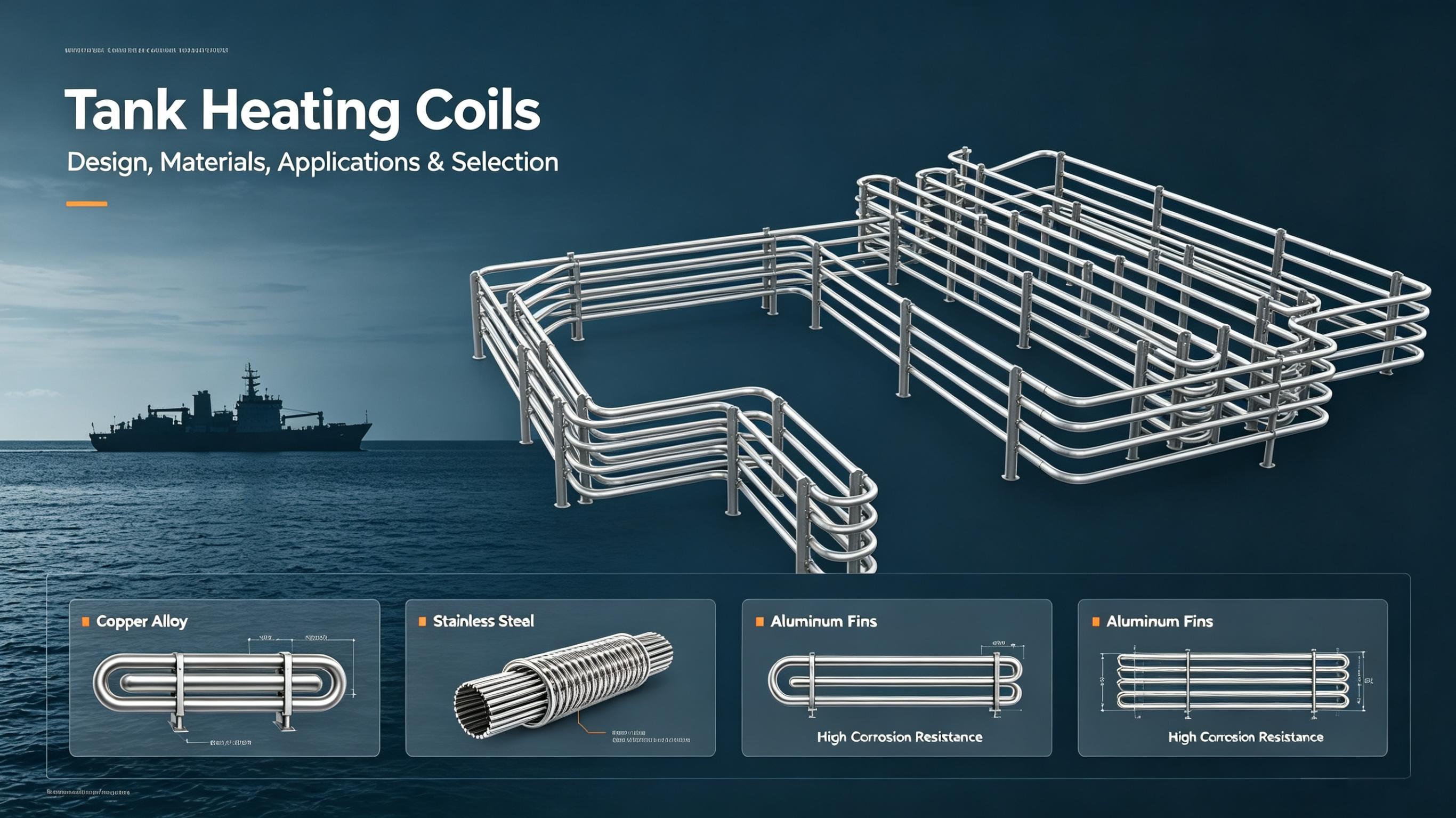
The basic principle is simple. A hot heating medium enters the coil, transfers heat through the metal wall, and leaves at a lower temperature.
The process can be summarized as:
Heating medium → coil wall → process fluid → controlled tank temperature
Steam is often selected when fast heating and high heat-transfer rates are required. Hot water can provide gentler heating and better temperature control for many applications. Thermal oil may be used when a higher operating temperature is needed without using high-pressure steam.
The actual heat-transfer performance depends on several factors, including:
A simplified heat-transfer relationship is:
Q = U × A × ΔT
Where:
This relationship helps engineers estimate the required coil area during preliminary design. Detailed sizing should also consider fluid properties, transient heating requirements, fouling, heat losses, and the selected heating medium.
A good design starts with the operating conditions rather than the coil itself. The coil should be sized and configured around the actual heating requirement of the tank.
The process fluid is one of the first parameters to define.
Engineers should consider:
Low-viscosity liquids can transfer heat more easily than heavy oils or other viscous fluids. A highly viscous liquid may also need circulation or agitation to distribute heat throughout the tank.
The design should identify both the initial and target temperatures.
For example, a tank may need to heat a liquid from 10°C to 60°C. Another application may only require the coil to maintain the contents at 40°C during storage.
These are different heating duties and may require different coil surface areas.
Heat transfer is affected by the temperature difference between the heating medium and the tank contents.
A larger temperature difference can increase the heating rate, but using an excessively hot heating medium may cause:
For temperature-sensitive products, a lower-temperature heating medium combined with a larger coil area may provide better control.
More coil surface area generally provides more heat-transfer capacity, assuming other operating conditions remain suitable.
However, simply increasing the coil length is not always the best solution. A long coil can increase pressure drop, occupy valuable tank space, and make installation and maintenance more difficult.
The design should balance:
Required heat duty + heat-transfer area + pressure drop + tank geometry + maintenance access
Common layouts include:
The best configuration depends on the tank shape, available space, fluid characteristics, required heat duty, and installation method.
For large tanks, the coil may be arranged over a substantial area near the tank bottom or along the tank wall. This helps distribute heat through the stored liquid.
Material selection affects corrosion resistance, service life, fabrication, heat transfer, and maintenance.
Stainless steel is widely used where corrosion resistance and product cleanliness are important.
Common stainless steel grades may include 304/304L and 316/316L, although the correct grade depends on the fluid and service environment.
Advantages can include:
316L stainless steel may be preferred in applications involving chlorides or more demanding corrosive environments, but grade selection should always be based on the actual chemistry and operating conditions.
Carbon steel is often selected for general industrial heating duties where corrosion conditions are manageable.
Advantages include:
Carbon steel may be appropriate for heating water, certain oils, and other compatible fluids. However, corrosion protection and fluid compatibility must be evaluated before selection.
| Factor | Stainless Steel | Carbon Steel |
|---|---|---|
| Corrosion resistance | Generally higher | Lower unless protected |
| Material cost | Usually higher | Usually lower |
| Common use | Corrosive, hygienic, demanding services | General industrial services |
| Maintenance | Often lower in suitable environments | May require corrosion control |
| Fabrication | Good | Good |
| Fluid compatibility | Broad, depending on grade | Must be carefully checked |
| Selection basis | Chemistry and service conditions | Chemistry, coating and service conditions |
The cheapest material is not necessarily the lowest-cost option over the complete operating life of the equipment. Material, fabrication, maintenance, replacement, and downtime should all be considered.
Steam is a common heating medium because it can provide high heat-transfer rates.
Steam heating coils are often used for:
The coil must be designed for the steam pressure and temperature. Condensate drainage is also important for reliable operation.
Hot water provides a more moderate heating source and can be useful where gentle temperature control is required.
It is commonly considered for:
Thermal oil systems can operate at relatively high temperatures while avoiding the need for high-pressure steam in some applications.
They can be suitable for:
The thermal-oil system must be selected according to the required temperature range, fluid compatibility, circulation conditions, and safety requirements.
Tank heating coils are used across many industries.
Heating may be required for heavy fuel oils, lubricating oils, asphalt-related products, and other viscous materials.
Maintaining the right temperature can reduce viscosity and make pumping and transfer easier.
Chemical storage tanks may require heating to maintain product properties or prevent crystallization and solidification.
Material compatibility is particularly important because the wrong coil material can lead to corrosion or contamination.
Heating coils can maintain the temperature of liquids during storage and processing.
Stainless steel is commonly considered for applications where hygiene, cleanability, and corrosion resistance are important.
Tank heating may be used where low temperatures can affect process performance or cause freezing.
The required heating duty is usually determined from tank volume, ambient conditions, target temperature, insulation, and fluid properties.
Many industrial facilities use heated tanks to store or condition process fluids before they are pumped into another part of the production system.
The coil can provide both initial heating and ongoing temperature maintenance.
Selecting the right coil requires more than choosing a material and pipe diameter.
Start with the exact fluid and its properties.
Record:
Calculate how much energy is required to bring the tank from its starting temperature to the target temperature.
The calculation should consider both the fluid and the tank's heat losses.
Choose between steam, hot water, thermal oil, or another suitable medium based on:
Compare stainless steel, carbon steel, and other suitable materials against the actual process environment.
Do not select a material based only on price. Consider corrosion, temperature, pressure, cleaning requirements, and expected service life.
The coil diameter, wall thickness, length, and total surface area should match the required heat-transfer duty and heating-medium flow.
Pressure drop through the coil should also be checked.
The coil must fit inside the tank without interfering with:
A heating system may include:
Good temperature control helps prevent overheating and keeps the stored liquid within its required operating range.
For steam systems, condensate should drain properly. The design should also allow inspection, cleaning, repair, and replacement where required.
Not every tank needs an internal heating coil.
Internal coils provide direct contact between the coil surface and the stored fluid. This can offer efficient heat transfer and a relatively compact arrangement.
External heating methods, such as heating jackets or external circulation systems, can simplify access to the heating surface and may be preferred for certain clean or hygienic processes.
The choice depends on:
Several problems can reduce heating performance.
A coil that is too small may not provide enough heat to reach the target temperature within the required time.
If the tank contents do not circulate well, the liquid near the coil can become much hotter than the rest of the tank.
Agitation, recirculation, or a better coil arrangement may help improve temperature distribution.
Deposits on the coil surface add thermal resistance and reduce heat transfer.
Fouling should be considered when the process fluid contains solids, polymers, salts, or other materials that can build up on heated surfaces.
A coil can fail prematurely if its material is not compatible with the process fluid.
Corrosion assessment should consider fluid chemistry, temperature, concentration, contaminants, and operating conditions.
Steam coils can suffer from poor heating performance if condensate is not removed effectively.
The steam system should be designed with appropriate condensate drainage and pressure management.
Regular inspection helps maintain heating performance.
A maintenance program may include:
The inspection frequency should reflect the fluid, material, temperature, pressure, operating hours, and applicable plant procedures.
Energy efficiency depends on the complete tank heating system rather than the coil alone.
Important factors include:
A well-insulated tank can reduce the amount of energy needed to maintain the required storage temperature.
For large storage tanks, maintaining temperature may require less energy than repeatedly heating the entire tank contents from a low starting temperature. Good process planning can therefore reduce energy consumption.
A useful technical specification should include enough information for the manufacturer or engineering team to design the coil correctly.
Typical requirements include:
| Parameter | Information to Provide |
|---|---|
| Tank type | Vertical, horizontal, fixed, mobile, etc. |
| Tank capacity | Working and design volume |
| Process fluid | Name and composition |
| Fluid temperature | Minimum, normal and maximum |
| Target temperature | Required storage/process temperature |
| Heating medium | Steam, hot water, thermal oil, etc. |
| Heating-medium pressure | Operating and design pressure |
| Heating-medium temperature | Inlet and outlet conditions |
| Material | Stainless steel, carbon steel, or specified grade |
| Coil configuration | Serpentine, spiral, helical, etc. |
| Design pressure | Coil design pressure |
| Design temperature | Coil design temperature |
| Connection type | Threaded, flanged, welded, etc. |
| Heat duty | Required heating capacity |
| Applicable standards | Project-specific requirements |
Providing accurate process information at the beginning can prevent costly redesign later.
A tank heating coil transfers heat into a stored liquid to raise or maintain its temperature. It is commonly used when the process fluid must remain pumpable, stable, or within a specified temperature range.
Stainless steel and carbon steel are common choices. Stainless steel is often selected for corrosive, hygienic, or demanding services, while carbon steel can be economical for compatible industrial fluids.
Not in every application. Stainless steel generally offers better corrosion resistance, but carbon steel may be a more economical choice when the process fluid and operating environment are compatible with it.
There is no single best heating medium. Steam, hot water, and thermal oil each suit different temperature ranges and process requirements. The choice should be based on heat duty, temperature control, available utilities, pressure, and fluid characteristics.
Coil size is based on the required heat-transfer duty, process-fluid properties, heating-medium conditions, temperature difference, heat-transfer coefficient, coil material, and available tank space.
Yes. They are often used to heat viscous liquids. However, the design should consider poor natural circulation and the need for agitation or recirculation to distribute heat evenly.
Common causes include fouling, corrosion, inadequate heating area, poor fluid circulation, insufficient heating-medium flow, condensate problems, and poor temperature control.
By maintaining the required liquid temperature, a heating coil can help keep a product within its specified viscosity or physical condition. This can make storage, pumping, and transfer more consistent.
Tank heating coils provide a practical method for controlled indirect heating of liquids in storage and process tanks. Their performance depends on the relationship between the process fluid, heating medium, coil surface area, material, tank geometry, and temperature control system.
Stainless steel is often suited to corrosive or hygienic applications, while carbon steel can offer a cost-effective solution for compatible industrial services. Steam, hot water, and thermal oil can all be suitable heating media when correctly matched to the required operating conditions.
For reliable design, specify the process fluid, target temperature, heat-transfer duty, heating medium, pressure, material, coil configuration, and tank dimensions before selecting the final heating coil. A properly designed system can provide stable heat transfer while supporting efficient storage and process-fluid handling.