

EN
Get In Touch

Double-wall pipe has a primary carrier pipe surrounded by a second pipe or jacket, while single-wall pipe has only one pipe wall for fluid containment. The main difference is that double-walled piping can provide secondary containment, leak detection, controlled ventilation, or thermal insulation, while single-wall piping is simpler and usually costs less.
Single-wall pipe is often suitable for ordinary water, air, steam, and non-hazardous process fluids when the surrounding environment does not require secondary containment.
Double-walled piping is more suitable when a project involves transport of hazardous materials, toxic or flammable fluids, cryogenic liquids, or fluids where a leak could cause significant safety or environmental problems.
For example, an LNG system may use a vacuum insulation double wall pipe to reduce heat transfer. A gas installation may use low pressure gas ventilation or high pressure gas ventilation between the inner and outer pipes. A controlled inert atmosphere can also be created with a positive pressure Nitrogen filled double wall pipe.
A single-wall pipe uses one pipe as the primary and normally only containment boundary for the transported fluid.
A double-wall pipe uses two concentric containment layers:
The key distinction is therefore not simply the number of pipes. It is how the space between the two walls is designed and what function the outer wall provides.
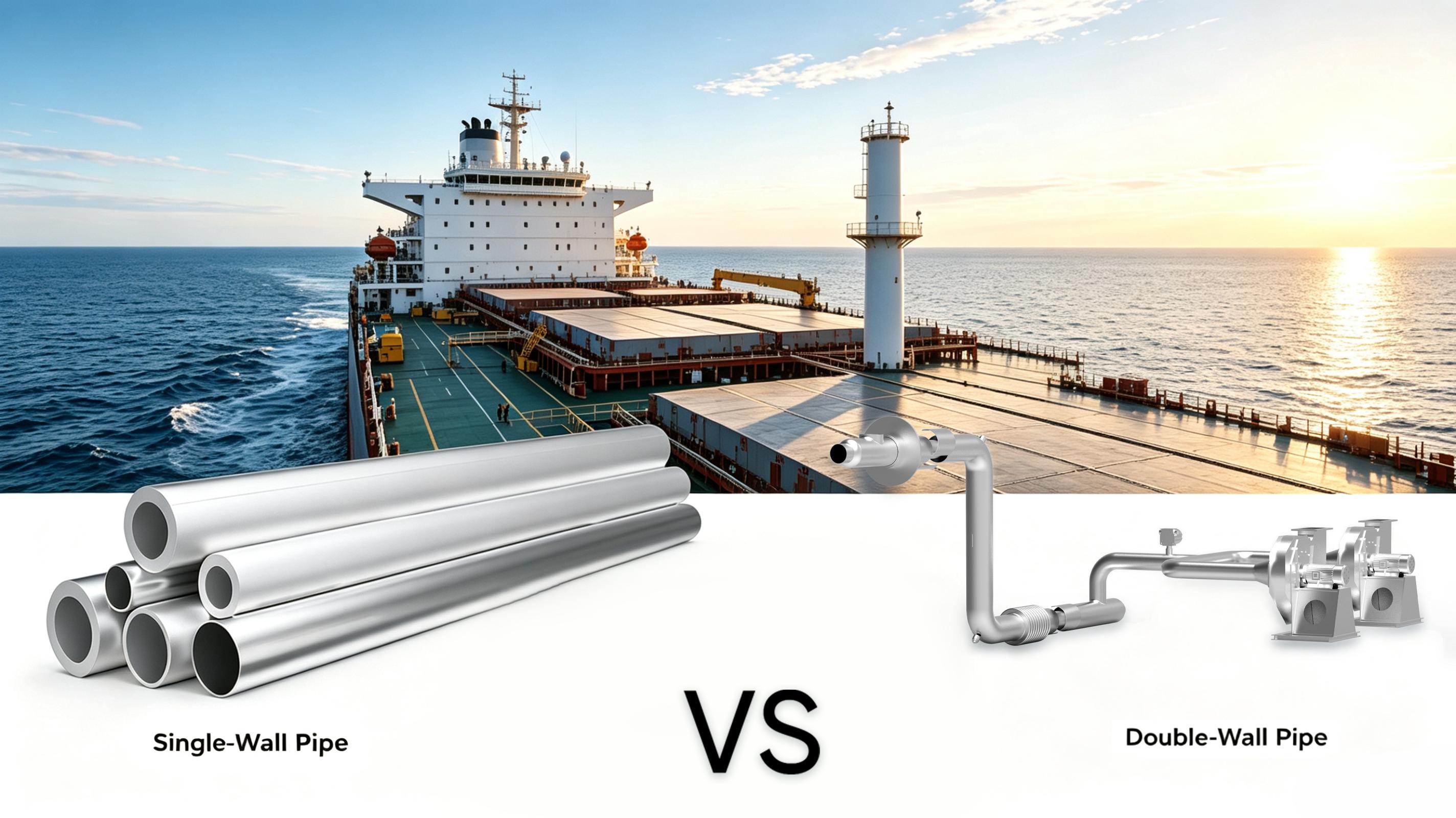
| Feature | Single-Wall Pipe | Double-Wall Pipe |
|---|---|---|
| Primary fluid containment | Yes | Yes |
| Secondary containment | No | Yes |
| Leak detection | Limited | Easier to integrate |
| Annular space | No | Yes |
| Gas ventilation | External system | Can use annular space |
| Nitrogen filling | Not normally applicable | Possible |
| Vacuum insulation | Not normally applicable | Possible |
| Environmental protection | Depends on installation | Higher level of containment |
| Installation complexity | Lower | Higher |
| Material consumption | Lower | Higher |
| Initial cost | Usually lower | Usually higher |
| Maintenance | Simpler | More complex |
| Hazardous-fluid applications | Application dependent | Often preferred where secondary containment is required |
| LNG applications | Possible | Common for specific cryogenic designs |
In a single-wall piping system, the pipe wall separates the process fluid from the surrounding environment.
The pipe must be designed for the service conditions, including:
For many standard services, this arrangement is sufficient.
Examples include:
However, a single-wall system provides no built-in secondary containment if the pipe develops a leak.
In double walled piping, the process fluid flows through the inner carrier pipe.
The outer pipe creates a second boundary around it.
The space between the two pipes can have different designs depending on the application.
The annular space can be connected to a ventilation system.
This approach may be used for hazardous gases where controlled ventilation is required.
Sensors can monitor the space for:
This provides an additional method for identifying a carrier-pipe leak.
The annular space can be filled with nitrogen and maintained at a controlled pressure.
This arrangement is known as a positive pressure Nitrogen filled double wall pipe.
The space between the two pipes can be evacuated to reduce heat transfer.
This creates a vacuum insulation double wall pipe, which is especially useful for cryogenic services.
The biggest difference is containment.
A single-wall pipe has one main barrier between the process fluid and the environment.
Double-wall piping adds a second layer.
If the carrier pipe leaks, the outer wall can contain or redirect the released fluid or gas, depending on the system design.
This is particularly useful for the transport of hazardous substances.
Leak detection is easier to integrate into many double-wall designs because the annular space provides a defined area for monitoring.
A single-wall pipe can also have leak sensors, but the sensor normally has to detect material after it has escaped from the pipe into the surrounding area.
With double-wall piping, monitoring can occur inside the secondary containment boundary.
A single-wall pipe relies heavily on the surrounding installation to manage a leak.
A double-wall pipe can provide an additional containment layer.
This can reduce the chance that hazardous chemicals, fuels, gases, or cryogenic fluids will immediately reach soil, water, occupied spaces, or other sensitive areas.
Single-wall piping can be insulated externally.
Double-wall piping can use the space between the pipes for insulation or vacuum insulation.
This makes double-wall construction particularly useful for low-temperature and cryogenic applications.
The annular space in double-walled piping can be designed for controlled gas movement.
For example, it can support:
A standard single-wall system does not have this dedicated annular space.
Single-wall piping is generally easier to install.
Double-wall piping requires additional components and engineering, including:
As a result, installation and maintenance can require more time and specialist knowledge.
Single-wall piping remains the practical choice for many applications.
Only one pipe and its associated fittings are required.
Routing, welding, support, inspection, and maintenance are generally easier.
The pipe surface is normally directly accessible for inspection and repair.
Single-wall piping is suitable for many non-hazardous and conventional services.
Depending on the fluid, single-wall piping can be manufactured from:
The outer pipe can contain a leak from the carrier pipe.
The annular space provides a defined location for leak detection equipment.
A second containment layer can reduce the potential consequences of a pipe leak.
The annular space can be connected to a controlled ventilation system.
A nitrogen-filled annular space can provide an inert atmosphere and support pressure-based monitoring.
A vacuum-insulated arrangement can reduce heat transfer.
The outer pipe can protect the carrier pipe from certain external impacts and installation hazards.
Single-wall pipe is often a good choice when:
For example, a conventional cooling-water line inside an industrial facility may not need double-wall construction.
The final choice should still be based on the applicable engineering requirements and site conditions.
Double-walled piping may be considered when:
The higher cost and complexity of double-wall construction should be weighed against the project's containment, monitoring, safety, and thermal requirements.
The transport of hazardous materials requires careful control of leakage.
Hazardous materials can include:
A single-wall pipe may be acceptable in some applications, but the consequences of a leak need to be evaluated.
Double-wall piping can provide an additional containment layer.
For example, if a carrier pipe transporting a hazardous chemical develops a small leak, the outer pipe may contain the released chemical until an alarm is generated and the system is isolated.
The exact response depends on the design.
A single-wall system may use:
The detection point may be outside the pipe itself.
Double-walled piping allows the annular space to be monitored directly.
Possible methods include:
The monitoring method should be selected according to the fluid and the expected leak behavior.
Low pressure gas ventilation systems use the annular space as a controlled ventilation path.
If the carrier pipe releases gas, the gas can enter the annular space and be directed toward a designated ventilation system.
Design considerations include:
This arrangement can be useful where controlled gas removal is more suitable than allowing leakage to enter the surrounding area.
High pressure gas ventilation requires additional attention to pressure and potential release rates.
A high-pressure carrier pipe can release a large amount of gas if it fails.
The outer pipe and ventilation system therefore need to be evaluated for possible pressure and flow conditions.
The design may consider:
The outer pipe should not simply be treated as a decorative cover. Its function and pressure conditions need to be clearly defined during engineering.
A positive pressure Nitrogen filled double wall pipe uses nitrogen in the annular space between the carrier pipe and outer pipe.
The nitrogen may serve several purposes.
Nitrogen reduces the presence of oxygen around the carrier pipe.
A pressure change in the annular space can provide an indication of a change in system condition.
Dry nitrogen can reduce moisture inside the annular space.
The nitrogen atmosphere can provide a more controlled environment around the carrier pipe.
A typical system may include:
The pressure must be controlled so that it does not create an unsafe condition for either pipe wall.
A vacuum insulation double wall pipe uses a vacuum between the carrier pipe and outer pipe.
The vacuum reduces heat transfer by limiting conduction and convection through the annular space.
This makes the configuration useful for cryogenic fluids.
Applications may include:
The system may include:
Vacuum performance must be maintained throughout the service life of the system.
LNG is stored and transported at cryogenic temperatures. Its piping system must control heat transfer while maintaining mechanical integrity at low temperature.
Double-wall piping can be used in LNG applications where the design calls for:
A vacuum-insulated double-wall configuration can reduce heat input into the LNG.
The carrier pipe material must also maintain suitable mechanical properties at cryogenic temperatures.
Stainless steel is widely considered for cryogenic piping because selected grades can provide good toughness at low temperatures.
Material selection should always be based on the specific LNG service and applicable design requirements.
Stainless steel is frequently used in double-wall piping systems.
Reasons include:
Common stainless-steel families may include austenitic grades used for process and cryogenic services.
However, "stainless steel" is not a single material.
The correct grade depends on:
The outer pipe does not necessarily need to use the same material as the carrier pipe.
Double-wall piping can be used in many industries.
Examples include:
Applications include the transfer of:
High-purity gas and chemical delivery systems can require additional containment and monitoring.
Certain chemical and process systems may use double-wall construction where containment and cleanliness requirements justify it.
Hydrogen systems may use double-wall designs for selected applications involving gas containment, ventilation, and controlled monitoring.
Laboratories and research facilities can use double-wall piping for hazardous gases and chemicals.
Single-wall piping generally has a lower purchase and installation cost.
Double-wall piping usually costs more because it requires additional:
However, purchase price alone should not determine the selection.
For hazardous or cryogenic services, the total project cost should also consider:
Single-wall piping is easier to inspect because the pipe surface is directly accessible.
Double-wall systems require inspection of both the carrier pipe and outer containment system.
Maintenance may include:
For vacuum-insulated systems, loss of vacuum may indicate damage, leakage, or insulation degradation.
Both systems can be designed safely when properly engineered.
The difference is the level of containment and monitoring available.
Single-wall piping relies mainly on the integrity of one pressure boundary.
Double-wall piping adds a second layer that can be used for containment, monitoring, ventilation, or insulation.
However, double-wall piping does not automatically make a system safe.
The design still needs to address:
Before selecting a double-wall configuration, engineers should define the service conditions.
Determine:
Determine:
Determine:
Decide whether the space will be:
Select suitable materials for both walls.
This may include stainless steel for the carrier pipe and another suitable material for the outer pipe, depending on the application.
The two pipe walls may experience different temperatures and movement.
The support system must allow the required movement while maintaining the correct position of the carrier pipe.
Use the following questions during the preliminary design stage:
If the consequences of a leak are low and no secondary containment is required, single-wall piping may be sufficient.
If leakage must be contained, monitored, ventilated, or isolated from the environment, double-wall piping may offer a better solution.
The main difference is containment. Single-wall pipe has one primary pipe wall, while double-wall pipe adds an outer pipe that can provide secondary containment, leak monitoring, ventilation, or insulation.
Double-wall pipe can provide additional containment and monitoring, which may reduce the consequences of certain leaks. However, safety depends on the complete piping design, materials, testing, monitoring, and operating procedures.
Not in every application. Requirements depend on the hazardous material, pressure, temperature, installation location, applicable codes, and local regulations. Some hazardous services may require secondary containment or other protective measures.
The outer pipe can contain leaks, protect the carrier pipe, provide a ventilation path, create a vacuum-insulated space, or provide a controlled environment around the carrier pipe.
Yes. Stainless steel is widely used for many double-wall applications, including chemical processing and cryogenic services. The specific grade must match the fluid and operating conditions.
Leak detection identifies changes inside the annular space that may indicate a carrier-pipe leak. Depending on the system, monitoring may use gas sensors, liquid sensors, pressure monitoring, or vacuum monitoring.
Low pressure gas ventilation is a configuration in which the annular space around the carrier pipe is connected to a controlled ventilation system. It can direct leaked or permeated gas to a designated discharge point.
High pressure gas ventilation is designed for double-wall gas systems where the carrier pipe operates at higher pressure. The design must consider the potential gas release rate, annular-space pressure, vent capacity, gas detection, and emergency isolation.
A positive pressure Nitrogen filled double wall pipe maintains nitrogen at a controlled pressure in the annular space. It can provide an inert environment and allow pressure changes to be monitored.
A vacuum insulation double wall pipe uses an evacuated annular space to reduce heat transfer. It is commonly considered for LNG and other cryogenic applications.
Yes. Double-wall piping can be used for LNG transfer and related cryogenic services. Vacuum-insulated designs can reduce heat transfer and help control cryogenic temperatures.
Usually. Single-wall piping uses less material and has a simpler fabrication and installation process. Double-wall piping costs more because of the additional pipe, fittings, supports, monitoring, ventilation, insulation, and testing requirements.
Single-wall piping is generally easier to inspect and maintain. Double-wall piping requires additional inspection of the outer containment, annular space, sensors, ventilation system, nitrogen system, or vacuum system.
Yes. The carrier pipe and outer pipe can use different materials when the design permits it. Material selection should be based on pressure, temperature, corrosion, mechanical loads, environmental exposure, and the intended function of each wall.
No. Double-wall construction does not prevent the carrier pipe from leaking. It provides another layer for containment, monitoring, ventilation, or insulation after a leak occurs.
The choice between double-wall pipe and single-wall pipe depends on the fluid, operating conditions, installation environment, and consequences of leakage.
Single-wall piping is simpler, easier to maintain, and usually less expensive. It is suitable for many conventional services where secondary containment is not needed.
Double-walled piping adds an outer containment layer and an annular space. This allows the system to support leak detection, secondary containment, controlled ventilation, nitrogen pressurization, or vacuum insulation.
For the transport of hazardous materials, double-wall construction may offer additional protection where a leak could affect people, equipment, or the environment.
For LNG and other cryogenic services, a vacuum insulation double wall pipe can help reduce heat transfer. For selected gas services, low pressure gas ventilation, high pressure gas ventilation, or a positive pressure Nitrogen filled double wall pipe can be used according to the required containment and monitoring strategy.
The best solution is not simply the pipe with more layers. It is the system that matches the actual fluid, pressure, temperature, material, containment strategy, monitoring method, and applicable engineering requirements.