

EN
Get In Touch

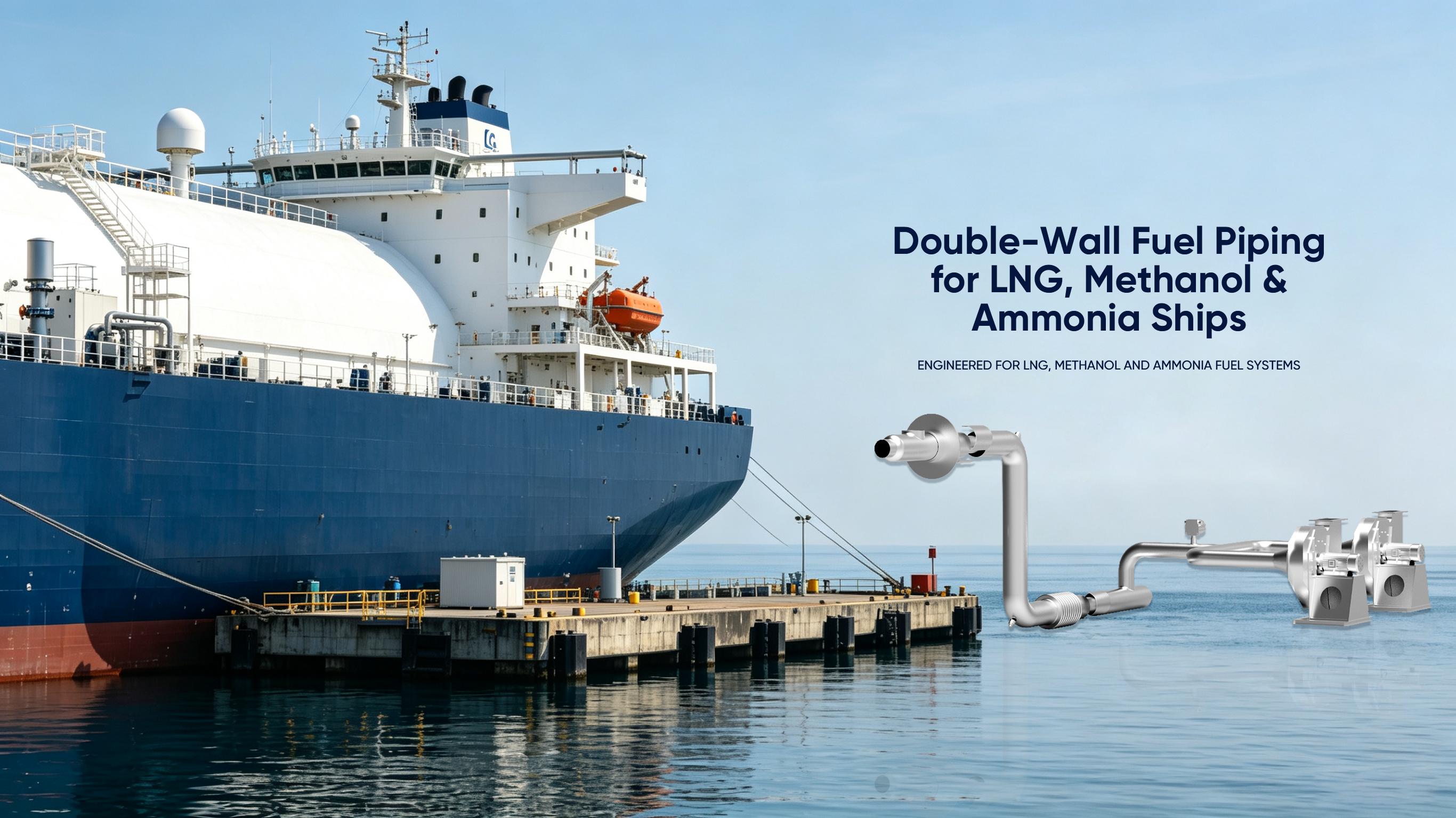
Double-wall fuel piping is a marine fuel piping arrangement in which the fuel pipe is enclosed by a second pipe or protective enclosure. The inner pipe carries the fuel, while the outer pipe provides secondary containment and a controlled space for ventilation, leak detection, or insulation.
This design is widely associated with alternative-fuel marine systems, including LNG Carriers, Methanol fueled ships, and Ammonia-Fueled Vessels.
The exact double-wall arrangement depends on the fuel.
The system must be designed around the fuel's pressure, temperature, toxicity, flammability, cryogenic behavior, material compatibility, ventilation requirements, and applicable marine regulations.
Double-wall fuel piping is a marine piping system in which a fuel-carrying pipe is surrounded by a second pipe or enclosure.
The two main parts are:
The space between the two walls may be used for:
Unlike a conventional single-wall fuel line, the double-wall arrangement provides an additional physical boundary between the fuel and surrounding machinery spaces.
This is particularly useful for ships using fuels that are cryogenic, flammable, toxic, or otherwise difficult to manage after a leak.
Marine fuel piping operates in a demanding environment.
Ships have limited space, machinery vibration, changing temperatures, and many enclosed areas. A fuel leak can also create fire, explosion, toxicity, or personnel-exposure risks depending on the fuel.
Double-wall fuel piping provides a controlled space around the primary fuel pipe.
If the inner pipe leaks, the released fuel can be directed toward a ventilation or detection system instead of immediately entering the surrounding machinery space.
The design can therefore support:
The outer pipe is not a substitute for good welding, inspection, pressure testing, or maintenance. Both the primary pipe and the complete containment arrangement must be properly engineered.
LNG, methanol, and ammonia have very different physical and safety properties.
Therefore, one double-wall design cannot simply be applied to all three fuels.
| Fuel | Main Characteristics | Double-Wall Design Focus |
|---|---|---|
| LNG | Cryogenic, flammable | Cold containment, insulation, ventilation, gas detection |
| Methanol | Liquid, flammable, toxic | Secondary containment, liquid leakage, ventilation, fire protection |
| Ammonia | Toxic, corrosive, potentially flammable under certain conditions | Toxic gas containment, ventilation, detection, material compatibility |
| Conventional fuel oil | Liquid, combustible | Secondary containment and leak control where required |
The piping material, outer containment, ventilation arrangement, sensors, valves, and safety systems must be selected for the specific fuel.
LNG is stored and transferred at cryogenic temperatures. A marine LNG fuel system must therefore manage both the fuel's low temperature and its flammable vapor.
Double-wall piping can provide a protected route for LNG fuel lines.
The inner pipe contains the LNG.
The outer pipe surrounds the inner pipe and provides a controlled space that can be ventilated or otherwise monitored.
For cryogenic sections, the design may also incorporate insulation to reduce heat transfer.
LNG Carriers transport liquefied natural gas in large cargo containment systems. Some LNG carriers also use LNG as fuel for their propulsion or auxiliary machinery.
Fuel piping on these vessels may connect LNG fuel storage systems to:
The double-wall arrangement helps separate the LNG fuel line from surrounding ship spaces.
The low temperature of LNG places specific demands on piping materials.
Selected stainless steel grades are commonly used for cryogenic piping because they can retain suitable toughness at low temperatures.
However, stainless steel is a broad material category. The specific grade must be selected according to:
Material selection should be confirmed through the ship's design specification and classification requirements.
Methanol fueled ships are designed to use methanol as a marine fuel, either as a primary fuel or as part of a dual-fuel arrangement.
Methanol is a liquid at normal shipboard temperatures, which means its fuel system differs from an LNG fuel system.
The major design concerns include:
A methanol leak can create both fire and personnel-exposure concerns.
A double-wall arrangement can provide secondary containment around the fuel line.
If the inner pipe leaks, the outer pipe can help direct the liquid or vapor toward a controlled drainage, detection, or ventilation system.
This is especially useful where fuel piping passes through enclosed machinery spaces or other areas where a fuel leak would be difficult to manage.
Material selection depends on the fuel system design and applicable marine requirements.
Stainless steel may be selected for certain methanol fuel piping because of its corrosion resistance and mechanical properties.
The actual pipe material should be evaluated against:
Ammonia-Fueled Vessels are being developed as part of the shipping industry's move toward lower-carbon and potentially zero-carbon-at-use fuel options.
Ammonia presents a different engineering challenge from LNG and methanol.
Its main safety concern for onboard fuel systems is toxicity.
Ammonia can be harmful to people at relatively low concentrations, so fuel leakage must be detected and controlled.
Double-wall fuel piping can create a controlled space around ammonia fuel lines.
The outer containment can help:
Ventilation and gas detection therefore form an important part of an ammonia fuel piping arrangement.
Material selection for ammonia fuel piping requires careful review.
Not every material that works with LNG or methanol should automatically be used with ammonia.
The engineering team needs to consider:
Selected stainless steels may be suitable for particular ammonia applications, but the exact material grade should be confirmed against the fuel specification and applicable marine standards.
| Factor | LNG | Methanol | Ammonia |
|---|---|---|---|
| Physical state in typical fuel storage | Cryogenic liquid | Liquid | Liquid, commonly stored under pressure and/or at low temperature |
| Main onboard concern | Cryogenic temperature and flammable gas | Flammability and toxicity | Toxicity and leakage |
| Double-wall function | Containment, insulation, ventilation | Containment and ventilation | Containment, ventilation, gas detection |
| Low-temperature design | Very important | Generally less demanding than LNG | Depends on storage and fuel system |
| Gas detection | Methane detection | Methanol vapor detection where required | Ammonia detection |
| Ventilation | Required according to system design | Required according to system design | Strong focus on controlled ventilation |
| Material selection | Cryogenic suitability | Fuel compatibility | Ammonia compatibility |
| Common pipe material options | Suitable stainless steels and other approved materials | Stainless steel and other compatible materials | Materials approved for ammonia service |
The table provides a general engineering comparison. The final design must follow the actual ship specification, fuel system design, flag requirements, and classification rules.
A complete system contains much more than two concentric pipes.
The inner pipe carries the fuel.
It is the primary pressure boundary and must be designed for the fuel's:
The outer pipe forms the secondary containment boundary.
It can also create a protected ventilation path around the fuel pipe.
Its design depends on the expected conditions inside the annular space.
The annular space is the gap between the inner and outer pipes.
Depending on the application, it can be:
The carrier pipe must remain correctly positioned inside the outer pipe.
Supports and spacers must account for:
For LNG systems, supports also need to limit unwanted heat transfer.
Fuel systems may include:
Valve selection depends on the fuel and system function.
Leak detection may use:
For LNG, methane detection may be required in relevant spaces.
For ammonia, ammonia gas detection is an important part of the safety system.
The outer pipe may be connected to a dedicated ventilation system.
The system may include:
Ventilation design must account for the properties of the fuel.
LNG piping may require substantial insulation because of its low temperature.
Insulation reduces heat transfer from the environment to the LNG.
This can help limit vapor generation and maintain the required fuel temperature.
Different fuels can require different annular-space arrangements.
A ventilated double-wall system uses the outer pipe as a controlled ventilation passage.
If the inner pipe leaks, the fuel enters the annular space and is directed toward a safe discharge or treatment location.
This configuration can be used for selected gas and liquid fuel systems.
A controlled inert gas environment may be used in selected applications.
Nitrogen can be supplied to the annular space to:
The exact arrangement depends on the ship's fuel system and applicable requirements.
For cryogenic applications, a vacuum-insulated configuration can reduce heat transfer.
This type of system is particularly relevant to LNG fuel transfer.
The annular space may contain insulation and be maintained at a low pressure.
The inner fuel pipe must be designed for the maximum expected pressure.
The outer pipe also needs to be evaluated for pressure conditions that could occur if the inner pipe leaks.
For high-pressure fuel gas systems, the pressure rise in the annular space can be rapid.
Temperature is particularly important for LNG.
The design must account for:
Methanol and ammonia systems have different temperature requirements.
Shipboard piping experiences temperature changes during:
The inner and outer pipes may experience different temperatures.
This can create differential thermal movement.
The design must therefore allow controlled movement without damaging supports, welds, valves, or connections.
Marine engines and machinery generate continuous vibration.
Piping systems can also experience:
Double-wall piping requires suitable supports and flexibility analysis to avoid excessive stress and fatigue.
A ship does not remain stationary.
Fuel piping may experience movement caused by:
The piping layout and support system should be designed for the expected ship motions and structural loads.
Ventilation and leak detection are closely connected to double-wall fuel piping.
The outer pipe creates a defined space where leaked fuel can be detected and controlled.
Methane is lighter than air under many typical conditions, although actual dispersion depends on temperature and release conditions.
Ventilation and gas detection locations should therefore be designed according to the expected release and airflow pattern.
Methanol vapor and liquid leakage require different detection and drainage considerations.
The system should prevent fuel accumulation in locations where it could create fire or personnel risks.
Ammonia is toxic and has a strong odor.
A controlled ventilation and detection system can help identify a leak and direct contaminated air away from occupied spaces.
The ventilation arrangement must be designed for the expected release conditions rather than simply maximizing airflow.
Stainless steel is widely used in marine piping systems.
It can offer:
For LNG, the selected grade must remain tough at cryogenic temperatures.
For methanol and ammonia, chemical compatibility must be checked.
The use of stainless steel does not eliminate the need for:
Marine fuel piping is often fabricated as prefabricated pipe sections before installation onboard.
Typical fabrication steps include:
Material certificates and identification should be checked.
Pipe ends are prepared according to the approved welding procedure.
Welding is carried out using qualified procedures and qualified welders.
Welds may be inspected using appropriate non-destructive testing methods.
The carrier pipe is positioned inside the outer pipe using the specified supports or spacers.
Testing is performed according to the applicable design and classification requirements.
The internal surfaces are cleaned according to the fuel system requirements.
Dimensions, supports, connections, valves, sensors, and ventilation paths are checked before installation.
Installation needs to account for the ship's structure and machinery arrangement.
Important points include:
The outer pipe should not obstruct inspection or maintenance of important components.
Where the piping passes through bulkheads or decks, the design must maintain the required fire, gas-tight, and structural properties of the ship.
The three fuels have different hazards.
The main concerns include:
Main concerns include:
Main concerns include:
A double-wall system should be integrated with the ship's overall fuel safety system rather than treated as a standalone component.
Marine fuel piping is subject to classification, flag-state, port, and other regulatory requirements.
Depending on the vessel and fuel, the project may need to consider:
For LNG-fueled ships, requirements for gas-fueled ships need to be considered.
For methanol and ammonia, the applicable fuel-specific requirements should be reviewed as part of the ship design.
The exact requirements vary by vessel type, fuel system, operating profile, and jurisdiction.
The outer pipe provides another physical barrier around the fuel pipe.
A leak can be directed into a controlled space rather than immediately entering the surrounding machinery area.
The annular space provides a defined area for sensors and monitoring.
The arrangement can reduce direct exposure to hazardous fuel in the event of a leak.
Fuel released into the annular space can be directed toward a designated ventilation system.
For LNG, the outer pipe can form part of an insulated or vacuum-insulated arrangement.
The additional containment layer can reduce the risk of fuel reaching the sea or other sensitive areas.
Double-wall piping also has trade-offs.
Two containment layers require more materials and fabrication work.
Alignment, supports, fittings, valves, and ventilation connections require additional engineering.
Both the carrier pipe and outer containment system need inspection.
Sensors, vents, drains, supports, and monitoring equipment add system complexity.
The outer pipe increases the overall pipe diameter.
This matters on ships where machinery spaces are compact.
The designer must consider the interaction between the inner and outer pipe, especially under thermal movement and vibration.
| Factor | Single-Wall Fuel Pipe | Double-Wall Fuel Pipe |
|---|---|---|
| Primary fuel containment | Yes | Yes |
| Secondary containment | No | Yes |
| Leak monitoring | External or indirect | Can be integrated |
| Ventilation space | No dedicated annular space | Yes |
| LNG cryogenic insulation | External insulation normally required | Can be integrated with jacket design |
| Hazardous-fuel protection | Depends on system | Additional containment layer |
| Installation | Simpler | More complex |
| Cost | Lower | Higher |
| Space requirement | Lower | Higher |
| Maintenance | Simpler | More involved |
Before selecting a system, define the fuel and ship operating conditions.
Determine whether the vessel uses:
Establish:
Determine whether the primary concern is:
Possible options include:
Select the carrier and outer pipe materials based on:
Account for:
Determine:
Check the applicable:
Double-wall fuel piping is a marine fuel piping system in which the primary fuel pipe is enclosed by an outer pipe or protective enclosure. The outer layer provides secondary containment and can support ventilation, leak detection, or insulation.
Some LNG Carriers use LNG as fuel for propulsion or auxiliary systems. Double-wall piping can provide containment and controlled ventilation around cryogenic fuel lines while also supporting insulation requirements.
The exact requirement depends on the ship design, fuel arrangement, applicable regulations, and classification requirements. Double-wall construction is commonly used for LNG fuel systems where additional containment and ventilation are required.
On Methanol fueled ships, double-wall piping can provide secondary containment and a controlled ventilation path around methanol fuel lines. It can help manage fuel leakage in machinery and other enclosed spaces.
Ammonia is toxic, so an ammonia fuel system needs effective measures for containment, leak detection, ventilation, and personnel protection. Double-wall piping can provide a controlled space around the primary fuel pipe.
Selected grades of stainless steel are widely used for cryogenic applications, including LNG systems. The specific grade must have suitable low-temperature toughness and meet the project's material and classification requirements.
Yes, selected stainless steels can be used for methanol fuel systems when the grade is compatible with the fuel and the operating conditions. The final selection should follow the vessel's engineering specification.
Selected stainless-steel grades may be suitable for ammonia service, but material compatibility must be verified for the specific fuel conditions. Engineers should consider corrosion, temperature, pressure, welding, and long-term service.
No. Double-wall piping does not stop the inner pipe from failing. It provides an additional containment layer that can limit the spread of released fuel and support detection and controlled ventilation.
Sensors can monitor the annular space for gas, liquid, pressure changes, or other abnormal conditions. The detection method depends on the fuel and system design.
LNG piping focuses heavily on cryogenic temperature and flammable gas management. Methanol systems focus on liquid fuel containment, flammability, and toxicity. Ammonia systems place strong emphasis on toxicity, gas detection, ventilation, and material compatibility.
Many marine fuel systems use controlled ventilation around the fuel pipe, but the exact arrangement depends on the fuel and applicable design requirements. The ventilation system must be designed according to the expected leak scenario and fuel properties.
Yes, it is generally more expensive than single-wall piping because it requires an additional containment layer, supports, fabrication, testing, and often ventilation and monitoring equipment.
Yes. The outer pipe increases the overall pipe diameter. Ship designers therefore need to consider equipment arrangement, machinery-space clearance, maintenance access, and pipe routing at an early design stage.
Double-wall fuel piping provides an additional containment layer around marine fuel lines and is particularly useful for alternative-fuel ships.
For LNG Carriers, the design must address cryogenic temperature, LNG vapor, insulation, and flammability.
For Methanol fueled ships, the focus is on liquid fuel containment, ventilation, fire protection, and toxicity.
For Ammonia-Fueled Vessels, containment, gas detection, ventilation, personnel protection, and material compatibility receive particular attention.
Stainless steel is widely used in marine piping systems, but the correct grade depends on the fuel, pressure, temperature, corrosion environment, welding method, and applicable marine requirements.
The best double-wall design is therefore fuel-specific. LNG, methanol, and ammonia should not be treated as interchangeable services. A well-designed system combines suitable pipe materials, secondary containment, supports, ventilation, leak detection, valves, insulation where required, testing, and compliance with the relevant marine rules.