

EN
Get In Touch

The top five marine cargo handling system manufacturers and engineering suppliers to consider are YADA Green Energy Solutions, Wärtsilä Gas Solutions, TGE Marine, CM Energy (TSC), and Marine Service Noord. These companies provide different combinations of cargo handling engineering, equipment manufacturing, piping systems, automation, installation, and lifecycle support for commercial vessels and specialized gas carriers.
Their solutions serve different types of cargo, including liquefied natural gas (LNG), liquefied petroleum gas (LPG), ethylene, ethane, ammonia, and liquid chemicals. Wärtsilä and TGE Marine have established expertise in liquefied gas carrier systems, while YADA offers integrated cargo piping and equipment solutions with in-house manufacturing and modular prefabrication capabilities. CM Energy (TSC) focuses on LPG and liquefied gas cargo systems, and Marine Service Noord specializes in marine mechanical engineering and LNG cargo handling installations.
The most suitable supplier depends on vessel type, cargo characteristics, transfer capacity, automation requirements, classification standards, project budget, and the level of engineering and after-sales support required.
A marine cargo handling system is an integrated arrangement of mechanical equipment, piping, pumps, valves, instrumentation, and control systems used to load, transfer, monitor, condition, and unload cargo aboard ships.
These systems are designed according to the vessel's cargo containment arrangement and the physical and chemical properties of the materials being transported. For LNG, LPG, ethylene, ethane, and ammonia carriers, specialized equipment is required to manage cargo pressure, temperature, flow rates, vapor, and operational safety.
A modern marine cargo handling system may include:
The objective is to achieve safe, efficient cargo handling operations while maintaining cargo integrity, controlling operating costs, and supporting reliable maritime logistics.
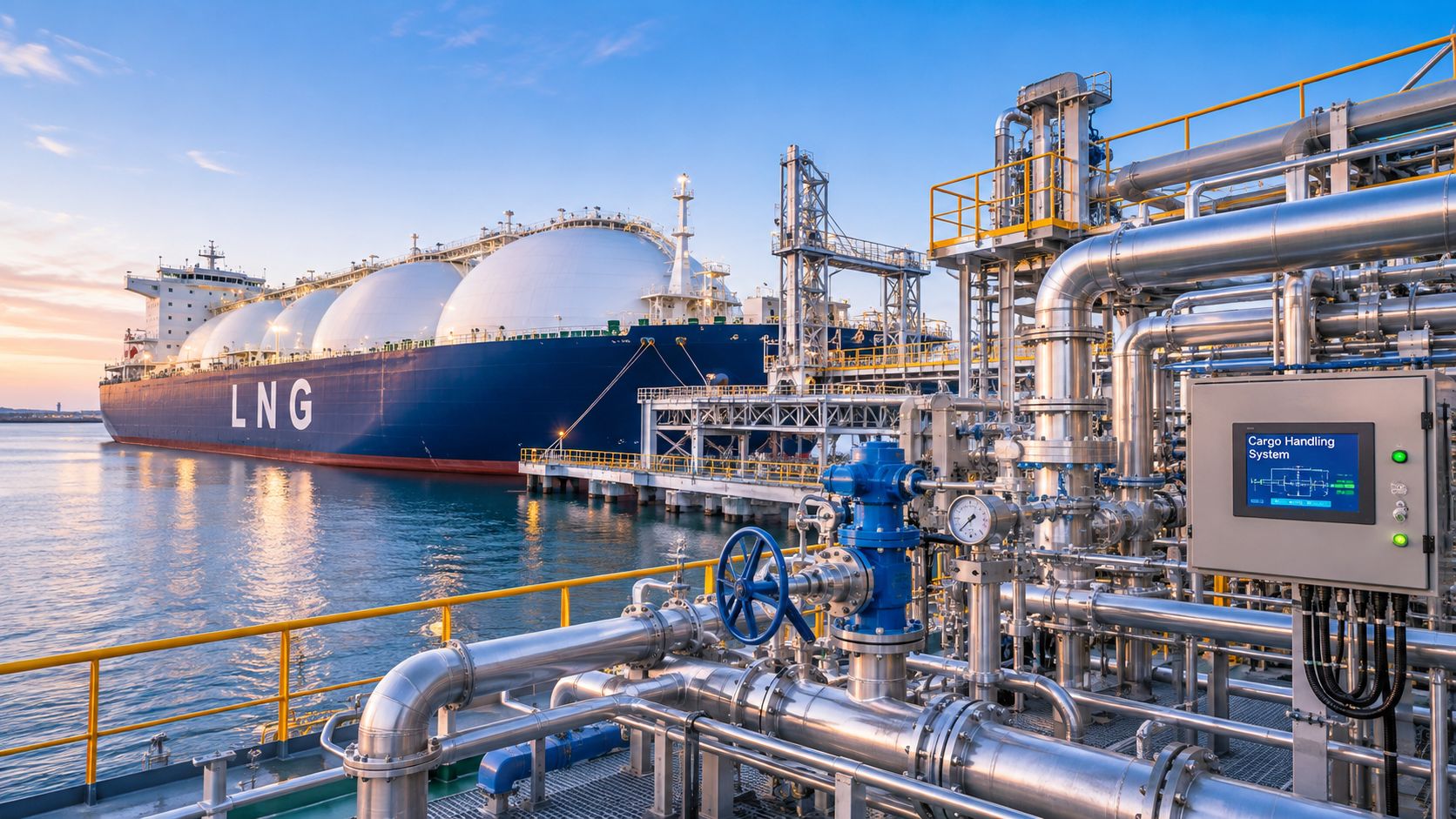
The following comparison highlights five suppliers with different technical strengths and project capabilities. It is an industry-oriented shortlist rather than a definitive ranking by revenue, installed capacity, or global market share.
| Manufacturer | Country / Base | Main Specialization | Suitable Applications |
|---|---|---|---|
| YADA Green Energy Solutions | China | Integrated cargo piping, in-tank equipment and turnkey engineering | LNG, LPG, LEG, chemical carriers |
| Wärtsilä Gas Solutions | Finland | Advanced gas cargo handling and reliquefaction systems | LNG, LPG, ethane, ethylene, ammonia |
| TGE Marine | Germany | Liquefied gas cargo engineering, tanks and systems | LNG, LPG, LEG, ammonia, CO₂ |
| CM Energy (TSC) | China | LPG cargo handling and marine clean-power systems | LPG, LEG and related gas carrier applications |
| Marine Service Noord | Netherlands | Marine mechanical systems, LNG cargo piping and installation | LNG bunker vessels, LNG barges and commercial vessels |
YADA Green Energy Solutions Co., Ltd. is a marine and offshore engineering company specializing in integrated piping systems, cargo handling solutions, and low-carbon energy technologies. Founded in 1993, the company has more than 30 years of experience serving the shipbuilding and offshore industries.
YADA operates two intelligent manufacturing bases in Jiaxing, Zhejiang Province, and Nantong, Jiangsu Province. Together, these facilities have an annual production capacity of approximately 100,000 tons. Its Nantong manufacturing base is located adjacent to a 10,000-DWT deep-water terminal, supporting the transportation and delivery of marine and offshore equipment.
Marine Cargo Handling System Capabilities
YADA provides cargo handling system solutions for chemical carriers, LPG carriers, LEG carriers, and LNG carriers. Its scope covers cargo transfer inside tanks, loading and unloading, temperature management, and safety protection.
Its product and engineering portfolio includes:
These components are configured according to vessel design, cargo properties, tank arrangements, operating pressure, temperature, and project specifications.
Integrated Manufacturing and Engineering
One of YADA's distinguishing capabilities is its combination of engineering, manufacturing, and project delivery.
The company provides services covering basic design, detailed engineering, stress analysis, optimization design, component manufacturing, pipe spool prefabrication, modularization, installation, commissioning, and lifecycle support.
Its manufacturing capabilities extend beyond individual pipe components to integrated assemblies and large offshore modules. This allows project teams to coordinate equipment interfaces and move suitable fabrication work from the shipyard to a controlled manufacturing environment.
For LNG and other cryogenic cargo applications, material selection, thermal contraction, pressure conditions, welding procedures, inspection, and testing must be addressed according to the applicable design requirements.
Advantages of YADA Marine Cargo Handling Solutions
YADA is particularly worth considering for shipowners, shipyards, and EPC contractors seeking an integrated supplier for marine cargo piping systems and associated in-tank equipment.
Its combination of manufacturing capacity, engineering coordination, and modular delivery can help reduce onsite construction work and improve project coordination.
Wärtsilä is a global marine technology and engineering group providing technologies and services for the marine and energy industries. Its Gas Solutions business specializes in systems for transporting, processing, and managing liquefied gases aboard specialized vessels.
Wärtsilä Gas Solutions is particularly well known for its cargo handling and reliquefaction systems for gas carriers of different sizes.
Marine Cargo Handling and Gas Carrier Solutions
Its gas carrier solutions cover several vessel categories, including:
The systems are designed to meet the requirements of different cargo containment arrangements, pressure conditions, and temperature ranges.
For vessels transporting LNG, LPG, ethylene, or ethane, cargo handling equipment must work with the relevant pumping, compression, vapor management, and transfer arrangements.
Advanced Gas Processing and Cargo Management
Wärtsilä's technical portfolio includes cargo handling and reliquefaction technologies. Depending on the vessel configuration, these systems can support cargo transfer, vapor management, and the handling of boil-off gas.
Reliquefaction equipment is used to return suitable vapor streams to liquid form, helping manage cargo tank pressure and reduce cargo losses in applicable systems.
The company also supplies fuel gas supply solutions and technologies supporting LNG bunkering and other marine energy applications.
Why Consider Wärtsilä?
Wärtsilä is a suitable option for shipowners and shipyards looking for established gas carrier engineering, cargo handling technology, and integrated marine energy solutions.
Its broad vessel coverage and experience in liquefied gas applications make it relevant to projects involving LNG, LPG, ethane, ethylene, and ammonia.
TGE Marine is a German engineering company specializing in liquefied gas systems for gas carriers, bunker vessels, and floating storage and regasification units (FSRUs).
The company provides engineering, procurement, and construction supervision services for marine gas systems, supporting shipyards during vessel design and construction as well as shipowners during vessel operation.
Liquefied Gas Cargo Handling Systems
TGE Marine's engineering scope includes cargo handling systems and tank solutions for various liquefied gas applications.
Its gas carrier portfolio covers:
Its published project experience includes more than 250 gas carriers delivered and more than 450 cylindrical or bilobe Type C tanks. The company also reports more than 45 years of experience in the gas carrier business.
Engineering for Specialized Cargo
Different gas cargoes require different storage and handling conditions.
For example, LNG requires cryogenic equipment and piping designed for extremely low temperatures. LPG systems must accommodate the specified pressure and refrigeration arrangements. Ethylene and ethane applications require equipment suitable for their respective cargo properties and operating conditions.
Ammonia transportation introduces additional material compatibility, toxicity management, and safety considerations.
TGE Marine's engineering approach addresses the vessel-specific requirements of these applications rather than treating all liquefied gases as having identical handling characteristics.
Engineering and Project Support
TGE Marine works with shipyards and vessel owners throughout the project lifecycle, including:
Its engineering-oriented business model is suitable for projects that require specialized liquefied gas system design and coordination.
CM Energy, through its TSC marine equipment business, provides marine clean-power technologies, offshore equipment, and cargo handling system solutions.
Its marine portfolio includes LNG fuel supply systems, methanol fuel supply systems, ammonia fuel systems, cargo handling systems, and marine cranes.
The company is particularly relevant to LPG and liquefied gas carrier projects requiring customized cargo handling engineering and equipment integration.
LPG and LEG Cargo Handling Systems
TSC has designed and delivered full-pressure LPG cargo handling systems and has expanded its engineering activities to semi-refrigerated and fully refrigerated cargo handling configurations in cooperation with its design partner.
Its published project experience includes:
The company's cargo handling scope can include cargo pumps, booster pumps, boil-off gas compressors, cargo monitoring, and emergency shutdown functions, depending on project requirements.
Integrated Cargo Control and Safety
Modern cargo handling systems require coordinated operation between mechanical equipment, instruments, and control systems.
TSC's system solutions address loading and unloading, cargo monitoring, pressure and temperature management, and ESD functions. Different system configurations are available according to vessel design and cargo handling requirements.
For LPG and other liquefied gas applications, the system design must consider cargo tank pressure, refrigeration conditions, vapor return, transfer capacity, and operating sequences.
Full-Lifecycle Project Support
CM Energy's published service scope includes engineering, manufacturing, installation, project execution, and after-sales support.
Its cooperation with specialist engineering partners also allows project teams to address system design and technical requirements for different vessel types.
For shipowners and shipyards evaluating suppliers in China, CM Energy (TSC) is worth considering for LPG cargo handling systems and related marine clean-power equipment.
Marine Service Noord is a Dutch marine engineering company specializing in the design, construction, installation, and commissioning of mechanical systems for commercial and specialized vessels.
The company has operated in the maritime engineering sector since 1988. Its published company information reports approximately 700 completed projects and more than 2,350 kilometers of installed piping.
Marine Cargo Handling and Mechanical Systems
Marine Service Noord provides mechanical installations for different vessel types, including:
Its engineering portfolio includes engine room installations, cargo handling systems, and specialized piping arrangements.
The company also has experience with LNG, methanol, hydrogen, and ammonia-related marine systems.
LNG Cargo Handling Systems
Marine Service Noord designs and builds LNG cargo handling systems for LNG bunker vessels and LNG bunker barges, including vessels of approximately 7,500 m³ capacity.
Its LNG system scope can include:
The design is developed according to vessel requirements, customer specifications, and applicable IGC Code and classification society requirements.
Installation and Commissioning Experience
Marine Service Noord's capabilities extend beyond equipment supply. The company can support engineering, workshop prefabrication, onboard installation, commissioning, and technical assistance.
This approach is useful for projects where piping design and installation coordination are as important as the selection of individual components.
Its practical marine engineering experience makes it a potential partner for shipyards and vessel owners seeking customized mechanical and LNG cargo handling installations.
Selecting a marine cargo handling supplier involves more than comparing equipment prices. The system must match the vessel, cargo properties, operating profile, safety requirements, and long-term maintenance strategy.
The following factors can help shipowners, shipyards, and EPC contractors evaluate potential suppliers.
Start by identifying the cargo the vessel will transport.
Different cargoes require different equipment, materials, pressure ratings, and temperature control arrangements.
| Cargo Type | Main Handling Considerations |
|---|---|
| LNG | Cryogenic temperatures, insulation, BOG management and specialized pumps |
| LPG | Pressure and refrigeration conditions, cargo transfer and vapor management |
| Ethylene | Low-temperature handling and cargo-compatible materials |
| Ethane | Cryogenic or refrigerated conditions depending on the system design |
| Ammonia | Toxicity management, material compatibility, leak detection and safety protection |
| Liquid chemicals | Corrosion resistance, cargo segregation and contamination prevention |
A supplier should demonstrate relevant engineering experience with the specific cargo and vessel configuration rather than relying solely on general marine equipment experience.
A capable manufacturer should be able to explain which activities are performed in-house and which are assigned to external partners.
Review its experience in:
Integrated manufacturing can simplify interface management and improve coordination between different equipment packages.
Marine cargo handling systems must comply with the regulations and technical requirements applicable to the vessel and cargo.
The International Maritime Organization's International Code for the Construction and Equipment of Ships Carrying Liquefied Gases in Bulk (IGC Code) provides the principal international framework for relevant gas carriers.
Depending on the vessel and equipment, project requirements may involve classification societies such as DNV, ABS, Lloyd's Register, Bureau Veritas, or China Classification Society (CCS).
Buyers should verify the actual certificates, approved drawings, equipment scope, and applicable project approvals. A general statement about international certification does not automatically establish approval for every vessel or cargo application.
Modern cargo handling systems rely on coordinated mechanical and electrical control.
A suitable system may include:
The degree of automation should match the vessel's operational requirements. Fully automatic operation is not necessarily appropriate for every cargo transfer activity; operators must retain the required oversight and safety procedures.
Marine equipment operates in demanding environments, and maintenance planning affects vessel availability and operating costs.
A supplier should explain its spare parts availability, service response arrangements, troubleshooting capabilities, inspection procedures, and technical support after delivery.
Where equipment condition data is available, predictive maintenance can help identify developing problems before they result in unplanned downtime.
Condition monitoring may involve vibration, temperature, pressure, pump performance, operating hours, and alarm trends. The actual monitoring scope depends on the equipment and installed instrumentation.
Lifecycle support should be evaluated from initial design through manufacturing, installation, commissioning, operation, and eventual equipment upgrades.
The lowest initial quotation does not always represent the lowest overall project cost.
Buyers should compare:
Modular prefabrication can reduce onboard fabrication work and improve installation planning. However, the benefits depend on vessel design, module dimensions, lifting arrangements, transport restrictions, and shipyard construction schedules.
The term marine cargo handling system can describe different technologies depending on the maritime application.
A shipboard liquid cargo handling system should not be confused with the machinery used to move containers, general cargo, or bulk cargo around a cargo terminal.
| System Category | Typical Equipment | Main Application |
|---|---|---|
| Shipboard liquid cargo systems | Pumps, cargo pipes, manifolds, compressors and valves | LNG, LPG, chemical and other liquid carriers |
| Container terminal handling | Ship-to-shore cranes, yard cranes and straddle carriers | Container loading, unloading and transportation |
| Bulk cargo handling | Conveyors, grab cranes, hoppers and ship loaders | Coal, grain, ore and other bulk cargo |
| Port automation systems | Terminal control software, sensors and automated equipment | Cargo terminal management and logistics |
Straddle carriers, for example, are used in container terminals to transport and stack containers. They are not normally components of an LNG or LPG carrier's onboard cargo handling system.
Similarly, bulk cargo systems use different mechanical arrangements from specialized liquid cargo systems.
Understanding this distinction helps buyers identify the right type of manufacturer and avoid comparing suppliers whose products serve different operational requirements.
The marine industry is developing more integrated and energy-efficient technologies as shipping companies respond to environmental regulations, operating costs, and changing fuel requirements.
Several trends are influencing the next generation of cargo handling equipment.
Modern cargo handling systems increasingly integrate sensors, digital interfaces, and centralized control systems.
These technologies allow crews to monitor cargo levels, temperatures, pressures, and transfer rates from integrated operator stations.
The objective is to improve operating consistency, reduce unnecessary manual intervention, and provide better visibility across cargo handling operations.
Predictive maintenance is becoming more relevant as vessel operators seek to reduce unexpected equipment failures.
By analyzing equipment operating data, maintenance teams can identify abnormal trends and plan inspections or repairs before equipment performance deteriorates.
For cargo pumps, compressors, valves, and other rotating or mechanical equipment, monitoring can support maintenance decisions and improve equipment availability.
The expansion of alternative marine fuels is creating new requirements for vessel equipment and cargo infrastructure.
LNG, ammonia, methanol, and hydrogen-related technologies are receiving attention in marine engineering.
Ammonia and hydrogen systems require application-specific engineering, materials, safety arrangements, and operating procedures. Their requirements should not be assumed to be identical to conventional LNG or LPG systems.
Modular prefabrication is helping shipyards manage increasingly complex vessel projects.
Manufacturing piping assemblies and equipment modules in workshops can reduce onboard construction activities and improve inspection access.
For manufacturers with integrated design and production capabilities, modular delivery can also simplify coordination between mechanical equipment, piping, and control interfaces.
A marine cargo handling system is an integrated arrangement of pumps, pipes, valves, compressors, instrumentation, and control equipment used to load, transfer, monitor, and unload cargo aboard a vessel. Specialized systems are designed for LNG, LPG, ethylene, ethane, ammonia, and liquid chemicals.
Five suppliers worth considering are YADA Green Energy Solutions, Wärtsilä Gas Solutions, TGE Marine, CM Energy (TSC), and Marine Service Noord. They provide different combinations of cargo handling engineering, equipment manufacturing, piping systems, automation, installation, and technical support.
Specialized marine cargo handling systems can support LNG, LPG, ethylene, ethane, ammonia, and various liquid chemicals. The required system configuration depends on cargo properties, tank design, pressure, temperature, and applicable safety requirements.
An LNG cargo handling system is designed for liquefied natural gas at cryogenic temperatures, while LPG systems are configured for liquefied petroleum gases under the specified pressure and refrigeration conditions. Their equipment, materials, insulation, pressure control, and cargo transfer arrangements can differ substantially.
Typical equipment includes cargo pumps, compressors, pipelines, manifolds, valves, flanges, prefabricated pipe spools, temperature and pressure instruments, tank level monitoring, control systems, and emergency shutdown equipment. Specific components depend on vessel type and cargo requirements.
Automated systems provide centralized monitoring and control of cargo transfer, pump operation, valve positions, tank levels, pressure, and temperature. They can reduce repetitive manual tasks, improve operational consistency, and help crews identify abnormal conditions more quickly.
Predictive maintenance uses equipment condition data and operating trends to identify potential problems before equipment failure occurs. Monitoring pumps, compressors, valves, and related equipment can help maintenance teams plan service activities and reduce unexpected downtime.
The required approvals depend on vessel type, cargo, equipment category, and project specifications. Relevant requirements may involve the IMO IGC Code and approvals or inspections from classification societies such as DNV, ABS, Lloyd's Register, Bureau Veritas, and CCS. Buyers should verify certificates against the actual equipment and project scope.
Shipboard cargo handling systems manage cargo transfer and storage-related operations aboard vessels. Terminal cargo handling equipment operates onshore or at ports and includes cranes, conveyors, hoppers, and straddle carriers. Both support maritime logistics but serve different operational functions.
Modular prefabrication allows piping assemblies and equipment modules to be manufactured and inspected in a factory before delivery to the shipyard. It can reduce onboard fabrication work, improve dimensional consistency, simplify installation planning, and support more efficient project delivery.
Some suppliers provide integrated engineering, equipment manufacturing, system integration, installation, and commissioning, while others specialize in particular components or automation technologies. Buyers should clarify the contractual scope, supplier interfaces, design responsibility, certification, and after-sales obligations before selecting a turnkey provider.
Shipowners should evaluate the supplier's experience with the intended cargo, vessel references, engineering capabilities, manufacturing capacity, classification approvals, automation integration, delivery schedule, spare parts availability, and lifecycle support. A technical comparison based on the vessel's actual specifications is more useful than relying on company size or initial quotation alone.
Marine cargo handling system manufacturers support the safe and efficient transportation of specialized cargo across international shipping networks. Their solutions vary from complete liquefied gas cargo systems to mechanical piping installations and advanced automation platforms.
YADA Green Energy Solutions offers integrated cargo piping, in-tank equipment, manufacturing, and modular engineering capabilities. Wärtsilä and TGE Marine have established expertise in liquefied gas carrier technologies. CM Energy (TSC) is worth considering for LPG cargo handling and related marine clean-power systems, while Marine Service Noord brings practical marine mechanical engineering, LNG piping, and installation experience.
For shipowners, shipyards, and EPC contractors, the best supplier is the one whose engineering scope, cargo experience, manufacturing capabilities, certification coverage, delivery arrangements, and lifecycle support match the actual vessel requirements.