

EN
Get In Touch

FPSO and offshore piping systems connect process equipment, utilities, storage facilities, and marine infrastructure within demanding offshore oil and gas projects. From topside process piping and gas treatment facilities to water treatment systems, high-pressure pipework, and modular equipment packages, each piping scope must align with the process design, structural layout, operating conditions, and offshore installation plan.
YADA provides project-oriented piping supply and integration solutions for FPSO, offshore oil and gas, and marine engineering projects. Depending on the agreed scope, these solutions can include carbon steel and alloy steel piping, duplex and super duplex stainless steel components, heavy-wall pipes, pipe fittings, flanges, valves, prefabricated pipe spools, skid units, pipe racks, and modular piping assemblies.
For EPC contractors, offshore module fabricators, and project procurement teams, a coordinated piping package helps connect material procurement, fabrication, inspection, documentation, and delivery planning. YADA's scope is defined according to project drawings, technical specifications, confirmed manufacturing capabilities, and the applicable inspection and approval requirements.
FPSO and offshore piping solutions are engineered piping supply, fabrication, assembly, and integration packages used in floating production facilities and offshore oil and gas installations. They connect processing equipment, fluid-handling systems, utilities, storage and transfer equipment, and other plant components through a coordinated network of pipes, fittings, valves, supports, and prefabricated assemblies.
For a floating production storage and offloading (FPSO) vessel, the piping scope may cover topside process systems, gas treatment, water treatment, cooling circuits, firewater distribution, utility services, and equipment connection assemblies. Depending on the project, it may also include pipe spools, skid-mounted piping, pipe racks, and modular assemblies prepared for installation.
A complete project package can involve engineering coordination, material procurement, pipe fabrication, welding, dimensional inspection, non-destructive testing, pressure testing, material traceability, preservation, and delivery. The exact responsibilities depend on the contract, project specifications, and the division of work between the EPC contractor, equipment suppliers, module fabricator, and piping supplier.
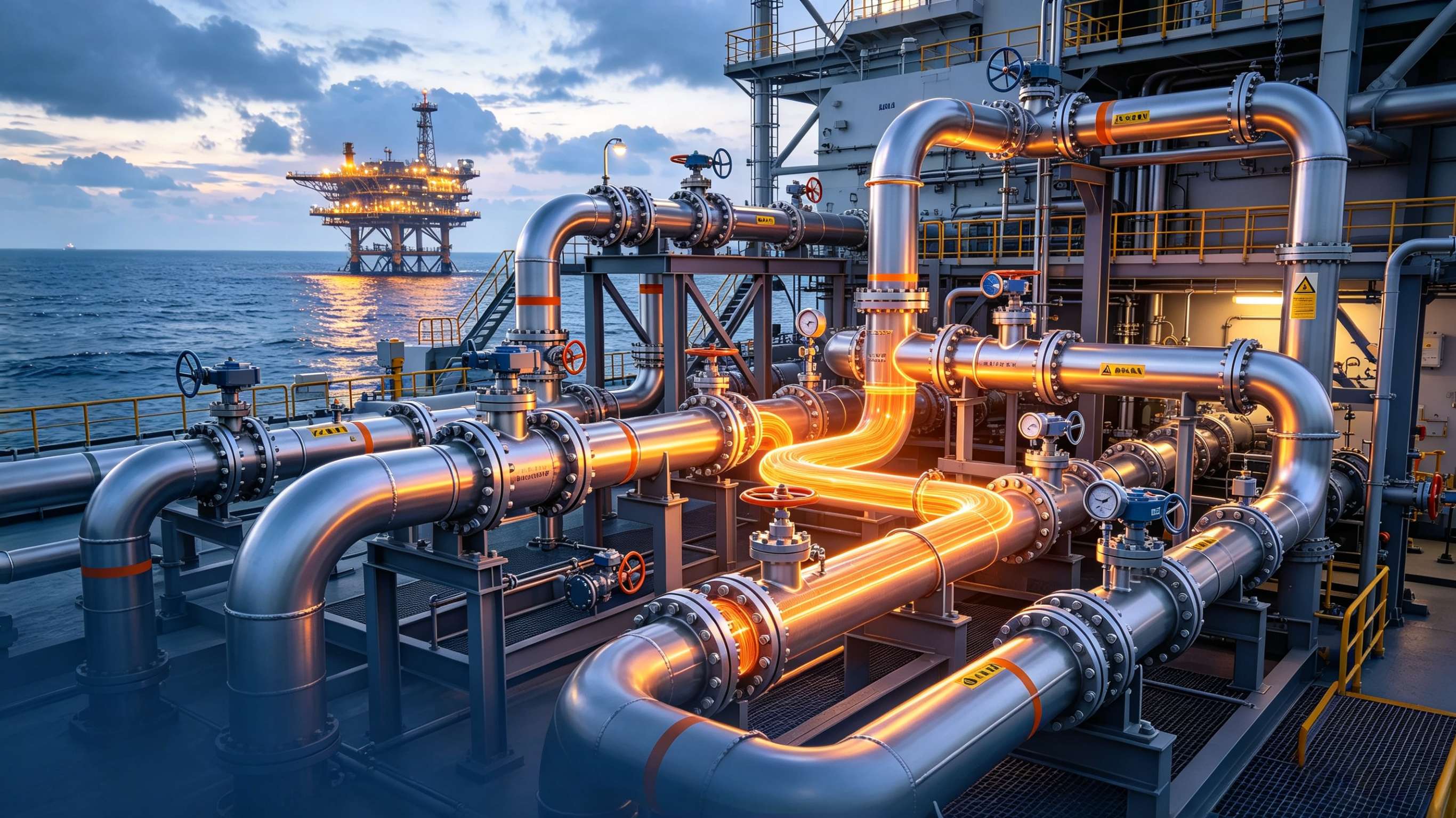
An FPSO receives hydrocarbons from offshore wells, processes the produced fluids, stores oil, and transfers production to a shuttle tanker or another designated transport arrangement. Its topside facilities combine process equipment, utility systems, control infrastructure, and supporting steel structures within a limited deck area.
Piping must be coordinated with equipment locations, structural supports, access routes, hazardous areas, lifting arrangements, and the offshore installation sequence. Material selection and fabrication requirements also vary between process fluids, seawater, gas service, and general utilities.
YADA's FPSO piping scope can be defined around specified piping products, fabricated assemblies, and project supply packages that match its confirmed capabilities.
Topside piping connects the process equipment and utility systems installed above the vessel's main deck. Depending on the facility design, it may serve separation, compression, gas treatment, produced-water handling, chemical injection, cooling, drainage, and firewater distribution.
Typical piping work packages may include:
The material, wall thickness, pressure rating, and connection specifications should be established for each service. Piping for corrosive process fluids or high-pressure gas requires a different specification from ordinary utility piping.
Offshore processing facilities may contain high-pressure gas lines, process piping, injection systems, and other services that require substantial wall thickness or specialized material grades.
Heavy-wall piping may be specified to meet design pressure, mechanical loading, corrosion allowance where applicable, temperature requirements, or project-specific dimensional criteria. The final wall thickness must be calculated and verified under the governing design code.
Procurement and fabrication reviews should address:
For duplex and super duplex stainless steel, fabrication controls must account for the material's metallurgical characteristics. For heavy-wall carbon or alloy steel, section thickness, heat treatment, weld preparation, and examination requirements may require additional planning.
YADA can review project-defined heavy-wall and high-pressure piping requirements to establish a suitable supply or fabrication scope, subject to verified manufacturing capability and technical acceptance.
Offshore processing facilities combine several process and utility systems, each with different fluid properties, pressure ranges, temperature conditions, and corrosion risks. Coordinating these systems requires consistent interface information and material specifications.
Hydrocarbon processing piping transfers produced fluids between separators, pumps, compressors, heat exchangers, storage systems, and other processing equipment. The design depends on the composition of the fluids, phase changes, pressure, temperature, and potential exposure to corrosive substances.
Project requirements may include carbon steel, alloy steel, stainless steel, duplex stainless steel, or other qualified materials. The selected grade must match the service conditions and the project's approved piping material specifications.
Typical procurement items include straight pipes, elbows, tees, reducers, flanges, valves, branch connections, and prefabricated pipe spools.
Gas treatment systems remove or reduce unwanted components from natural gas before it is used, compressed, reinjected, or exported. Depending on the process, equipment may include separators, scrubbers, dehydration units, filtration equipment, heat exchangers, and gas compressors.
Piping between these units must accommodate the specified operating pressure, temperature, gas composition, and equipment connection requirements. Where wet gas, carbon dioxide, hydrogen sulfide, or other corrosive constituents are present, the material specification may require additional environmental assessment.
Gas turbine installations may also require piping interfaces for designated fuel gas, lubrication, cooling, and utility services. These lines must be coordinated with the turbine package supplier's connection requirements and the applicable safety design.
Offshore water systems may serve seawater intake, cooling, injection, produced-water treatment, desalination, and utility applications. Their operating conditions vary according to salinity, chemical treatment, pressure, temperature, and the presence of suspended solids or deposits.
The piping material may be selected from carbon steel with suitable protection, stainless steel, duplex stainless steel, super duplex stainless steel, or other approved materials according to the application.
For seawater service, particular attention should be given to localized corrosion, erosion, crevice formation, deposits, and the compatibility of pipe fittings, valves, and connection components.
Offshore facilities also contain piping for compressed air, service water, cooling, drainage, firewater, and other designated utility functions. Although these systems may operate at lower pressures than hydrocarbon process lines, their materials, routing, supports, and connections must still satisfy the applicable project requirements.
The scope may include pipe racks, branch lines, valve assemblies, equipment connections, and prefabricated sections designed for installation within the facility's structural arrangement.
FPSO and offshore projects often require more than individual pipe supply. The procurement package may combine multiple component types into coordinated assemblies to simplify material management, fabrication planning, and installation.
A piping package may contain:
Every component must be compatible with the specified material grade, nominal size, wall thickness, pressure class, temperature range, and connection standard.
For high-pressure systems, the pressure-temperature ratings of flanges and valves must be checked against the design conditions. A pipe's material strength alone does not establish the rating of the complete piping assembly.
Pipe spools are assembled pipe sections manufactured according to approved drawings or isometrics before being delivered to the installation site. A spool may include straight pipe, elbows, tees, reducers, flanges, and other specified components.
Factory pipe fabrication can provide better access for welding and inspection, improve dimensional control, and reduce the amount of individual pipe assembly required offshore.
A typical spool fabrication workflow includes:
Offshore projects may require spool numbers, weld maps, material certificates, inspection records, and installation references to remain traceable throughout the supply chain.
Skid units combine designated equipment and piping on a supporting frame so that a package can be transported and installed as a coordinated assembly. Examples may include pump skids, filtration packages, utility modules, and other equipment packages defined by the project.
A skid piping scope may include pipework, fittings, valves, supports, instrument connection points, and equipment interfaces. The supply boundary should identify whether the skid fabricator, equipment supplier, EPC contractor, or piping supplier is responsible for the frame, machinery, controls, electrical components, testing, and commissioning.
YADA's involvement should be specified according to the actual work package, whether it covers piping supply, prefabricated assemblies, or a defined level of module integration.
Pipe racks support and organize multiple piping routes within topside facilities and processing modules. Their layout must accommodate pipe spacing, support loads, thermal movement, access, equipment interfaces, and the structural design.
Modular piping assemblies can combine pipe spools, supports, valves, and equipment connections into installation-ready sections. The benefits depend on accurate engineering information and the degree of prefabrication completed before shipment.
For offshore projects, module dimensions, lifting points, transport limits, connection interfaces, and installation sequence should be coordinated early. Changes made after fabrication can create additional work across structural, piping, electrical, and equipment disciplines.
The offshore environment can expose piping to seawater, humid and salt-laden air, temperature variation, vibration, corrosive process fluids, and demanding mechanical loads. Material selection should therefore be based on the specific service rather than the offshore location alone.
Carbon steel is widely used in offshore piping when its strength, temperature range, corrosion protection, and applicable design requirements meet the service conditions. Alloy steel may be specified where elevated-temperature performance or other material properties are required.
The design must account for corrosion protection, wall thickness, welding, heat treatment where required, and the operating environment.
Duplex stainless steels combine austenitic and ferritic phases, providing high mechanical strength and improved resistance to several forms of chloride-related corrosion compared with common austenitic stainless steel grades.
Super duplex grades, such as UNS S32750, may be specified for more aggressive seawater or process environments. Their suitability depends on the actual fluid chemistry, temperature, stress conditions, fabrication quality, and project qualification requirements.
For more detailed information about material grades, corrosion resistance, heavy-wall products, and traceability, refer to YADA's Super Duplex Stainless Steel Piping Solutions page where the documented scope matches the project requirements.
Offshore EPC projects often require materials to be traceable from receipt through fabrication and final delivery. Traceability connects each component to its material grade, heat or batch identification, manufacturing records, and required test certificates.
The procurement specification may require:
The exact documentation depends on the material, product standard, project quality plan, and contract. Requirements should be agreed before purchase to avoid documentation gaps during inspection or final handover.
Offshore pipe fabrication requires control of material identity, dimensions, joining processes, inspection, and preservation. The quality plan should be matched to the component type, service conditions, applicable standards, and project inspection requirements.
Pipe fabrication may involve cutting, beveling, forming, fit-up, welding, machining, and assembly. The production process must follow the approved drawings, material specifications, and qualified procedures applicable to the work.
For heavy-wall and high-pressure systems, weld preparation, access, heat input, heat treatment, and inspection requirements should be confirmed before production begins. Duplex and super duplex materials may require additional metallurgical controls to maintain the specified properties.
Depending on the project, inspection may include visual examination, dimensional checks, radiographic testing, ultrasonic testing, magnetic particle testing, liquid penetrant testing, or other specified methods.
Not every method applies to every material or weld. The inspection and acceptance criteria should follow the governing code, project specification, and approved inspection and test plan.
Pressure or leak testing verifies the integrity of the relevant piping system or assembly under specified test conditions. The method, pressure, duration, medium, and acceptance criteria must be established by the applicable design and test procedure.
Before delivery, project quality controls may also cover component identification, coating or surface condition, flange protection, internal cleanliness, packaging, and preservation against transport or storage damage.
YADA's actual inspection, testing, and documentation responsibilities should be defined in the purchase order and quality plan. Any third-party inspection, certification, or approval must be confirmed for the relevant scope.
Offshore projects operate under coordinated engineering, procurement, fabrication, transport, and installation schedules. A piping package that is technically compliant may still cause delays if its interfaces, documentation, or delivery sequence do not match the project plan.
For EPC contractors and module fabricators, the supply strategy should connect technical requirements with fabrication readiness and delivery milestones.
Before fabrication, the project team should establish the applicable piping classes, line lists, material specifications, equipment connection details, spool isometrics, and module boundaries.
Interface reviews may cover:
The level of engineering support provided by YADA should be defined in the project scope, distinguishing supply based on approved drawings from design responsibility or independent engineering verification.
A coordinated delivery plan should align material availability, production sequence, inspection hold points, document submission, packing, and shipment.
For prefabricated pipe spools and modular assemblies, identification and packaging should make it possible to match each delivered item to its installation location and inspection records.
Project management responsibilities may include tracking procurement status, coordinating technical clarifications, monitoring fabrication milestones, and preparing agreed documentation. The exact responsibility split should be stated in the contract.
Piping decisions affect the long-term operation of an offshore facility. Material selection, accessibility, corrosion protection, inspection access, spare-part availability, and maintainability should be considered alongside initial procurement cost.
A suitable piping package can help reduce installation rework and simplify future maintenance when the design, fabrication quality, and documentation are aligned. Long-term performance still depends on operating conditions, inspection, maintenance practices, and adherence to the approved design limits.
FPSO projects are a major application for offshore piping, but similar procurement and fabrication requirements also appear in other offshore oil and gas developments.
Fixed and floating platforms use piping for hydrocarbon processing, gas compression, utility distribution, cooling, water injection, and fire protection. Prefabricated spools and modular piping assemblies can support construction when interfaces and installation sequences are well coordinated.
Deep water projects may combine floating production facilities, subsea equipment, export systems, and complex marine infrastructure. Topside piping connects the production and processing equipment installed on the facility, while subsea pipelines and flexible risers form separate engineering scopes with distinct design, manufacturing, qualification, and installation requirements.
YADA's topside piping and fabrication scope should not be interpreted as a claim to manufacture subsea pipelines or flexible risers unless those products and capabilities are explicitly confirmed.
An FPSO may transfer stored crude oil to a shuttle tanker through a project-defined offloading arrangement. The associated systems can involve designated piping, manifolds, valves, and equipment interfaces.
The precise division between FPSO piping, offloading equipment, transfer hoses, marine loading systems, and vessel-side equipment depends on the project design. Each interface should be confirmed against the approved engineering scope.
Some offshore projects share equipment and piping requirements with onshore gas industry facilities, including gas treatment, compression, water treatment, and process utility systems. The same material and fabrication principles may apply, but environmental loads, structural interfaces, applicable codes, and installation methods can differ.
FPSO and offshore projects require a coordinated approach to piping products, component compatibility, prefabrication, documentation, and delivery. YADA's offering is intended to support defined supply and integration scopes for customers working on demanding marine and offshore facilities.
Pipes, fittings, flanges, valves, and specified piping components can be organized around project material specifications, approved drawings, and procurement requirements, subject to confirmed supply availability.
Projects involving thick-wall pipes, pressure-rated fittings, and specialized material grades require early technical confirmation. YADA can review the requested specifications to determine whether the scope fits its verified sourcing and fabrication capabilities.
Where supported by the agreed manufacturing scope, pipe spools and piping assemblies can be prepared according to approved drawings and installation interfaces. The scope should define included fabrication operations, inspections, testing, and documentation.
Offshore procurement requires clear material identification and inspection records. The project quality plan should define the required certificates, testing, traceability, and release documentation before production and delivery.
Material supply, fabrication sequence, inspection milestones, packing, and delivery can be coordinated around the agreed project schedule. The delivery plan should reflect actual production capacity, material availability, transport conditions, and contract milestones.
YADA welcomes inquiries from EPC contractors, offshore module fabricators, FPSO project teams, shipyards, and procurement departments seeking project-specific piping supply and integration.
To support a technical review, please provide the following information where available:
YADA can review the information to define the requested supply scope, confirm technical requirements, and identify any manufacturing, testing, or documentation points that require further clarification before quotation.
FPSO and offshore piping solutions cover the supply, fabrication, assembly, and integration of piping used in floating production facilities and offshore oil and gas installations. The scope may include topside process piping, heavy-wall pipes, pipe fittings, flanges, valves, prefabricated pipe spools, skid piping, pipe racks, and modular assemblies.
An FPSO may contain piping for oil and gas processing, gas treatment, compression, water treatment, seawater cooling, produced-water handling, firewater, utilities, and equipment connections. The material, pressure rating, wall thickness, and fabrication requirements depend on each system's operating conditions and approved design.
YADA can review project-specific requirements for heavy-wall and high-pressure piping supply or fabrication. Availability and suitability depend on the material grade, diameter, wall thickness, pressure conditions, manufacturing route, inspection requirements, and verified production capabilities. These details should be confirmed before quotation.
Prefabricated pipe spools are assembled in a workshop before delivery to the installation site. They can improve dimensional control, provide better access for welding and inspection, and reduce the amount of individual pipe assembly required offshore. Their effectiveness depends on accurate drawings, material traceability, interface coordination, and a suitable delivery sequence.
FPSO piping generally refers to piping installed on the vessel or its topside modules to connect processing equipment and utilities. Subsea pipelines transport fluids along the seabed, while flexible risers connect subsea infrastructure to floating facilities and accommodate vessel movement. These products require different engineering, manufacturing, qualification, and installation methods, so their supply scopes should be treated separately.
A quotation request should include the project type, piping service, material grades, pipe dimensions, wall thickness, pressure and temperature conditions, component list, drawings or isometrics, applicable codes, inspection and testing requirements, traceability documentation, quantities, and delivery schedule. For modular packages, include skid or pipe rack interfaces, module dimensions, and installation constraints.